Abstract
Court accessibility failures represent the most fundamental barrier to justice for persons with disabilities — exclusion that begins not with legal frameworks but with physical infrastructure. The Convention on the Rights of Persons with Disabilities obligates states to ensure effective access to justice for persons with disabilities. Across jurisdictions — Nepal, India, Ireland, Canada — the same structural sequence repeats: CRPD ratification, domestic disability legislation, and then no binding independent audit of whether justice facilities are physically accessible. The result is that compliance remains unverifiable. This analysis examines six jurisdictions and institutional mechanisms to argue that CRPD Article 13, read with Article 9 and General Comment No. 2, creates a justiciable infrastructure obligation that states routinely acknowledge but structurally refuse to enforce. The gap is not between rights and resources. It is between rights and audit.
The Problem That Precedes All Other Problems
Disability and access to justice disability scholarship concentrates on procedural accommodation: sign language interpretation, accessible document formats, modified hearing procedures. These matter. But they share a common precondition that receives far less attention: the person with a disability must be able to enter the building.
A wheelchair user who cannot reach a district court hearing room has no use for procedural accommodation rules. A person with a mobility impairment who cannot access a police station’s complaint registration desk cannot benefit from improved FIR procedures. Physical infrastructure is the precondition for every procedural right that follows.
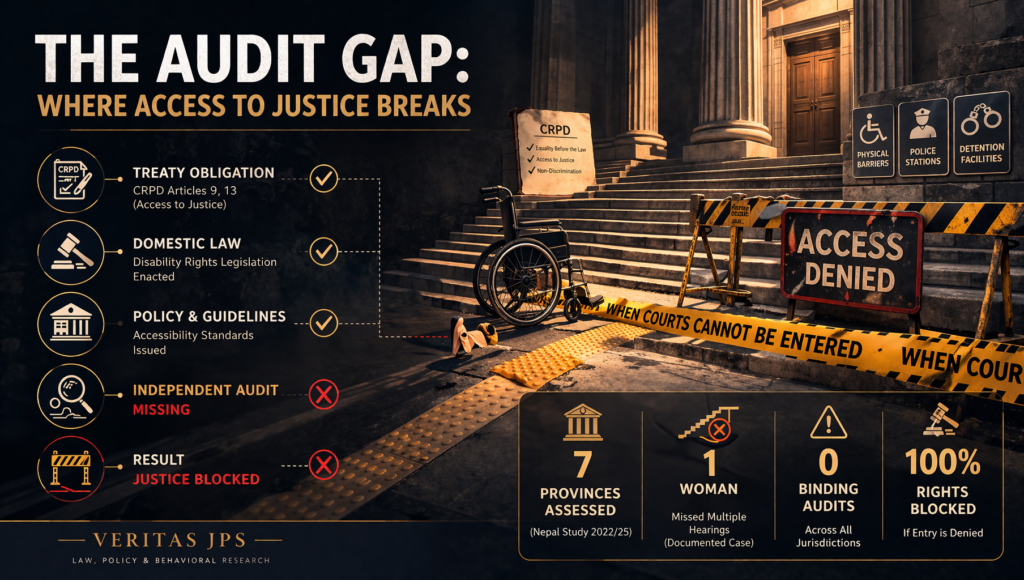
The Nepal National Human Rights Commission and National Federation of the Disabled-Nepal (2022/2025) study across all seven provinces documented this directly. Courtrooms lacked ramps and elevators. A woman using a wheelchair missed multiple district court hearings because the court building offered no wheelchair access. A deaf woman could not file a First Information Report at a police station — not because the law excluded her, but because the building’s design did. Province-level recommendations — install ramps, mandate accessibility in infrastructure budgets, conduct disability inclusion audits — confirm that these were not isolated maintenance failures. They were design defaults.
CRPD Article 13 and the Physical Infrastructure Obligation
CRPD Article 13 requires states to “ensure effective access to justice for persons with disabilities on an equal basis with others, including through the provision of procedural and age-appropriate accommodations.” The text names procedural accommodation explicitly. It does not prescribe minimum physical infrastructure standards for justice facilities, and it does not mandate periodic independent facility audits.
The CRPD Committee, through Concluding Observations compiled by the International Disability Alliance (April 2025 edition), has extended the obligation. States have been directed to eliminate physical and attitudinal barriers to all justice facilities, ensure physical accessibility of court buildings through universal design, and adopt action plans for physical access including accessible transportation. These are not suggestions. They are treaty body directives to signatory states.
Here is the structural gap. Article 13 names procedural accommodation. Physical infrastructure accessibility derives from Article 9’s general accessibility obligation as applied to justice facilities. The Committee treats the two obligations as complementary. States exploit the interpretive space between them — prioritising procedural accommodations (cheaper, more visible, easier to report on) over capital infrastructure investment (which requires budgetary commitment across building cycles).
Article 9’s General Comment No. 2 (2014) calls for states to establish “a monitoring, reporting and evaluation system” covering National Accessibility Standards, with “redress and sanctions for non-compliance.” This is the strongest formal hook for an independent audit argument in the treaty architecture. It does not specify that the monitoring body must be independent of the state. No jurisdiction identified in this analysis has implemented it as a third-party audit mechanism covering justice facilities.
Disability Access to Justice Across Five Jurisdictions
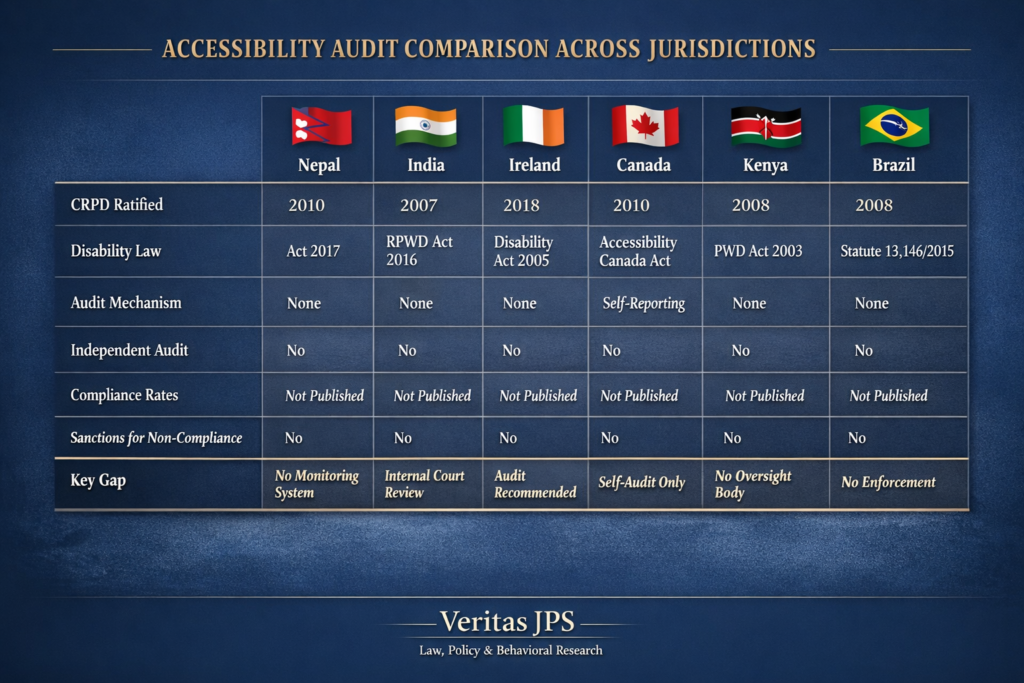
The structural sequence is consistent across the jurisdictions examined.
Nepal
Nepal ratified the CRPD in 2010. The NHRC/NFDN study (2022, reported 2025) found systemic physical inaccessibility across police stations, courtrooms, and detention facilities in all seven provinces. Province-specific recommendations included installing ramps and tactile guiding paths (Lumbini Province), mandating accessibility in infrastructure budgets (Karnali Province), and conducting disability inclusion audits in courts (Gandaki Province). The NHRC’s Sixth Strategic Plan (2021–2026) now prioritises access to justice for persons with disabilities. No independent audit mechanism has been established.
India
India presents a striking case. The Supreme Court of India itself constituted an Accessibility Committee in December 2023, chaired by Justice S. Ravindra Bhat, which audited the Court’s own premises. The committee found an absence of wheelchair-friendly amenities, inadequate tactile flooring, and insufficient designated seating for persons with disabilities. India’s apex court formally recognised it did not meet basic physical accessibility standards. A November 2024 court order directed the Central Government to frame mandatory accessibility rules under the Rights of Persons with Disabilities Act 2016 (RPWD Act), Section 40, within three months. Citation reflects reported judicial practice. Verify with primary case law databases for specific authority. Whether those rules have been formally notified as of early 2026 is not confirmed in available public records. The Supreme Court audit was internal — not an independent third-party review. Approximately 25,000 district and subordinate courts across India were not covered.
Ireland
Ireland, a common law jurisdiction that ratified the CRPD in 2018, produced a direct assessment. The Irish Human Rights and Equality Commission (IHREC, November 2024) recommended that accessibility reform “be informed by an end to end accessibility audit” implemented with “a publicly reported, timetabled and resourced plan.” The core finding was the absence of an audit mechanism — the audit gap itself was the structural finding. Ireland’s independent monitoring body for the CRPD recommended an audit. It did not have one.
Canada
Canada represents the most institutionally developed self-reporting mechanism found. The Courts Administration Service (CAS, 2025) began systematic facility inspection under the Accessible Canada Act (S.C. 2019, c. 10). The Act mandates published accessibility plans, progress reports, and a complaints route through the Accessibility Commissioner. The CAS can identify non-compliance without being able to fix it — Public Services and Procurement Canada (PSPC) is “ultimately responsible for implementing corrective actions.” That split between identifier and implementer is itself an accountability gap. Plans are self-reported, not independently audited. No compliance rate for identified physical items is publicly available. Federal courts represent a fraction of justice proceedings; provincial and territorial courts — where most criminal and civil disability-related matters are heard — operate under separate frameworks.
Infrastructure Barriers as Gendered Denial of Justice
The UN Secretary-General’s report to the Commission on the Status of Women (March 2026), prepared for CSW70, identifies physical infrastructure barriers at police stations, courts, jails, prisons, and government buildings as a specific access barrier for women and girls with disabilities. Organisations referencing the report cite concrete implementation measures: lifts, ramps, and sign language interpretation at justice facilities.
The report situates infrastructure inaccessibility within a finding that women hold 64% of the legal rights of men globally. Physical barriers compound that inequality — a woman with a disability faces both the legal rights deficit and the infrastructure exclusion. In crisis zones, the report identifies infrastructure collapse as a distinct denial mechanism separate from legal framework gaps.
This has doctrinal consequences. The International Review of the Red Cross (June 2025) argues that failure to eliminate physical and attitudinal barriers post-armed conflict potentially engages ICC jurisdiction over crimes against women and girls with disabilities. The argument is doctrinal — not yet confirmed by case law — but it reframes infrastructure failure. Not an administrative shortcoming. A violation with jurisdictional consequences.
The Accessibility Audit Gap: Why Compliance Is Unverifiable
A peer-reviewed analysis published in PMC (October 2025) examining Article 13 operationalisation confirms that reasonable accommodation obligations apply to access to justice even though Article 13 does not explicitly mention them. The study identifies access to justice as a determinant of the realisation of all other rights — health, employment, education. Physical facility accessibility is implied by Article 13’s equal-basis obligation.
Implying an obligation and enforcing it are different acts. Across every jurisdiction examined, the same enforcement architecture is missing:
No state has implemented a binding, periodic, independent third-party audit of physical accessibility across courts, police stations, and detention facilities with published compliance rates. Canada comes closest with statutory self-reporting, but self-reporting without independent verification and without published compliance rates does not constitute an audit. India’s Supreme Court conducted an internal review — of one facility. Ireland’s independent monitoring body recommended an audit that does not exist. Nepal’s NHRC documented the problem across seven provinces but has no audit mandate. The CRPD Committee directs states to establish monitoring systems but does not specify independence from the state.
The pattern is consistent: states acknowledge the obligation, produce reports, and sometimes even document non-compliance — but the mechanism that would make court accessibility verifiable and enforceable does not exist.
Independent periodic audit with published results and sanctions for non-compliance. That is the missing architecture.
What Remains Unmeasured
One gap runs through the entire evidence base. No peer-reviewed study found in this analysis has measured the causal relationship between physical facility inaccessibility and case attrition or withdrawal rates for disabled litigants. The Nepal study documents a woman who missed multiple hearings. No jurisdiction systematically tracks how many cases are abandoned, delayed, or never filed because the person could not physically access the facility.
Without that data, the scale of exclusion stays invisible. Physical infrastructure failure does not produce visible denials of justice — it produces invisible ones. Cases never filed do not appear in court statistics. Hearings missed due to building inaccessibility are recorded as non-attendance, not as infrastructure failure. The measurement gap protects the status quo.
Institutional Implications
Three conclusions follow.
First, CRPD Article 13, read with Article 9 and General Comment No. 2, creates a justiciable obligation for physical infrastructure accessibility at justice facilities. The Committee’s Concluding Observations — directing states to eliminate physical barriers, ensure universal design, and adopt resourced action plans — are specific enough to ground domestic legal challenges. The obligation exists. The enforcement mechanism does not.
Second, the gap between obligation and enforcement is a design choice, not a resource constraint. States that can build courthouses can build accessible courthouses. The absence of independent audit reflects a governance decision to leave compliance to political discretion rather than subject it to verifiable, periodic, independent review with published results.
Third, measuring case attrition linked to facility inaccessibility should be a research and policy priority. Until jurisdictions track cases lost to infrastructure failure — not just cases heard despite it — the full scale of exclusion will remain undocumented.
The right to access justice means nothing if you cannot enter the building where justice is administered. That is not a metaphor. It is a measurable infrastructure condition. No jurisdiction currently measures it.
About VeritasJPS
VeritasJPS provides evidence-based research and advisory at the intersection of access-to-justice policy, disability rights law, and institutional governance design. Our work supports institutional decision-makers — judges, policymakers, and compliance leaders — with rigorous analysis grounded in empirical evidence and legal scholarship.
Leave a Reply