Abstract
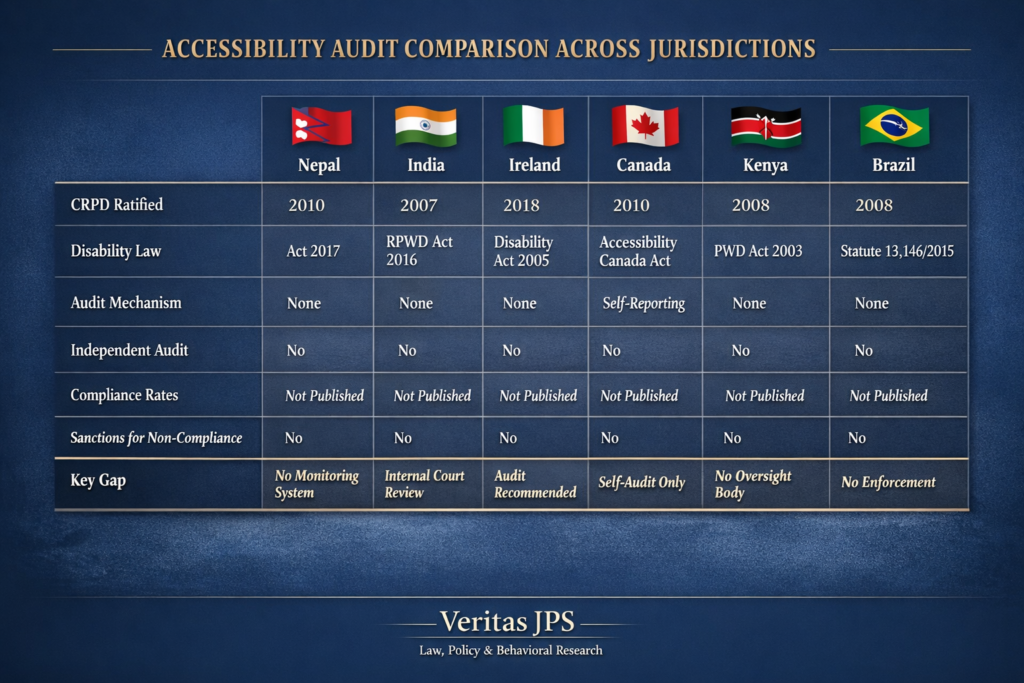
Sludge audits — structured assessments of cognitive, emotional, and administrative friction in government processes — have been applied across tax, benefits, health, and licensing in 14 OECD member states since 2023. Court-facing procedural communications remain absent from every published audit. The administrative burden framework, validated across multiple government domains, predicts that procedural complexity triggers citizen disengagement before formal non-compliance occurs — through heuristic shortcuts activated at first contact with documentation requirements. This analysis examines why sludge audit courts exclusion persists in the highest-stakes compliance environment in public administration, and argues that judicial councils should treat sludge audits of procedural communications as a governance obligation.
The Cognitive Mechanism: Friction Before Failure
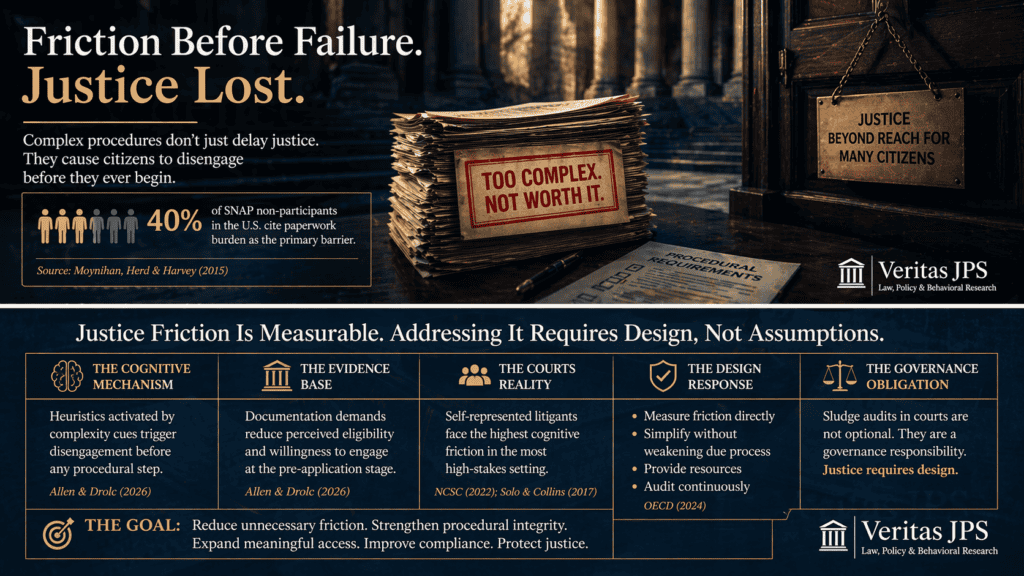
The administrative burden framework developed by Moynihan, Herd, and Harvey identifies three distinct cost types that predict citizen disengagement from government programmes: learning costs (knowing what is required), psychological costs (stigma, stress, confusion), and compliance costs (documentation and procedural steps). Of these, compliance costs carry the strongest direct empirical base. In U.S. federal programme data, 40% of SNAP non-participants cited paperwork burden as the primary barrier to participation.
The mechanism is not rational calculation. It is heuristic. Allen and Drolc’s 2026 experiments (N=4,376 across three pre-registered studies) demonstrate that documentation requirements and mismatched effort-time cues reduce perceived eligibility and willingness to apply at the pre-application stage — before any procedural step has been taken. Citizens assess complexity cues and withdraw. The cognitive shortcut fires before the rational evaluation begins.
This finding has a critical qualification. Allen and Drolc found that prompting respondents to estimate effort concretely reversed the heuristic effect — but only among those who already possessed the required documentation or could form a concrete time estimate. For populations that lack both resources and procedural familiarity — the defining characteristic of self-represented litigants — friction reduction alone is insufficient without resource provision. The two interventions are complementary, not substitutable.
Sludge Audits: Where They Have Been Applied — and Where They Have Not
The OECD’s Fixing Frictions report (2024), documenting the International Sludge Academy’s work across 16 government teams in 14 countries, establishes Good Practice Principles for auditing time, cognitive, emotional, and social burdens in administrative processes. Ten case studies cover tax administration, health check attendance (NSW achieved a 24% increase), licensing, and internal government operations.
Court-facing procedural communications are absent from all ten case studies. The OECD OPSI’s October 2025 update confirms that an international sludge audit methodology is under development by an expert panel chaired by Cass Sunstein, scoped to “administrative processes and services.” Enforcement communications receive a reference in the context of regulatory compliance — not citizen-facing court procedure.
Pakistan’s PIDE has produced a judicial system sludge audit (Vol. 3, 2023-2025) estimating the economic costs of procedural delays and administrative friction in criminal trials. This appears to be the only published sludge audit applied to a judicial system in any jurisdiction. Its focus on transaction costs rather than citizen cognitive pathways limits direct comparability with the OECD framework, but its existence confirms that judicial procedure is auditable — the institutional choice not to audit it elsewhere is a governance decision, not a technical constraint.
Why Courts Have Been Excluded from Sludge Audits
Three structural features distinguish court procedures from the government domains where sludge audits have been applied.
First, procedural complexity in courts is mandated by statute. Civil procedure rules, service requirements, and filing deadlines exist because the adversarial system requires procedural integrity. Friction reduction in tax forms does not raise due process concerns. Friction reduction in court filing requirements does — or is perceived to.
Second, court procedures are adversarial. In benefits and tax settings, the government and the citizen share an interest in successful completion. In litigation, one party may benefit from the opponent’s cognitive friction. Sludge audit methodology has not been tested in adversarial contexts where friction serves a strategic function.
Third, procedural design in courts has been treated as a question of law, governed by rules committees and judicial councils, rather than a question of behavioural design. Brennan-Marquez and Maher’s 2025 analysis in the Georgetown Law Journal identifies “micro-costs” — tiny attentional impositions that deplete cognitive resources cumulatively — as a mechanism producing procedural dropout among justice-impacted individuals. The framing is significant: it places cognitive friction inside legal scholarship, not outside it.
None of these features justifies the absence of cognitive friction assessment. They explain why courts have avoided it. They do not establish that avoidance is defensible.

The Access-to-Justice Dimension
Self-represented litigants constitute 50-80% of family law proceedings in Canada and an estimated 12-30% of federal civil caseloads in the United States. In U.S. federal courts between 1998 and 2017, pro se plaintiffs won only 3% of final judgments compared with parity outcomes when both parties were represented.
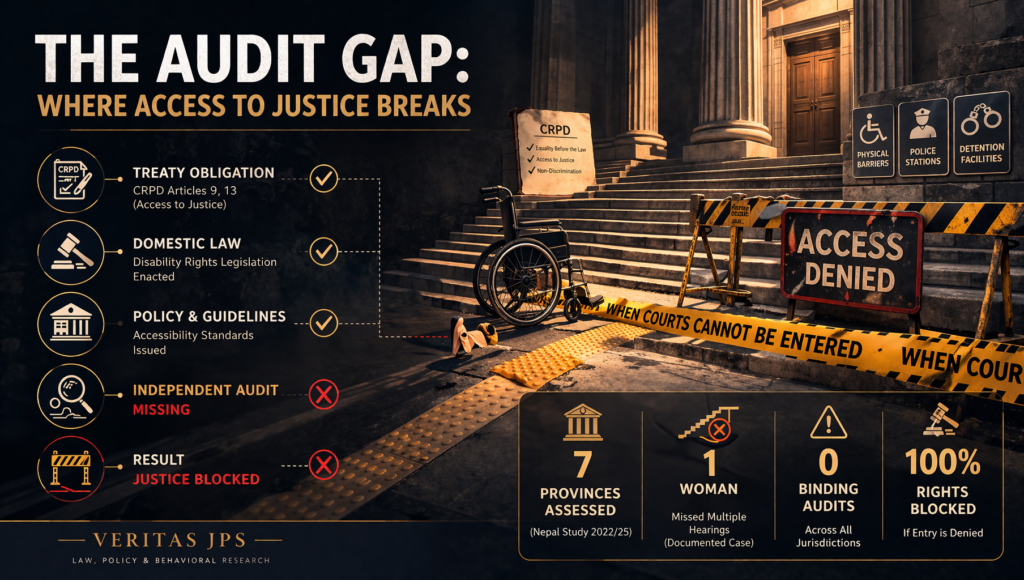
The dominant reform discourse frames this gap as a legal representation deficit. It is — but it is also a procedural design deficit that cognitive friction analysis predicts and that the current reform frame cannot diagnose. The European Court of Human Rights held in Airey v Ireland (1979) that the right of access to court under Article 6 must be practical and effective, not theoretical and illusory. Procedural communications that exceed the cognitive processing capacity of the populations they govern produce theoretical access — and court accessibility frameworks that omit cognitive dimensions remain incomplete.
Default judgment rates in SRL-heavy dockets, case abandonment, and strike-out rates are downstream outputs of cognitive friction. No published study has isolated default judgment rates attributable specifically to procedural cognitive load — as distinct from legal representation gap or case-merits disparity — in any jurisdiction. That isolation is the single most actionable empirical gap for judicial councils.
Institutional Implications for Judicial Sludge Audits
Three governance actions follow from this evidence.
First, judicial councils should commission sludge audits of their public-facing procedural communications — filing requirements, hearing notices, self-represented litigant guides, default judgment warnings — using the OECD Good Practice Principles as a methodological starting point, adapted for adversarial contexts. The failure of judicial integrity systems to self-diagnose procedural barriers reinforces the case for external audit methodologies.
Second, the OECD’s ongoing international sludge audit methodology development should explicitly include judicial and enforcement procedures in its scope. The absence of courts from the current framework is not a technical limitation — it is a scope decision that can be revised.
Third, the cognitive friction finding and the legal aid finding are complementary, not competing. Friction reduction without resource provision is insufficient for populations lacking documentation and procedural familiarity. Resource provision without friction reduction leaves the procedural architecture intact as a cognitive barrier. Reform strategies that address one without the other will produce incomplete results.
Citation reflects reported judicial practice. Verify with primary case law databases for specific authority. (Applied to: Hjalmarsson & Neilson 2026 working paper; PIDE judicial sludge audit)