Partisan Motivated Reasoning and the Limits of Judicial Legitimacy Reform
Dr. Wasif Ali Shah
PhD Psychology · Barrister · Former Judge

Institutional reform discourse treats judicial legitimacy as a function of procedural quality — transparency, enhanced reasoning, appointment diversity, open hearings. Recent evidence from political psychology and judicial legitimacy research challenges this assumption at its cognitive foundation. Studies across multiple democratic jurisdictions (2023–2026) document that partisan identity governs how citizens process court decisions, producing asymmetric trust updating where identical judicial outputs generate opposite legitimacy signals depending on prior political alignment. This analysis examines the empirical evidence for motivated reasoning as the primary input-processing mechanism in judicial trust formation, evaluates the gap between international independence frameworks and cognitive reception architecture, and considers what non-procedural institutional levers — particularly legitimacy communication design — might credibly shift trust perceptions when procedural inputs are cognitively rerouted by partisan identity. The findings carry direct implications for judicial councils, court leadership, and policymakers who allocate reform resources on the assumption that better procedure yields higher trust.
The Procedural Assumption and Its Cognitive Blind Spot
Partisan motivated reasoning has reframed what was once a settled premise in judicial legitimacy reform: that if courts demonstrate fairness through transparent reasoning, neutral treatment, respectful process, and visible independence safeguards, citizens will recognise those inputs and update trust accordingly. The logic runs from institutional behaviour to public perception in a relatively direct line. Improve the signal, and the receiver adjusts.
This premise has shaped everything from judicial training curricula to court administration strategy. The UN Basic Principles on the Independence of the Judiciary (1985) and the Bangalore Principles of Judicial Conduct (2002) articulate structural guarantees — security of tenure, adequate remuneration, transparent appointment, behavioural standards of impartiality — that courts worldwide have adopted as the architecture of independence. The unstated assumption is that visible compliance with these structural conditions will be read at face value as evidence of genuine independence.
Partisan Motivated Reasoning and Judicial Legitimacy
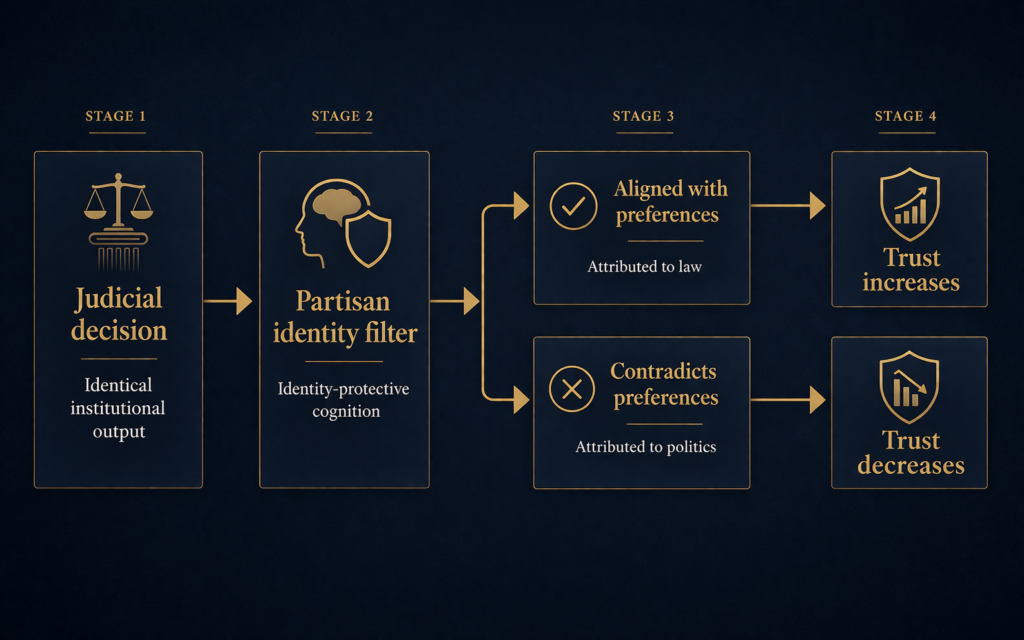
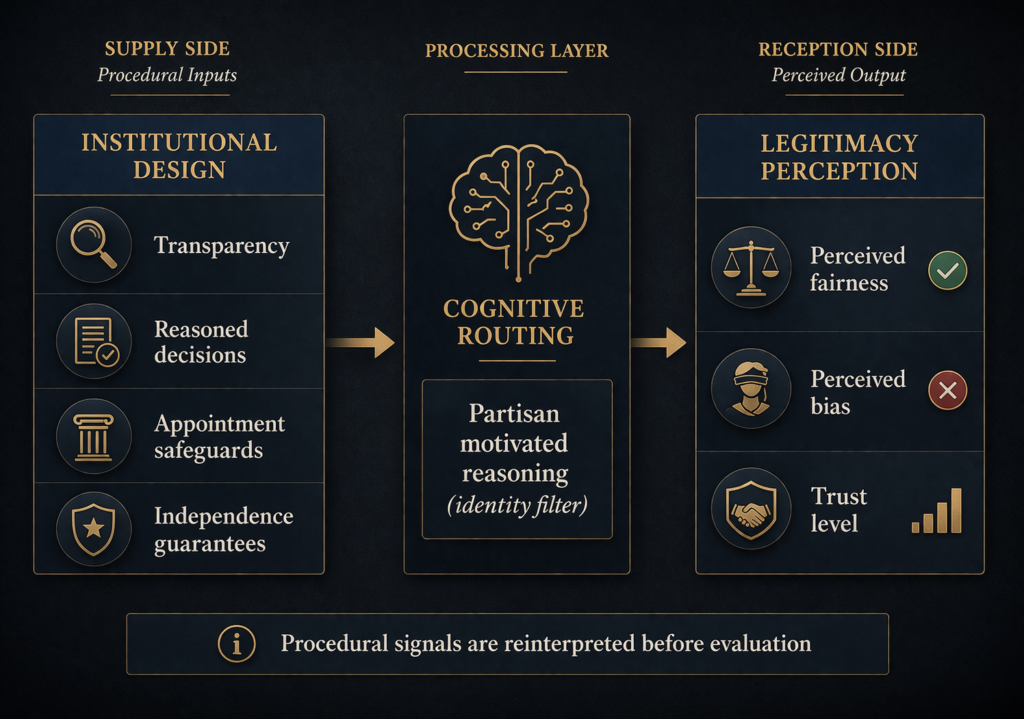
The cognitive science of the last decade exposes a specific flaw in that logic. It presumes a quasi-rational evaluator who processes institutional cues and updates beliefs accordingly. The motivated reasoning literature documents something different: citizens in partisan environments first route judicial outputs through identity-protective cognition — classifying decisions as favourable or threatening to their political group — and only then generate attributions of fairness or bias. The procedural inputs are not ignored. They are reinterpreted after partisan filtering has already set the evaluative direction.
This distinction changes the entire reform calculus. If procedure is upstream of trust, then procedural improvements are the right investment. If partisan cognition is upstream of procedural evaluation, then procedural reforms are operating on a variable that has already been processed and relabelled before it reaches the citizen’s legitimacy judgment.
Asymmetric Trust Updating: Evidence Across Jurisdictions
The empirical case for motivated reasoning in judicial trust has strengthened substantially between 2023 and 2026, with convergent findings across different democratic systems and research designs.
A 2025 study published in the British Journal of Political Science examined citizen reactions to judicial checks on incumbent governments. The experimental design exposed respondents to identical descriptions of courts ruling against the government. The central finding was directionally split: government supporters decreased their trust in the judiciary following the ruling, while opposition supporters increased theirs. Same institutional act. Opposite trust trajectories. The procedural characteristics of the decision were held constant. What varied was the partisan lens through which the output was processed.
This pattern is not confined to a single jurisdiction. Gadarian et al. (2023), writing in the Proceedings of the National Academy of Sciences, documented a parallel mechanism at the U.S. Supreme Court. Their experimental and observational data showed that respondents attributed decisions they agreed with to the Court’s legal character and principled reasoning, while attributing decisions they opposed to political motivation. The institutional process was identical — the same Court, the same procedural posture, the same constitutional framework. But citizens cognitively split that single process into “law” when outcomes aligned with their preferences and “politics” when outcomes contradicted them. The Court’s hybrid legal-political character enabled this by providing two available interpretive frames that respondents selected based on policy agreement rather than procedural observation.
The geographic scope extends to European constitutional courts. A 2025 experiment published in the Journal of Law and Courts tested partisan, procedural, and populist frames on perceptions of the Czech Constitutional Court. Frames emphasising which political actors had appointed the judges, or portraying the court as an unelected elite overriding democratic will, significantly reduced perceived fairness and legitimacy. Legalistic and procedural frames had more limited or contingent positive effects. The identity cue — who owns this court — dominated the procedural cue — how this court operates. Comparable findings were reported by Magalhães et al. (2023) in experiments involving courts in Norway and Portugal, where signalling partisan appointment reduced fairness perceptions relative to neutral legalistic descriptions.
Motivated reasoning also operates within the judiciary itself. Lu (2025), analysing over a century of U.S. Circuit Court opinions in PLOS ONE, found that judicial writing styles and citation patterns were predictive of judges’ political affiliations. While this study addresses judicial behaviour rather than public trust, it identifies a potential feedback loop: if judicial outputs carry detectable partisan signals in their reasoning patterns, those signals provide raw material for motivated reasoning among the public, reinforcing the identity-based interpretive cycle.
The Procedural Fairness Counterpoint — and Its Limits
The motivated reasoning evidence does not eliminate procedural fairness as a variable in legitimacy formation. It repositions it.
A 2026 study accessible through Cambridge Core tested whether reasoning styles in judicial opinions — specifically the incorporation of procedural fairness elements such as clear explanation and acknowledgement of competing arguments — could improve perceived legitimacy independently of outcome agreement. The findings suggest they can, at least under some conditions. Reasoning quality retains an independent effect on fairness perceptions.
Two qualifications constrain this finding. First, the study does not fully map the interaction between procedural fairness and strong partisan identity. It remains unclear whether procedural improvements retain their positive effect when partisan stakes are high and elite cues are actively framing the court as a partisan actor. The motivated reasoning studies suggest that under those conditions, procedural signals become secondary — absorbed or overridden by identity-driven processing.
Second, ecological validity. Most motivated reasoning experiments use stylised vignettes with high-salience, politically charged cases — the conditions where partisan cognition is strongest. Real-world judicial legitimacy includes routine, low-salience decisions where partisan identity may be less activated and procedural quality may exert greater independent influence. But legitimacy crises do not emerge from routine cases. They emerge from exactly the high-stakes, politically polarised decisions where motivated reasoning is most operative.
The pragmatic implication: procedural reform and motivated reasoning operate on different legitimacy registers. Procedural improvements may contribute to a baseline reservoir of institutional goodwill that cushions courts during low-salience periods. When legitimacy is contested — when political actors frame courts as captured, biased, or illegitimate — procedural quality alone appears insufficient to counteract identity-driven reinterpretation.
Citation reflects reported judicial practice. Verify with primary case law databases for specific authority.
International Frameworks and the Cognitive Architecture Gap
The mismatch between the reform paradigm and cognitive reality is mirrored at the level of international standards. The UN Basic Principles specify structural conditions for independence: security of tenure, adequate remuneration, freedom from inappropriate interference, transparent appointment. The Bangalore Principles add behavioural requirements: integrity, impartiality, propriety, equality, competence, diligence.
Both instruments are designed to ensure that courts actually behave independently. Neither addresses the question of whether citizens are cognitively equipped to perceive that independence accurately when partisan identity provides an alternative interpretive frame. The assumption is that structural independence, if visibly maintained, will be read as independence. The motivated reasoning evidence suggests that this assumption fails precisely when it matters most — in polarised environments where political actors actively contest the meaning of judicial decisions.
The practical consequences are measurable. Judicial integrity systems that fail by design illustrate this supply-side limitation clearly: judicial councils and court leadership bodies worldwide invest in appointment transparency, diversity initiatives, enhanced reasoning, and public communication on the assumption that these measures will build legitimacy. If motivated reasoning intercepts these signals — reinterpreting transparency as a screen for partisan capture, diversity as political tokenism, enhanced reasoning as sophisticated rationalisation of predetermined outcomes — then the reform investment produces no return on the trust variable it targets.
This is not a marginal gap. International and domestic judicial independence frameworks address the supply side of legitimacy (structural conditions) but leave the demand side (cognitive reception) entirely unspecified. Legitimacy communication design — how courts control the interpretive frame through which their decisions are processed — exists in no international standard, no model judicial training curriculum, and no court administration guideline that the current evidence base identifies. Judicial reform mandates that rely exclusively on structural compliance face the same cognitive reception failure at the implementation stage.
Non-Procedural Levers for Judicial Legitimacy
If procedural reform operates on the wrong variable in partisan contexts, the institutional question becomes: what operates on the right one?
The research base does not yet provide a validated playbook. But several directions emerge from the evidence structure.
Institutional Identity Framing
The Czech framing study demonstrates that the interpretive frame applied to courts substantially affects legitimacy perceptions. Partisan and populist frames depress trust; legalistic frames partially protect it. Courts may need to actively maintain a legalistic frame for their work through their own communication — not through political intermediaries. The current default, in which courts produce decisions and leave interpretation to media, politicians, and social platforms, surrenders the interpretive frame to actors with motivated reasoning incentives.
Insulated Legitimacy Communication Channels
If partisan elites recode judicial independence as partisan alignment, courts need communication infrastructure that bypasses elite intermediation. Judicial councils, court press offices, and judicial education bodies are potential vehicles — but only if they operate with genuine editorial independence from the political actors whose framing drives motivated reasoning. Many judicial communication bodies are themselves politically appointed or resourced. That is the transmission problem.
Counter-Attitudinal Credibility Design
The motivated reasoning literature outside judicial contexts identifies conditions under which counter-attitudinal information can update beliefs: source credibility that crosses partisan lines, unexpected messengers who share the audience’s identity but challenge its conclusion, and institutional framing that separates the decision from the partisan contest. Translating these findings into judicial communication design is speculative but directionally promising.
Legitimacy Reservoir Investment
If procedural reforms build a baseline reservoir of goodwill during low-salience periods — even if they cannot counteract motivated reasoning during high-salience crises — then the argument for continued procedural investment is not that it drives trust directly, but that it builds the cushion that absorbs partisan shocks. The institutional design question becomes one of portfolio allocation: how much to invest in procedural improvement (baseline resilience) versus legitimacy communication (crisis resistance).
Institutional Implications
The convergent evidence on partisan motivated reasoning in judicial trust evaluation produces several direct implications for institutional decision-makers.
Reform resource allocation requires recalibration. Judicial councils that invest exclusively in procedural improvement — transparency, reasoning quality, appointment diversity — are addressing a variable that motivated reasoning intercepts before it reaches legitimacy evaluation. Procedural reform is not worthless. It is insufficient. Legitimacy communication design deserves dedicated budget, staffing, and strategic attention alongside procedural improvement.
The governance vacuum around judicial legitimacy communication demands institutional attention. If neither the UN Basic Principles nor the Bangalore Principles address how citizens cognitively process independence signals, and if political actors fill that vacuum with partisan framing, then courts are structurally exposed to legitimacy erosion that no procedural reform can remedy. Closing that gap requires new institutional infrastructure — expanded mandates for judicial councils, dedicated legitimacy communication units, or international standard-setting that extends independence frameworks to include cognitive reception. The problem is not isolated: constitutional redesign as a mechanism for judicial delegitimization demonstrates how structural vulnerability enables politically motivated erosion when no cognitive-reception framework exists to defend institutional credibility.
The ecological validity gap in the evidence base requires its own institutional investment. Most motivated reasoning findings come from experimental vignettes with high-salience cases. Courts need longitudinal data tracking how real populations update trust across sequences of favourable and unfavourable decisions in real political environments. Without that data, the evidence base tells us what happens in controlled conditions but not how durable or modifiable these effects are in the field. AI judicial oversight introduces a further layer of legitimacy risk in this gap — algorithmic decision-making tools deployed before governance frameworks can frame their outputs are especially vulnerable to partisan motivated reasoning.
Judicial training curricula need to incorporate the cognitive science of legitimacy perception. Judges who understand that their decisions will be processed through identity-protective cognition — regardless of reasoning quality — are better positioned to design communications that anticipate and partially mitigate that processing. This is not about judges becoming political communicators. It is about judges understanding the cognitive environment in which their work is received.
The uncomfortable conclusion is that courts cannot earn trust solely by being trustworthy. In a partisan information environment, trustworthiness is necessary but not sufficient. The gap between institutional behaviour and public perception is filled by cognitive architecture that courts did not design and do not address. Closing that gap is not a communication problem to be delegated to a press office. It is a governance architecture problem that belongs on the agenda of every judicial council, court president, and justice ministry that claims to take institutional legitimacy seriously.
About VeritasJPS
VeritasJPS provides evidence-based research and advisory at the intersection of jurisprudence, political psychology, and institutional governance. Our work supports institutional decision-makers — judges, policymakers, and compliance leaders — with rigorous analysis grounded in empirical evidence and legal scholarship.
Cite This Analysis
Shah, S. W. A. (2026). Partisan Motivated Reasoning and the Limits of Judicial Legitimacy Reform. VERITAS Jurisprudence & Psychological Science. Published 9 April 2026. https://veritasjps.com/research-analysis/partisan-motivated-reasoning-judicial-legitimacy/Published 9 April 2026 · Updated 9 April 2026
VeritasJPS — Law, Policy & Behavioral Research
Browse All Research & Analysis →Related Research

Automation Bias in AI Human Oversight Under the EU AI Act
Quick Answer: Automation bias is the cognitive mechanism Article 14 of the EU AI Act names but does not functionally regulate. The Act requires awareness of over-reliance, yet it does not mandate behavioral countermeasures such as cognitive forcing, override protocols, or audit trails for judicial AI oversight. Abstract The EU AI Act is the first […]

Moral Disengagement and Institutional Ethics: Why Integrity Systems Fail Cognitively
Quick Answer: Moral disengagement explains why institutional actors can know ethical rules yet rationalise violations at the moment of conduct. Current integrity systems focus on codes, training, committees, and sanctions, but rarely target the cognitive mechanisms that suspend self-regulation. That design gap leaves judicial and institutional ethics systems structurally exposed. Abstract Institutional ethics systems — […]

Cognitive Regulatory Capture: The Independence Failure Anti-Corruption Design Cannot Reach
Cognitive capture produces enforcement leniency without corruption, financial incentives, or institutional failure. A 2025 systematic review consolidates evidence that current regulatory governance frameworks — including the OECD Principles — leave this dominant capture mechanism unaddressed.