Automation Bias in AI Human Oversight Under the EU AI Act
Dr. Wasif Ali Shah
PhD Psychology · Barrister · Former Judge

Quick Answer: Automation bias is the cognitive mechanism Article 14 of the EU AI Act names but does not functionally regulate. The Act requires awareness of over-reliance, yet it does not mandate behavioral countermeasures such as cognitive forcing, override protocols, or audit trails for judicial AI oversight.
Abstract
The EU AI Act is the first binding regulatory instrument to name automation bias as a risk to human oversight of AI systems. Article 14 requires providers of high-risk AI to enable human reviewers’ “awareness” of the tendency to defer to automated outputs over independent judgment. Yet the Act establishes no legal standard for what constitutes an adequate behavioral countermeasure against the risk it identifies. This gap matters because the behavioral science evidence consistently demonstrates that awareness-based interventions are the weakest available tool for suppressing over-reliance in high-stakes environments. Across jurisdictions — EU, US, and Global Majority — no regulatory framework currently requires documented behavioral override protocols as an authorization condition for judicial AI systems, leaving human oversight at the level of procedural description rather than functional specification. This analysis examines the evidence base, maps the jurisdictional gap, and identifies what institutional decision-makers need to address before “meaningful human oversight” can mean anything more than a signature on a compliance form.
The Regulatory Promise and Its Behavioral Contradiction
Article 14 of the EU AI Act represents a genuine regulatory advance. It requires providers of high-risk AI systems to design those systems so that human oversight is possible, and it imposes on deployers a duty to assign oversight to competent persons. Critically, Article 14(4)(b) specifically references automation bias — the only binding AI regulation globally to name the phenomenon in statutory text.
What follows the naming is the problem. Laux and Ruschemeier (2025), writing in the European Journal of Risk Regulation, identify a structural asymmetry at the core of Article 14: the Act places the awareness obligation on providers, but the organizational and contextual conditions that generate over-reliance — task design, interface architecture, time pressure, institutional incentive structures — reside with deployers. The Act does not directly bind deployers on behavioral countermeasure standards. A regulatory framework that diagnoses the disease and prescribes the treatment to the wrong party.
This is not a marginal drafting point. If the cognitive mechanism operates — as the foundational literature established and current research confirms — below the threshold of conscious awareness, then mandating that providers “enable awareness” of the bias is a category error. You cannot instruct someone to be aware of a process that, by definition, evades conscious detection without structural intervention.
What Does the Evidence Show About Awareness-Based Interventions?
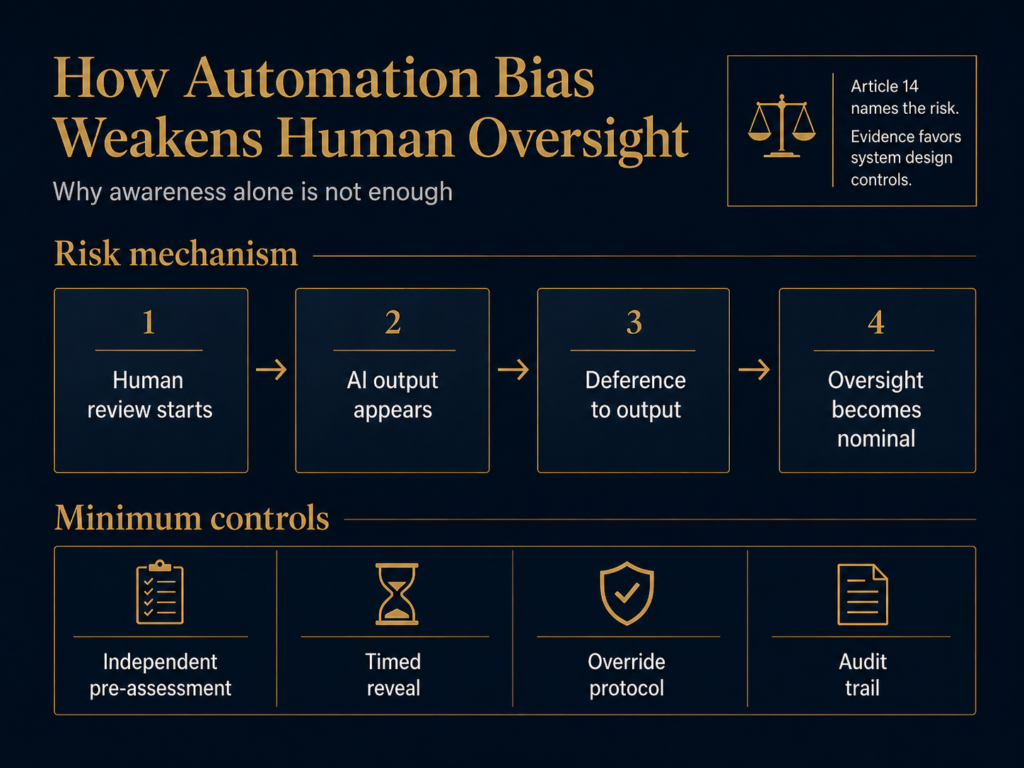
The European Data Protection Supervisor’s TechDispatch #2/2025 put the point bluntly: the mechanism renders nominal human oversight functionally equivalent to automated decision-making. When a human reviewer accepts an AI output primarily because it was produced by an automated system, the oversight step adds procedural cost without adding decisional independence. The TechDispatch cited radiological evidence — a 2023 study in which 27 radiologists reviewing 50 mammograms showed significantly reduced accuracy when exposed to incorrect AI suggestions. The reviewers did not simply agree with the AI. They actively performed worse than they would have without it.
A systematic review published in Human Factors by Crockett, Stanton, and colleagues (2024) examined 80 articles covering 100 debiasing investigations across 91 cognitive bias types. The review found that approximately 80% of identified technological debiasing strategies were reportedly effective. That finding might seem to undercut the concern — debiasing works, so what is the problem?
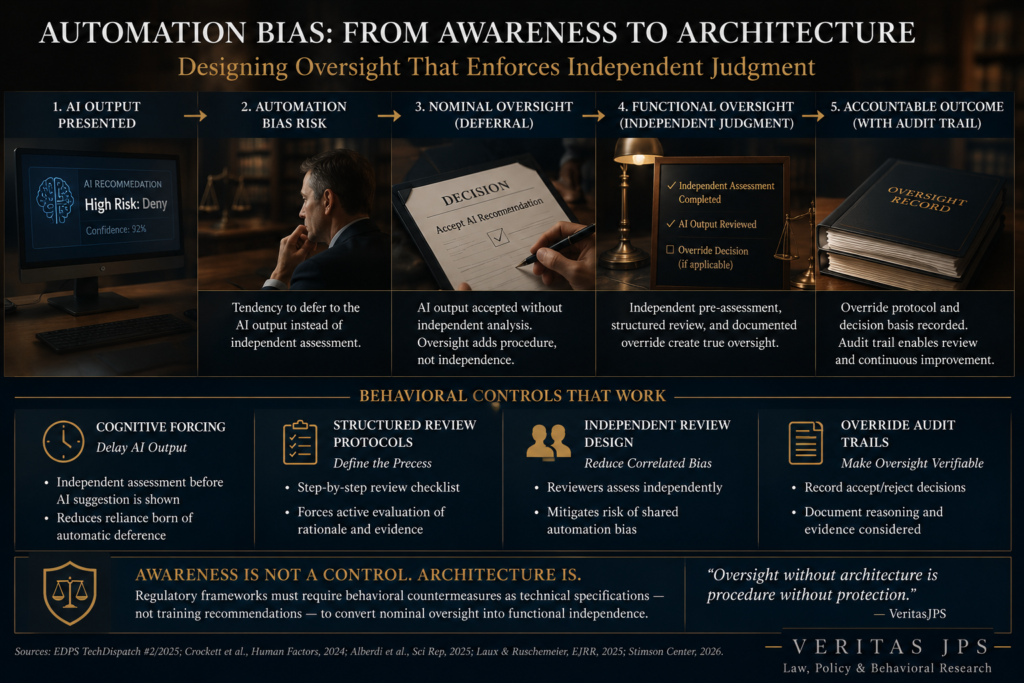
Category specificity. The strategies that show effectiveness are predominantly information-design and procedural interventions: restructuring how information is presented, introducing mandatory delays, requiring independent pre-commitment before AI output is revealed. These are system-design countermeasures. The dominant intervention deployed in institutional practice remains awareness-based training — precisely the approach the Article 14 framework defaults to. The systematic review confirms that the tools exist. The regulatory architecture chooses not to mandate them.
Cognitive Forcing: The Intervention That Works but Nobody Requires
Alberdi and colleagues (2025), publishing in Nature Scientific Reports, tested cognitive forcing interventions — structured delays in AI information presentation designed to compel independent assessment before automated output is available. Their experimental findings showed that cognitive forcing reduced over-reliance under measured conditions. Need-for-cognition moderated outcomes: individuals with higher dispositional engagement with effortful thinking benefited more. Combined cognitive forcing with structural delay outperformed awareness training alone.
Citation reflects reported judicial practice. Verify with primary case law databases for specific authority.
Two boundary conditions matter here. The study population was not drawn from judicial or regulatory professionals — transfer from clinical and laboratory settings to adjudicative environments is assumed, not tested. And cognitive forcing requires system-level implementation. It is an interface design choice, not a training module. Requiring it means mandating how AI systems present information to human reviewers, a technical specification that Article 14’s current text does not contemplate.
The foundational automation-bias literature — Parasuraman and Manzey’s experimental work across aviation, process control, and medical diagnosis — established decades ago that awareness training does not reliably suppress reliance on incorrect AI outputs in time-pressured, high-stakes environments. The core finding has been replicated across domains. What remains absent is judicial-specific replication: no published experimental study has measured incidence in judges, magistrates, or regulatory adjudicators using AI tools in live settings.
The Global Majority Gap: Oversight Without Architecture
The Stimson Center’s 2026 survey of AI deployments across Global Majority judicial systems — covering Egypt, China, Brazil, UAE, Argentina, Colombia, Singapore, Türkiye, and India — documents a starker version of the same problem. Only 9% of surveyed judges’ organizations have issued any AI usage guidelines or provide training resources. External audit requirements for AI systems are absent across the documented deployments.
UNESCO survey data referenced in the Stimson report shows that 92% of judges surveyed are aware of AI tools, and 44% use AI professionally. Only 6% reported using AI outputs without any verification — a reassuring figure, except that it is self-reported. The behavioral science literature on AI over-reliance demonstrates consistently that individuals who believe they are exercising independent judgment are frequently not doing so. Self-reported verification rates and actual cognitive independence are different measurements entirely. No behavioral instrument was used to assess incidence in any of the surveyed jurisdictions.
The governance consequence: in the jurisdictions where judicial AI is most rapidly being adopted — often without the institutional infrastructure of EU-level regulatory frameworks — over-reliance operates with no detection mechanism, no audit trail, and no institutional standard against which to measure whether oversight is functional or cosmetic.
Comparative Regulatory Mapping: Who Requires What
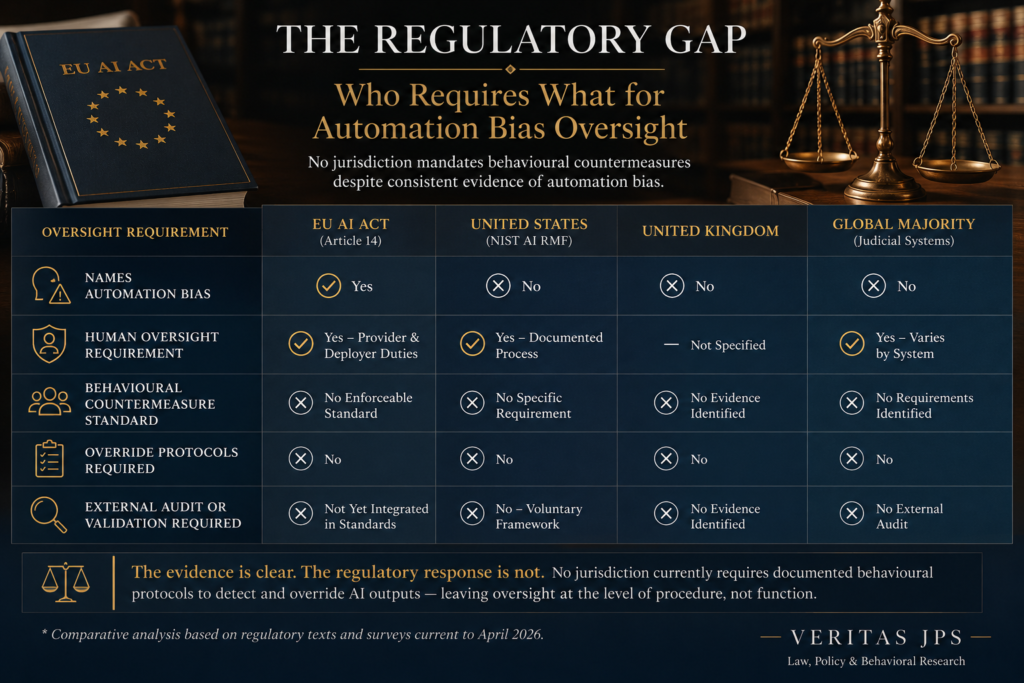
The jurisdictional picture, mapped against behavioral countermeasure requirements, reveals a consistent gap:
- EU (Article 14, AI Act): Names the cognitive risk; mandates provider-level awareness obligation; no enforceable deployer-level behavioral countermeasure standard; harmonized standards have not yet incorporated behavioral science benchmarks. Laux and Ruschemeier conclude that it is legally unclear how to prove whether the mechanism operated in a specific oversight event under the current text.
- United States (NIST AI Risk Management Framework): Voluntary framework. Govern 2.1 requires documented roles and responsibilities for AI risk. Map 3.5 requires human oversight processes to be defined, assessed, and documented. The framework does not specify behavioral countermeasures for the bias as a distinct requirement. No binding enforcement mechanism.
- United Kingdom: The identified evidence base returns no 2024–2026 study specifically measuring this bias in UK judicial AI deployments. UK Judicial College guidance on AI-assisted decision-making oversight was not retrievable at source-verification level. The record is silent.
- Global Majority (Stimson Center survey jurisdictions): No external audit requirements; no behavioral override protocol requirements identified in any surveyed jurisdiction; 91% of judicial organizations have issued no AI guidelines at all.
No jurisdiction currently requires what the behavioral science evidence identifies as the minimum functional standard: documented protocols specifying how human reviewers will detect and override AI outputs, validated against the cognitive mechanism as a distinct risk.
Article 14(5) and the Risk of Correlated Bias
One provision in Article 14 deserves particular scrutiny. Article 14(5) requires that for certain biometric identification uses, at least two natural persons verify the AI system’s output before action is taken. This dual-reviewer requirement is the strongest behavioral safeguard in the Act’s text.
The literature raises an unexamined question. If both reviewers are exposed to the same AI output, their biases may be correlated rather than independent. Two reviewers deferring to the same automated recommendation does not provide the error-correction function that dual review is designed to achieve. No published study has tested whether correlated over-reliance between co-exposed reviewers negates the Article 14(5) safeguard. The provision assumes independence that the cognitive mechanism may defeat.
What the Evidence Does Not Yet Show
A 2025 study published in PLOS ONE, analysing panel data across SDG-16 countries from 2019 to 2023, found that AI integration in judicial systems contributes to reduced bias in adjudication over medium and long time horizons, with mixed and less significant effects in the short term. This finding qualifies any suggestion that AI in courts invariably increases bias. It does not, however, measure automation bias as a distinct cognitive construct. The study examined aggregate bias reduction at the country level using wavelet quantile correlation — a macro-level analysis that cannot isolate the specific mechanism of over-reliance on AI outputs at the individual decision-maker level.
The distinction matters. The policy question is not whether AI improves aggregate outcomes over time — it may well do so — but whether the specific cognitive process corrupts the oversight mechanism that is supposed to ensure AI outputs are subject to independent human review. Aggregate improvement and individual oversight failure can coexist.
What Institutional Decision-Makers Should Require
The evidence base supports five institutional implications:
- Behavioral protocol as technical specification: National competent authorities authorizing high-risk AI systems in judicial contexts should require — as a condition of authorization, not as a training recommendation — a documented behavioral protocol specifying how human reviewers will detect and override AI outputs. This protocol should be treated as a technical system requirement, validated and audited alongside other conformity assessment criteria.
- Cognitive forcing as minimum standard: Harmonized standards under the AI Act should incorporate cognitive forcing interventions — mandatory independent pre-assessment before AI output is presented — as a minimum behavioral design requirement for high-risk systems in adjudicative settings.
- Override audit trails: Deployer institutions should be required to maintain auditable records of override decisions: when a human reviewer accepted an AI output, when they rejected it, and the documented basis for each decision. Without this trail, neither internal governance nor external review can distinguish functional oversight from automated rubber-stamping.
- Correlated bias testing for dual review: Before relying on Article 14(5) dual-reviewer provisions as a meaningful safeguard, regulators should commission experimental testing of correlated over-reliance between co-exposed reviewers to determine whether the independence assumption holds.
- Behavioral measurement in Global Majority deployments: International institutions supporting judicial AI adoption — including UNESCO and bilateral development agencies — should require behavioral measurement instruments for this cognitive risk as a condition of deployment support, not merely adoption surveys.
About VeritasJPS
VeritasJPS provides evidence-based research and advisory at the intersection of jurisprudence, behavioral science, and AI governance. Our work supports institutional decision-makers — judges, policymakers, and compliance leaders — with rigorous analysis grounded in empirical evidence and legal scholarship.
Learn more at VeritasJPS.
Cite This Analysis
Shah, S. W. A. (2026). Automation Bias in AI Human Oversight Under the EU AI Act. VERITAS Jurisprudence & Psychological Science. Published 9 May 2026. https://veritasjps.com/research-analysis/automation-bias-ai-act/Published 9 May 2026 · Updated 9 May 2026
VeritasJPS — Law, Policy & Behavioral Research
Browse All Research & Analysis →Related Research

Optimism Bias and the Enforcement Communication Gap: Why Regulated Entities Discount Compliance Risk
Optimism bias in compliance risk helps explain why regulated entities discount enforcement exposure. This article analyses asymmetric belief updating, omission neglect, and the communication design gap that leaves paper-compliance structurally intact.

Physical Infrastructure Failure as Structural Denial of Access to Justice for Persons with Disabilities
Court accessibility under CRPD remains largely unverifiable because states acknowledge the right, document physical barriers, and still avoid independent audit of justice facilities, police stations, and detention sites.

Why GBV Response Protocols Fail at Early Intervention
GBV response protocols exist across many jurisdictions, yet institutional silos keep them from working. This analysis examines why survivors become de facto case managers, which coordination models reduce failure, and what minimum design standards are missing from international frameworks.