Moral Disengagement and Institutional Ethics: Why Integrity Systems Fail Cognitively
Dr. Wasif Ali Shah
PhD Psychology · Barrister · Former Judge

Quick Answer: Moral disengagement explains why institutional actors can know ethical rules yet rationalise violations at the moment of conduct. Current integrity systems focus on codes, training, committees, and sanctions, but rarely target the cognitive mechanisms that suspend self-regulation. That design gap leaves judicial and institutional ethics systems structurally exposed.
Abstract
Institutional ethics systems — codes of conduct, integrity committees, compliance training, sanctions regimes — address rule knowledge, attitudinal alignment, and deterrence. They do not address the cognitive mechanism through which institutional actors with full knowledge of ethical rules selectively suspend their own self-regulatory standards at the moment of conduct. That mechanism — moral disengagement, formalised by Bandura through eight distinct cognitive processes — is documented as an independent predictor of unethical behaviour in public-sector and organisational settings. This analysis examines the evidence base across peer-reviewed research (Pires et al., 2025; Fida et al., 2025; Hameduddin et al., 2024), institutional compliance assessments (Nigeria ICPC, 2024), and authoritative training frameworks (UNODC, Bangalore Principles) to assess whether current judicial and institutional integrity systems engage the disengagement architecture at the intervention design level. They do not. Intervention redesign targeting specific disengagement mechanisms is both theoretically grounded and empirically overdue.
Why Do Ethics Violations Persist Among Actors Who Know the Rules?
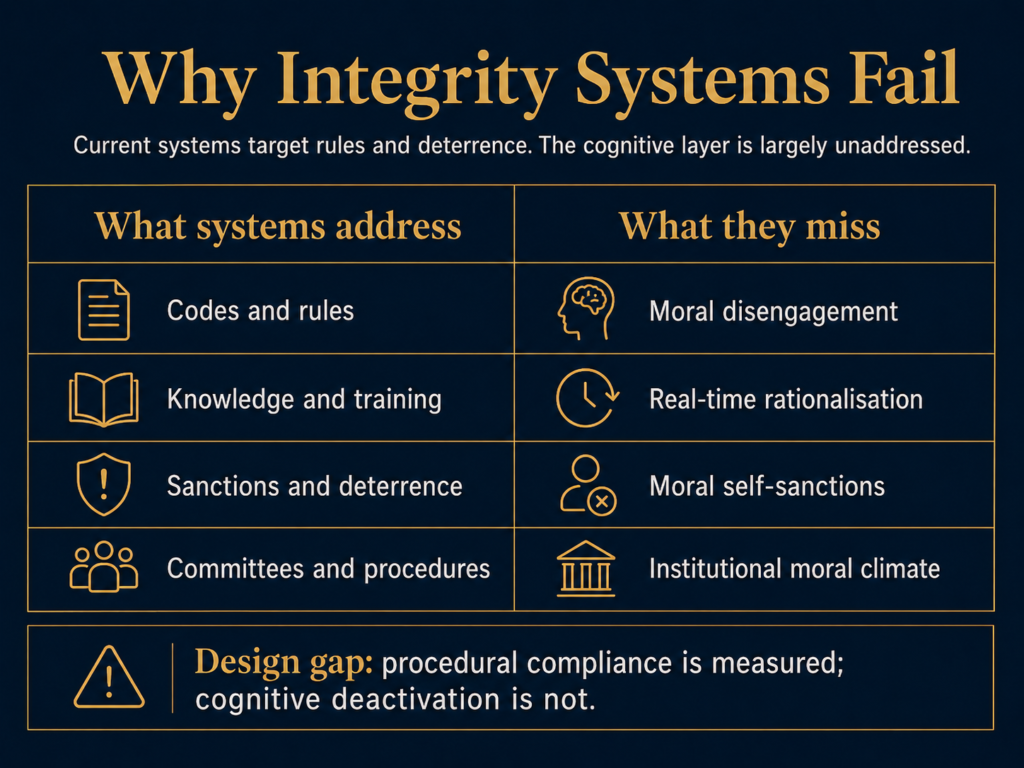
The conventional institutional response to ethics failures follows a recognisable sequence: strengthen the code, increase training hours, raise sanctions. Each measure assumes a specific failure point. Stronger codes assume ambiguity in the rule. More training assumes a deficit in knowledge. Higher sanctions assume deterrence is insufficient.
None of these assumptions addresses the documented cognitive process through which an institutional actor — a judge, a regulator, a senior public servant — holds full knowledge of the applicable ethical standard, believes themselves to be an ethical person, and selectively disengages their own moral self-sanctions at the moment the rule would otherwise constrain their conduct.
The Nigeria ICPC Ethics and Integrity Compliance Scorecard assessed 330 federal Ministries, Departments and Agencies against a procedural checklist covering ethics unit establishment, code of conduct deployment, training delivery, integrity committee operation, and anti-corruption policy compliance. Zero of 330 MDAs achieved full compliance. Fifteen agencies — including the Supreme Court of Nigeria — scored in the failure band. The codes existed. The training infrastructure was constituted. The compliance result was zero.
This outcome is not anomalous within the moral disengagement literature. It is precisely what the framework predicts when institutional integrity design targets the knowledge and deterrence tiers while leaving the cognitive rationalisation tier unaddressed.
Bandura’s Framework: Eight Mechanisms of Moral Self-Sanction Deactivation
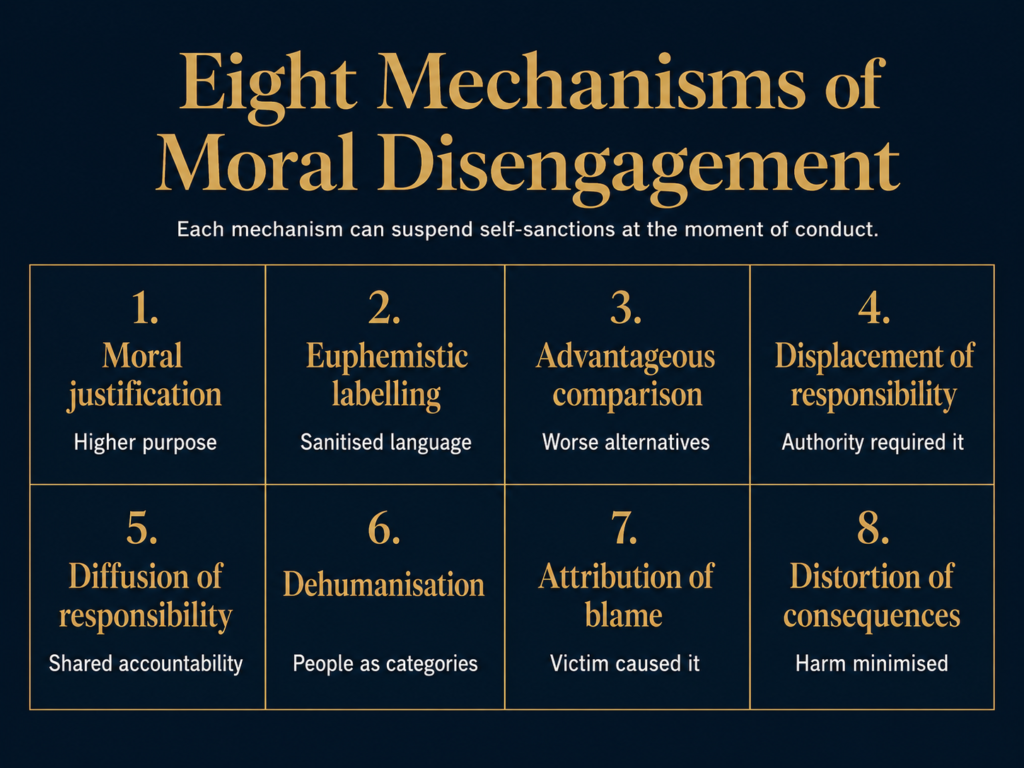
Albert Bandura formalised the moral disengagement framework across publications from 1986 to 2002, identifying eight cognitive mechanisms through which individuals selectively deactivate their own moral self-sanctions:
- Moral justification — recasting harmful conduct as serving a higher moral purpose
- Euphemistic labelling — using sanitised language to obscure the nature of the action
- Advantageous comparison — comparing the action favourably against worse alternatives
- Displacement of responsibility — attributing agency to authority figures or institutional mandates
- Diffusion of responsibility — distributing accountability across group members so no individual bears it
- Dehumanisation — reducing those affected to categories rather than persons
- Attribution of blame — assigning causation to the victim or circumstance
- Distortion of consequences — minimising, ignoring, or misconstruing the harm caused
Each operates independently. An actor need not activate all eight — a single pathway suffices to suspend moral self-regulation on a specific action while preserving the actor’s general self-concept as an ethical person. This specificity is what makes the framework operationally significant: each mechanism is individually identifiable, measurable, and in principle targetable through specific intervention design.
The Evidence: Moral Disengagement in Institutional Settings
Public Sector: Self-Control, Leadership, and the Limits of Sanctions
Pires, Marques and colleagues surveyed 529 public servants across two major Brazilian federal institutions using structural equation modelling. Instruments included a moral disengagement scale, an ethical culture inventory, self-control measures, and an ethical leadership scale.
The primary finding: low self-control was the strongest predictor of moral disengagement. Not rule ambiguity. Not weak sanctions. Not pay dissatisfaction. Ethical leadership reduced disengagement scores independently of formal compliance infrastructure. Risk perception and compensation perceptions related to ethical culture but not directly to disengagement. Formal sanctions operated at the extrinsic motivation level — they did not shift disengagement scores.
The institutional design implication is direct. A system built on sanctions and procedural compliance addresses extrinsic deterrence. The mechanism driving the violation responds to psychological variables: self-regulatory capacity, leadership quality, institutional ethical climate. These are different intervention targets requiring different design logic.
Limitations are material. Two institutions, one country, no judicial-specific population, no longitudinal arm. Cross-cultural instrument validity outside Brazil is unconfirmed. The findings align with the broader organisational literature but lack replication in judicial populations.
Organisational Moral Disengagement: When the Institution Itself Disengages
Fida, Skovgaard-Smith, Barbaranelli and colleagues introduced Organisational Moral Disengagement as a construct distinct from individual moral disengagement. Across four empirical studies, the authors developed and validated a scale measuring the extent to which organisational members perceive the organisation itself as morally disengaged.
The finding extends the architecture from individual cognition to institutional climate. When members perceive the organisation as morally disengaged, unethical pro-organisational behaviour and silence become normatively expected outcomes. Organisational Moral Disengagement predicted these behaviours independently of individual scores — meaning that even actors with strong personal ethical commitments may engage in or tolerate wrongdoing when the institutional signal is that the organisation has already disengaged.
For courts and regulatory agencies, the construct raises a pointed question. Does the institutional culture of a given court or judicial council communicate moral engagement — or disengagement? If the signal is disengagement — through tolerance of procedural shortcuts, normalisation of non-compliance, visible non-enforcement of integrity standards — the Fida et al. findings suggest individual-level training will not override the institutional-level signal.
Constraints on direct application are clear: sector specificity to judicial or regulatory populations is unconfirmed, full sample characteristics are available only in the journal version, and the Organisational Moral Disengagement construct is new and unreplicated in court settings.
Corruption Rationalisation and the Disengagement Architecture
The 2025 Regulation & Governance study “The Excuses We Make” maps eight corruption rationalisation strategies directly onto Bandura’s eight mechanisms, establishing a conceptual unification between the corruption rationalisation literature and the disengagement framework. The mapping positions corruption in institutional settings as following the disengagement architecture at the cognitive level — not as a separate phenomenon requiring a separate theory.
The systematic review by Hameduddin, Engbers and Ritz synthesised 93 studies covering 241 empirical evidence cases on civil servant corruptibility. Moral justification for administrative corruption emerged as the outcome of a multi-layered social cognition process: accountability conflicts, social obligations, and culturally reinforced norms drive rationalisation beyond individual greed. Seven dimensions of corruption micro-foundations were identified, with value conflicts between professional integrity and in-group loyalty constituting a distinct pathway.
Neither study used the Bandura scale as a primary psychometric instrument. Both mapped cognitive mechanisms conceptually rather than through standardised measurement. Judicial officers were not isolated from general civil service populations. The evidence supports the theoretical architecture but does not provide judicial-specific validation.
The Gap: Global Judicial Ethics Frameworks and the Missing Cognitive Dimension
The Bangalore Principles
The Bangalore Principles of Judicial Conduct remain the primary international reference standard for judicial ethics. Six values — independence, impartiality, integrity, propriety, equality, competence and diligence — are articulated with interpretive commentary.
The document contains no reference to psychological mechanisms of ethical failure, cognitive disengagement processes, or the behavioural architecture through which judges rationalise violations of the stated values. The framework declares what values judges should hold. It does not engage the mechanism through which judges who hold those values selectively disengage from them under specific conditions. That is a design choice, not an oversight — but it is a design choice with measurable consequences.
UNODC Judicial Ethics Training
The UNODC Judicial Ethics Training Package, deployed across 40 pilot sites in 38 countries, is built on the Bangalore Principles and UNCAC Article 11. The training targets knowledge acquisition and principle internalisation through e-learning, trainers’ manuals, and self-directed study.
One reference mentions awareness of cognitive biases that can affect judicial work. That is the sole psychological element in the training design. Moral disengagement theory does not appear. The eight mechanisms are absent. No intervention exercise targets the rationalisation process.
The UNODC package is the primary global standard for judicial ethics training. Its reach — 38 countries — makes this gap not incidental but definitional. It is the default condition of the most widely deployed judicial ethics training system operating internationally.
The ICPC EICS: Infrastructure Without Cognitive Architecture
The EICS methodology assesses what exists: whether ethics units have been established, codes deployed, training records maintained, integrity committees constituted. It does not assess what these mechanisms produce at the behavioural level. It cannot determine whether zero compliance reflects infrastructure deficit — agencies genuinely lacking the formal apparatus — or disengagement from available infrastructure, where the apparatus exists but actors have cognitively neutralised it.
That distinction matters for reform design. If the failure is infrastructure deficit, the remedy is investment. If the failure is disengagement from operational infrastructure, the remedy is intervention redesign targeting the cognitive mechanism. The EICS cannot distinguish between these failure modes. Neither can any comparable national integrity assessment framework in the accessible evidence base.
Does Ethics Training Reach the Disengagement Mechanism?
The primary counterevidence comes from Mumford and colleagues’ meta-analysis — 66 empirical studies, 106 ethics courses, 150 effect sizes, N=10,069 participants. Ethics training produces medium-effect gains overall, with the largest effects on knowledge acquisition and self-perception, and a smaller but confirmed effect on ethical decision-making.
The question is whether the decision-making effect reaches the disengagement mechanism or reflects improved performance on training-context scenarios — low-pressure, post-training assessment rather than real institutional decisions under social pressure. No study in the meta-analysis isolated moral disengagement as an outcome variable. None measured pre/post changes in disengagement scale scores following training.
The meta-analytic evidence is consistent with two interpretations. Training may improve what the actor knows and how they perceive themselves without reducing the cognitive process that suspends knowledge at the moment of conduct. Or some training modalities may partially reach the disengagement mechanism through scenario-based decision practice. The evidence does not resolve which interpretation holds. No subsequent study has tested the question directly in judicial populations.
What Does Disengagement-Targeted Intervention Design Require?
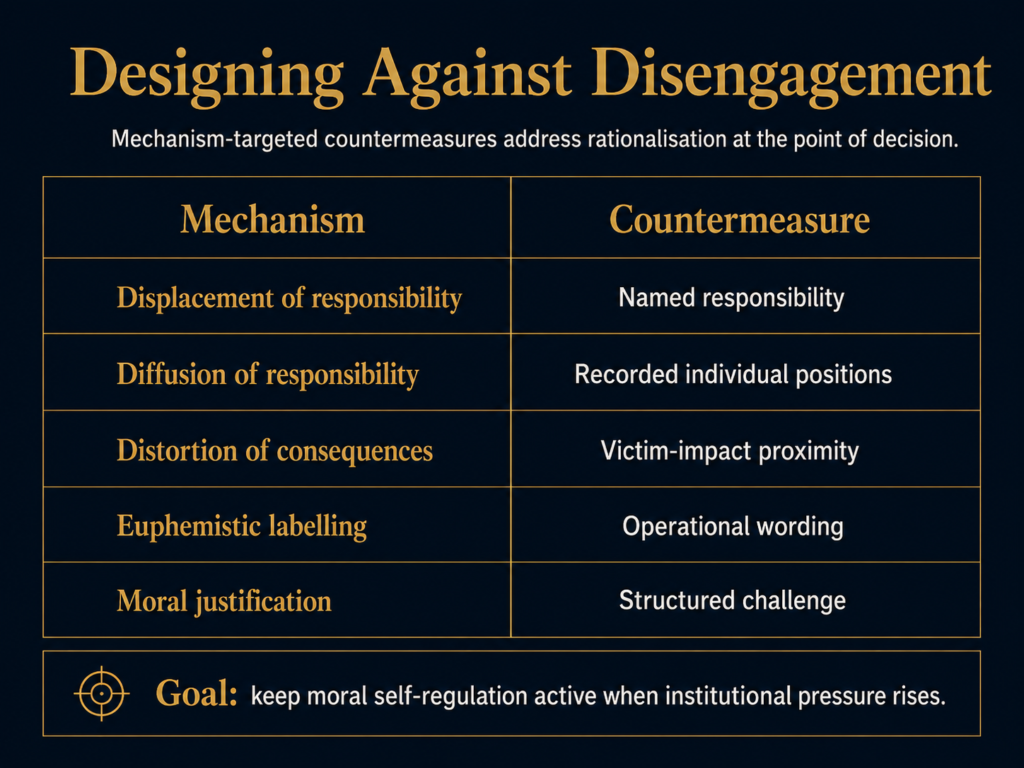
The framework, unlike general ethics theory, specifies failure points with sufficient precision to design against:
- Against displacement of responsibility: Named-responsibility provisions that attach an individual officer’s name to specific decisions, eliminating the cognitive availability of “the system required it” or “the committee decided.”
- Against diffusion of responsibility: Structured accountability where each participant in a collegial decision records their individual position and reasoning before deliberation — preventing post-hoc absorption into collective anonymity.
- Against distortion of consequences: Victim-impact proximity exercises, not as punitive measures but as cognitive countermeasures making the consequences of institutional action psychologically present at the point of decision.
- Against euphemistic labelling: Narrative reframing tools requiring institutional actors to describe their actions in operational rather than euphemistic terms during ethics review.
- Against moral justification: Structured challenge protocols where the justificatory narrative is subjected to peer examination — not the decision itself, but the cognitive frame used to rationalise it.
No peer-reviewed intervention study has tested these designs against actual disengagement scale scores in public-sector or judicial populations. The intervention logic follows directly from the mechanism theory, but the evidence base is entirely pre-intervention. We know the mechanisms operate. We know current systems do not target them. We know the theoretical architecture for targeting them. The empirical validation gap sits between mechanism evidence and intervention evidence.
Open Methodological Gaps
The evidence base, while sufficient to identify the design failure, contains material gaps:
- No peer-reviewed study has measured Bandura disengagement scale scores in judicial officers as a distinct population
- No study has assessed whether UNODC Bangalore-based training reduces disengagement scores at any of its 40+ pilot sites
- No study has mapped which of the eight mechanisms predominate specifically in judicial ethics violations
- No comparative study tests whether civil law, common law, and hybrid systems differ in mechanism prevalence
- Bandura’s MMDS has not been validated for non-Western institutional governance populations in the accessible literature
- The Organisational Moral Disengagement construct has not been applied to courts or regulatory bodies
- No study has tested named-responsibility provisions, victim-impact proximity, or narrative reframing as interventions against disengagement scores in institutional populations
Institutional Implications
Five design implications follow for judicial academies, integrity bodies, and regulatory governance architects.
Intervention target reclassification. Ethics system design should distinguish between knowledge-tier interventions — codes, training content — and disengagement-tier interventions — mechanism-targeted countermeasures. The two address different failure points. They require different design logic.
Training redesign. Judicial ethics training programmes, including those built on the Bangalore Principles, should incorporate moral disengagement theory as core curriculum. Officers who understand how they rationalise are better positioned to recognise rationalisation in progress.
Accountability architecture. Named-responsibility provisions and individual decision recording in collegial contexts target the displacement and diffusion mechanisms directly. These are structural features, not training content — they alter the institutional architecture in which decisions occur.
Assessment methodology. National integrity assessment frameworks need psychological compliance components alongside procedural ones. A scorecard that cannot distinguish between infrastructure deficit and disengagement from infrastructure cannot diagnose the failure it measures.
Research commissioning. Judicial academies and international bodies should commission validation studies of the disengagement scale in judicial populations and pilot intervention studies targeting specific mechanisms. The theoretical architecture is mature enough to design against. The validation gap is closeable.
About VeritasJPS
VeritasJPS provides evidence-based research and advisory at the intersection of jurisprudence, behavioural science, and institutional governance. Our work supports institutional decision-makers — judges, policymakers, and compliance leaders — with rigorous analysis grounded in empirical evidence and legal scholarship.
Learn more about VeritasJPS research and advisory work.
Cite This Analysis
Shah, S. W. A. (2026). Moral Disengagement and Institutional Ethics: Why Integrity Systems Fail Cognitively. VERITAS Jurisprudence & Psychological Science. Published 8 May 2026. https://veritasjps.com/research-analysis/moral-disengagement-integrity-systems/Published 8 May 2026 · Updated 8 May 2026
VeritasJPS — Law, Policy & Behavioral Research
Browse All Research & Analysis →Related Research

Automation Bias in AI Human Oversight Under the EU AI Act
Quick Answer: Automation bias is the cognitive mechanism Article 14 of the EU AI Act names but does not functionally regulate. The Act requires awareness of over-reliance, yet it does not mandate behavioral countermeasures such as cognitive forcing, override protocols, or audit trails for judicial AI oversight. Abstract The EU AI Act is the first […]

Cognitive Regulatory Capture: The Independence Failure Anti-Corruption Design Cannot Reach
Cognitive capture produces enforcement leniency without corruption, financial incentives, or institutional failure. A 2025 systematic review consolidates evidence that current regulatory governance frameworks — including the OECD Principles — leave this dominant capture mechanism unaddressed.

The Confidence-Accuracy Dissociation in Eyewitness Evidence: Why Courts Still Trust Confident Witnesses
Eyewitness confidence and identification accuracy are independent variables, yet no jurisdiction mandates a jury instruction targeting this cognitive dissociation. This analysis maps the science and the procedural gap across four jurisdictions.