Confirmation Bias on the Bench: Why Judicial Debiasing Without Psychometric Baseline Assessment Is Institutional Guesswork
Dr. Wasif Ali Shah
PhD Psychology · Barrister · Former Judge

Judicial training institutions across common law and civil law systems deliver cognitive debiasing curricula without first establishing whether — or to what degree — the judges being trained rely on the heuristics those programmes target. The publication of the Judicial Heuristics Awareness Questionnaire (J-HAQ) by Malegiannaki, Chatzopoulos, and Tsagkaridis in March 2025 marks the first validated psychometric instrument designed specifically for judicial populations. Its central findings — that years of professional experience show no statistically significant correlation with heuristic reliance or metacognitive awareness, and that judges fall into distinct high- and low-awareness clusters — expose a structural gap in every existing judicial training design: no programme in the documented record uses validated pre-intervention baseline assessment. This analysis examines the J-HAQ’s methodology and implications alongside two decades of convergent empirical evidence, the comparative institutional training landscape, and the normative frameworks that govern judicial competence — none of which currently require measured cognitive performance as a training design input. The absence of judicial debiasing psychometric assessment at the programme design stage means that interventions remain untested against the very cognitive mechanisms they claim to address.
The Measurement Problem in Judicial Debiasing
Judicial education on cognitive bias is not new. Since Guthrie, Rachlinski, and Wistrich published their landmark 2001 study demonstrating that 167 US federal magistrate judges were susceptible to all five tested cognitive illusions — anchoring, framing effects, hindsight bias, representativeness, and egocentric bias — the proposition that judges are not immune to systematic cognitive error has moved from controversial claim to settled premise. Judicial academies in multiple jurisdictions now include cognitive bias content in continuing professional development programmes.
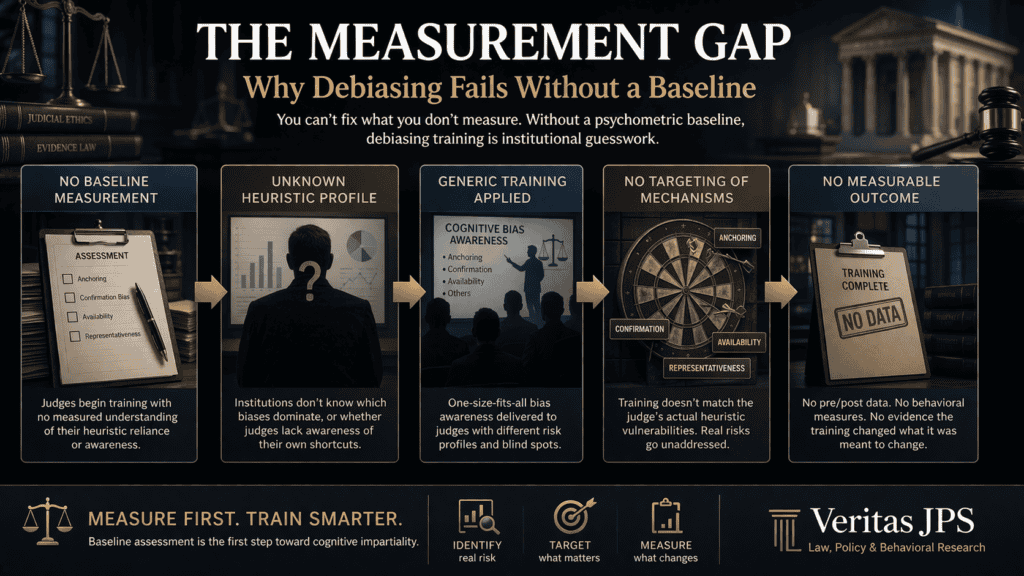
What has not moved is the measurement infrastructure. The question is no longer whether judges are susceptible to heuristics — the empirical record is convergent on that point across methods, jurisdictions, and legal traditions. The question is whether any judicial training institution can demonstrate that its debiasing intervention actually changes the target behaviour. That requires measurement before and after the intervention. Until March 2025, no validated psychometric instrument existed to provide that measurement for judicial populations specifically.
The distinction matters more than it might appear. General cognitive bias instruments — the Cognitive Reflection Test, anchoring sensitivity tasks, framing manipulation checks — measure heuristic susceptibility in laboratory conditions across generic populations. They were not designed to capture the decision-making ecology specific to judicial work: the interaction between legal reasoning, evidentiary evaluation, procedural constraints, and the professional culture of adjudication. A judge deciding bail under time pressure in an adversarial hearing operates in a different cognitive environment from a psychology undergraduate completing a survey. Instruments validated on the latter do not automatically transfer to the former. The gap in judicial debiasing psychometric assessment is not merely administrative — it is methodological.
The J-HAQ: First Psychometric Assessment Tool for Judges
Malegiannaki, Chatzopoulos, and Tsagkaridis (2025) addressed this gap directly. Their Judicial Heuristics Awareness Questionnaire was developed and administered to 52 active-duty judges drawn from 54 of 63 First Instance Courts and 11 of 19 Appeal Courts across Greece — a civil law jurisdiction where judges play an active inquisitorial role in evidence gathering and case management.
The instrument began with 19 items, reduced to 12 through Principal Component Analysis (KMO = 0.77; Bartlett’s χ²(66) = 199.96, p < .001). The final version confirmed a four-factor structure — availability, confirmation bias, representativeness, and anchoring — explaining 67.13% of total variance with an overall Cronbach’s α of 0.82. A five-item Cognitive Reflection Test served as a concurrent validity comparator.
Three findings carry institutional weight.
First, the four-factor structure itself. The J-HAQ empirically decomposes “cognitive bias” — a term judicial training programmes typically treat as a monolithic category — into four distinct measurable components. The decomposition has direct design implications: a training programme targeting anchoring requires different pedagogical architecture than one targeting confirmation bias. Generic “bias awareness” sessions conflate mechanisms that operate through different cognitive pathways.
Second, the two-cluster metacognitive finding. Two-step Cluster Analysis identified a high-awareness group (n=30) and a low-awareness group (n=22). The clusters differed significantly by educational level (t(40.52) = 1.98, p = 0.03) but not by age, gender, or — critically — years of professional experience. Judges in both clusters self-reported relatively low heuristic use overall. The authors’ interpretation: this reflects “metacognitive myopia” rather than genuinely reduced reliance. Judges who cannot detect their own heuristic use will naturally report low use, regardless of actual reliance levels.
Third, the experience null finding. Years of professional judicial experience showed no statistically significant correlation with either heuristic reliance or metacognitive awareness. This directly contradicts the assumption embedded in most judicial training design — that seniority brings cognitive sophistication and that debiasing resources should be concentrated on newer judges. The J-HAQ data point in the opposite direction: metacognitive assessment should apply equally across career stages.
Limitations of the J-HAQ and What Remains Untested
The instrument’s limitations are substantial. They must be stated plainly. The sample of 52 judges falls below the authors’ own recommended minimum of 67 for adequate statistical power. The study draws from a single jurisdiction — Greece — with a civil law inquisitorial tradition that differs structurally from common law adversarial systems where oral cross-examination, party-led evidence presentation, and adversarial challenge provide external debiasing pressures absent in civil law proceedings.
The exclusive reliance on self-report creates an interpretive ambiguity the instrument cannot internally resolve. Low self-reported heuristic use could indicate genuine low reliance — consistent with Gigerenzer’s ecological rationality framework, which holds that heuristics are adaptive tools calibrated to environmental structure rather than systematic errors. Under high-caseload conditions, fast heuristic processing may represent efficient decision-making rather than cognitive failure. The J-HAQ study acknowledges this theoretical tension without resolving it.
No concurrent behavioural outcome measure was administered. The instrument cannot tell us whether a judge who scores high on the confirmation bias factor actually produces more biased decisions — or whether metacognitive cluster membership predicts reversal rates, sentencing variance, or other measurable performance indicators. That validation step remains entirely untested.
Replication is absent. The factor structure, cluster distribution, and the experience null finding remain specific to one Greek sample until independent work confirms generalisability.
Two Decades of Convergent Evidence on Judicial Cognitive Bias
The J-HAQ did not emerge in an empirical vacuum. It sits within a body of research that has documented judicial heuristic susceptibility through different methodological lenses since the early 2000s.
Guthrie, Rachlinski, and Wistrich’s foundational 2001 study used experimental vignettes with 167 US federal magistrate judges and found statistically significant effects for all five tested cognitive illusions. Judges were marginally less susceptible to framing effects and representativeness than lay populations, but the core finding — that legal training and judicial experience do not eliminate systematic heuristic reliance — has been replicated and extended by the same research team in subsequent work.
Englich, Mussweiler, and Strack (2006) demonstrated that experienced German legal professionals, including judges, were significantly influenced by irrelevant numerical anchors in sentencing scenarios — even when participants were aware of the anchor’s irrelevance. The anchoring effect persisted despite expertise, awareness, and high motivation for accuracy.
Citation reflects reported judicial practice. Verify with primary case law databases for specific authority.
Qualitative evidence from a non-Western jurisdiction tells a consistent story. Semi-structured interviews with retired judges and senior advocates in Pakistan (ASSA Journal, 2025) documented confirmation bias in precedent interpretation and anchoring bias in sentencing. Sociocultural and moral frameworks were found to interact with cognitive shortcuts in ways the Western experimental literature has not examined. The study recommended embedding psychological literacy in judicial education but applied no standardised measurement instrument.
What these studies share — across experimental vignettes, psychometric self-report, and qualitative interview; across the United States, Germany, Greece, and Pakistan; across common law and civil law traditions — is a convergent conclusion: legal training does not eliminate heuristic reliance, professional experience does not reduce it, and judges themselves frequently cannot detect when they are relying on cognitive shortcuts rather than deliberative legal reasoning. The structural failure of mixed court deliberation documented in lay-professional judge interactions illustrates the same metacognitive blind spot in a different institutional setting.
The Ecological Rationality Counterargument
Intellectual honesty requires confronting the strongest objection to the bias-as-error framing that underpins most judicial debiasing programmes.
Gigerenzer’s adaptive toolbox model holds that heuristics are not systematic cognitive failures but ecologically rational tools — fast, efficient decision strategies calibrated to the structure of the environment in which they are deployed. Under this model, a judge who relies on availability heuristics in a high-volume docket is not necessarily committing a cognitive error. The judge may be making decisions that are “good enough” for the decision context, conserving cognitive resources for cases that genuinely demand deliberative processing.
This is not a fringe position. It represents a major theoretical divide in cognitive science — one that the empirical literature on judicial decision-making has not resolved. The J-HAQ study explicitly acknowledges the tension: its data are consistent with both the metacognitive myopia interpretation (judges do not detect their own bias) and the ecological rationality interpretation (judges genuinely do not rely heavily on heuristics because their professional environment selects for deliberative processing).
The resolution matters for intervention design. If heuristic reliance is pathological, training should aim to reduce it. If heuristic reliance is adaptive, training should aim to improve metacognitive calibration — helping judges recognise when heuristic processing is appropriate and when it is not — rather than treating all heuristic use as error.
No existing judicial training programme engages with this distinction. Debiasing curricula uniformly assume the bias-as-error model without testing whether that assumption applies to the specific population being trained.
The Comparative Judicial Training Landscape
Judicial academies across different legal traditions include cognitive bias content in their curricula. None in the documented record use validated psychometric baseline assessment.
The École Nationale de la Magistrature (ENM) in France — the principal training institution for the French judiciary — incorporates neuroscience and cognitive bias content into at least some programmes. Documentation from a 2022 co-design project with the user-centred design firm Amurabi confirms integration of cognitive bias modules into non-professional judge training. No ENM documentation references a validated psychometric instrument for pre- or post-training assessment of heuristic reliance.
The UNODC Judicial Conduct and Ethics framework — the principal international training package implementing the Bangalore Principles — lists “awareness of a range of cognitive biases” and “reflective skills to counter these biases” among its stated learning outcomes. It specifies no measurement instrument, no baseline assessment protocol, and no outcome evaluation methodology.
The Australian Law Reform Commission’s Background Paper JI6 (2021) represents the most thorough institutional review of the evidence base. It synthesises international empirical literature and recommends both structural procedural reforms — such as separating bail and trial judges to reduce confirmation bias — and integration of cognitive psychology into judicial education. It does not recommend psychometric baseline assessment. It pre-dates the J-HAQ by four years.
Notably absent from the documented record: curriculum-level details for the Deutsche Richterakademie (Germany), the Judicial College (England and Wales), the Federal Judicial Center (United States), and the National Judicial Institute (Canada). Whether these institutions use any form of psychometric baseline assessment cannot be confirmed from available evidence. The gap in comparative data is itself telling — if leading judicial training institutions were conducting validated pre/post cognitive assessment, the practice would likely appear in published evaluations or institutional reports. The pattern mirrors the broader judicial reform mandates that fail at implementation — where design intent does not survive institutional execution.
The Normative Gap: Bangalore Principles and Cognitive Competence
The Bangalore Principles of Judicial Conduct (2002) — the nearest thing to a universal normative standard for judicial behaviour — address competence through Value 6: judges must “maintain and enhance” the knowledge, skills, and personal qualities necessary for proper judicial performance.
Value 6 is oriented toward legal knowledge and professional diligence. It does not address psychometric assessment of cognitive competence, heuristic reliance measurement, metacognitive training design, or validated instrument deployment as a condition of programme design or evaluation.
The gap between “impartiality” as an ethical aspiration (Value 2) and “confirmation bias” as a measurable cognitive mechanism is not bridged in the text, its commentary, or any known implementing guidance. The Principles assume that judicial commitment to impartiality — expressed through ethical conduct, absence of prejudice, and procedural fairness — translates into cognitive impartiality. The empirical record documented above suggests that assumption is unsupported. Where judicial integrity systems fail by design, the failure extends to the cognitive dimension — accountability frameworks that do not measure cognitive performance cannot assure it.
No judicial council in the documented record has interpreted Value 6 to require validated cognitive baseline assessment as part of continuing judicial education. The instrument to enable such assessment now exists. The normative mandate for its use does not.
What Measurement-Before-Intervention Design Would Require
If a judicial training institution adopted the J-HAQ or a successor instrument as a baseline assessment tool, the training design cycle would change in three concrete ways.
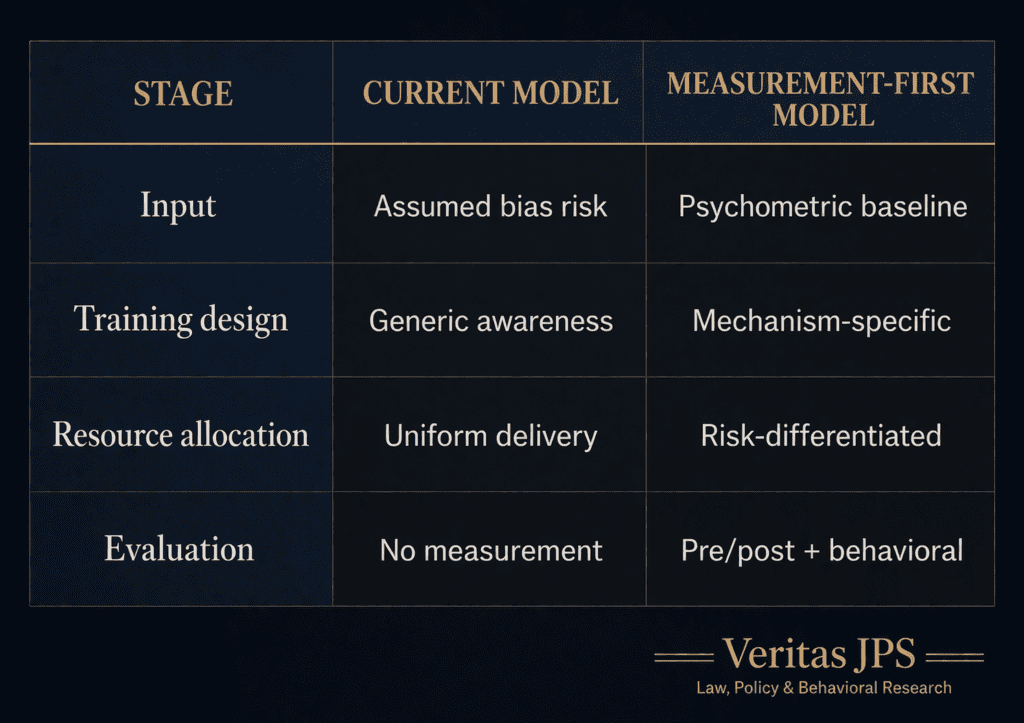
First, training needs analysis would become empirically grounded rather than assumption-driven. Instead of designing a generic “cognitive bias awareness” module, an academy could identify which heuristics dominate in its specific judicial population — and whether that population splits into metacognitive clusters requiring differentiated pedagogical approaches.
Second, training evaluation would acquire a measurable endpoint. Pre/post J-HAQ administration would allow assessment of whether the intervention shifted self-reported heuristic awareness — and, with concurrent behavioural measures added, whether awareness change correlated with decision quality change. No judicial training programme currently publishes outcome data on heuristic reliance as a primary metric.
Third, resource allocation would become defensible. Judicial training budgets are finite. An institution that can demonstrate measured change in the target variable can justify continued investment. An institution that cannot is funding professional comfort rather than cognitive performance improvement.
Institutional Implications
- Baseline assessment mandate. Judicial academies and judicial councils should require validated psychometric baseline assessment of heuristic reliance before designing or procuring debiasing training programmes. The J-HAQ provides a starting instrument; cross-jurisdictional replication should be commissioned as a priority.
- Differentiated training design. The J-HAQ’s four-factor structure and two-cluster metacognitive finding indicate that generic “bias awareness” training conflates distinct cognitive mechanisms. Training architecture should differentiate between confirmation bias, anchoring, availability, and representativeness — and between judges who demonstrate metacognitive awareness and those who do not.
- Outcome measurement infrastructure. Judicial training effectiveness should be evaluated against measured cognitive and behavioural outcomes, not against participant satisfaction surveys or attendance metrics. Pre/post psychometric assessment should become a standard component of programme evaluation.
- Normative framework revision. The Bangalore Principles’ silence on cognitive competence assessment represents an outdated conception of judicial competence that predates the empirical evidence base. Implementing bodies should consider whether Value 6 guidance requires supplementation to address validated cognitive performance measurement.
- Cross-jurisdictional replication priority. The J-HAQ’s construct validity for common law adversarial systems remains untested. Judicial training institutions in common law jurisdictions — particularly those with established continuing judicial education infrastructure — should commission replication studies before adopting or dismissing the instrument’s findings.
About VeritasJPS
VeritasJPS provides evidence-based research and advisory at the intersection of jurisprudence, cognitive science, and institutional governance. Our work supports institutional decision-makers — judges, policymakers, and compliance leaders — with rigorous analysis grounded in empirical evidence and legal scholarship.
Learn more: [website URL]
Cite This Analysis
Shah, S. W. A. (2026). Confirmation Bias on the Bench: Why Judicial Debiasing Without Psychometric Baseline Assessment Is Institutional Guesswork. VERITAS Jurisprudence & Psychological Science. Published 9 April 2026. https://veritasjps.com/research-analysis/judicial-debiasing-psychometric-assessment/Published 9 April 2026 · Updated 9 April 2026
VeritasJPS — Law, Policy & Behavioral Research
Browse All Research & Analysis →Related Research

Automation Bias in AI Human Oversight Under the EU AI Act
Quick Answer: Automation bias is the cognitive mechanism Article 14 of the EU AI Act names but does not functionally regulate. The Act requires awareness of over-reliance, yet it does not mandate behavioral countermeasures such as cognitive forcing, override protocols, or audit trails for judicial AI oversight. Abstract The EU AI Act is the first […]

Moral Disengagement and Institutional Ethics: Why Integrity Systems Fail Cognitively
Quick Answer: Moral disengagement explains why institutional actors can know ethical rules yet rationalise violations at the moment of conduct. Current integrity systems focus on codes, training, committees, and sanctions, but rarely target the cognitive mechanisms that suspend self-regulation. That design gap leaves judicial and institutional ethics systems structurally exposed. Abstract Institutional ethics systems — […]

Cognitive Regulatory Capture: The Independence Failure Anti-Corruption Design Cannot Reach
Cognitive capture produces enforcement leniency without corruption, financial incentives, or institutional failure. A 2025 systematic review consolidates evidence that current regulatory governance frameworks — including the OECD Principles — leave this dominant capture mechanism unaddressed.