
Abstract
Reactive devaluation in ENE design explains why early neutral evaluation programs that use attributed proposals may undermine settlement before substantive evaluation begins. Early neutral evaluation programs in courts worldwide use attributed proposals as the default format for settlement exchange — the opposing party’s name attaches to the offer. Experimental evidence spanning three decades establishes that this design choice activates reactive devaluation, a cognitive mechanism by which disputants automatically discount proposals attributed to the counterparty regardless of substantive merit. This analysis traces the evidence from foundational social psychology experiments through legal negotiation replications and commercial dispute contexts, examines the absence of cognitive architecture provisions in the UNCITRAL Model Law on International Commercial Mediation (2018) and the Singapore Convention on Mediation (2019), and evaluates debiasing mechanisms including anonymous framing and single-text procedures. It maps the jurisdictional and methodological gaps that leave this design defect unaddressed by any binding international instrument, and assesses the boundary conditions — ecological validity, repeat-player attenuation, cultural moderation — that qualify the extrapolation from laboratory to courtroom.
The Cognitive Mechanism: What Reactive Devaluation Does
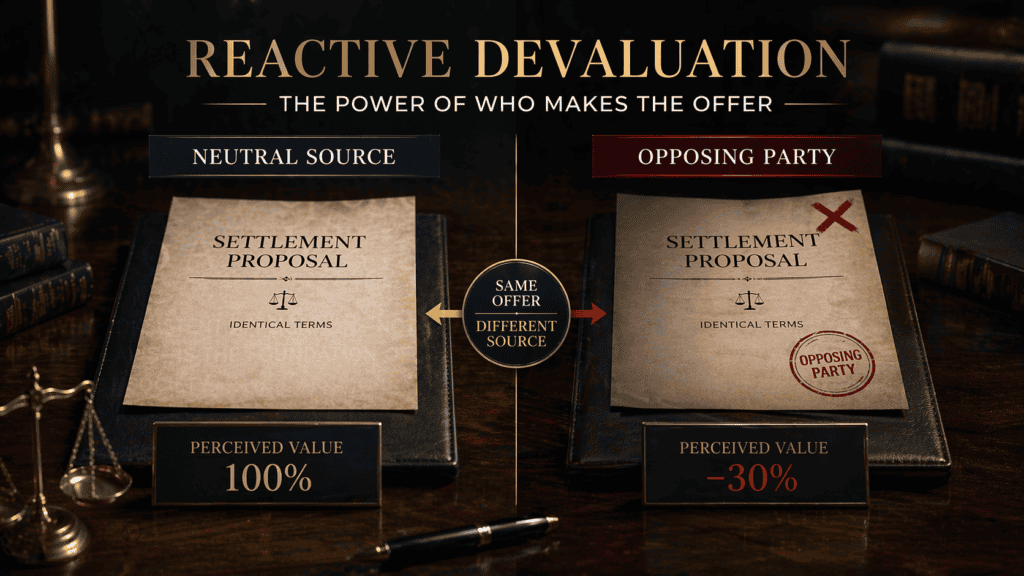
Reactive devaluation describes a specific and replicable cognitive pattern: when a proposal is attributed to an adversary, recipients rate it as less attractive, less fair, and representing a smaller concession than an identical proposal attributed to a neutral source or their own side. The mechanism is automatic — it operates before substantive evaluation of the proposal’s terms.
Stillinger, Epelbaum, Keltner, and Ross (1990) documented this effect in two experiments. The first presented US members of the public with nuclear arms-reduction proposals attributed to either President Reagan or General Secretary Gorbachev — identical proposals received different attractiveness ratings depending on attributed source. The second asked Stanford undergraduates to evaluate a divestment compromise attributed to the university administration versus a neutral source. Proposals attributed to the administration were rated as representing a less significant concession. Ross and Stillinger (1991) subsequently characterised reactive devaluation as one of three psychological barriers to conflict resolution, alongside partisan perception and naive realism.
The finding is directional and consistent: across every experimental condition, attribution to an adversarial source reduced proposal acceptance. The mechanism is not strategic posturing — subjects did not consciously decide to reject the counterparty’s offer for tactical reasons. The discounting was perceptual. They genuinely evaluated the same terms as worse when they knew who proposed them.
Replication in Legal Negotiation Settings
The question for ENE program design is whether reactive devaluation operates in legal dispute contexts with the same reliability as in social psychology experiments. The available evidence says yes. The caveats concern ecological validity.
Korobkin and Guthrie (1994), published in the Michigan Law Review, conducted nine laboratory experiments with approximately 450 subjects — law students and lay populations at Stanford’s Center on Conflict and Negotiation. Their findings confirmed that reactive devaluation was operational in simulated litigation settlement negotiation. Subjects discounted settlement offers attributed to the opposing party relative to identical offers attributed to a neutral or own-side source. The effect held alongside framing and equity-seeking biases, suggesting reactive devaluation operates as an independent cognitive variable rather than a downstream effect of other negotiation biases.
Korobkin and Guthrie (2004), writing in the Harvard Law Review, extended this analysis by examining how reactive devaluation, anchoring, and framing biases interact in legal bargaining. Their synthesis identified the cognitive architecture of proposal exchange — who proposes, at what stage, in what format — as a design variable with measurable effects on settlement outcomes. When counterparty attribution triggers reactive devaluation and combines with initial offer anchoring, settlement resistance amplifies beyond what either bias produces alone.
The ecological validity caveat is real. These were laboratory experiments. Subjects operated without legal counsel, without the iterative positional dynamics of actual litigation, and without the institutional structure of a formal ENE session. Korobkin and Guthrie acknowledged that legally represented parties in institutional ENE may exhibit different magnitudes of reactive devaluation — counsel may partially buffer direct client-to-counterparty attribution exposure. Whether counsel reduces the effect, amplifies it by adopting the bias on behalf of clients, or has no measurable impact remains untested.
Beyond the Laboratory: Commercial Dispute Evidence
Yam, Fong, and Chan (2020), published in the ASCE Journal of Management in Engineering, extended reactive devaluation documentation into construction project dispute negotiation. Through practitioner survey and conceptual framework synthesis, they found that counterparty attribution of proposals reduced acceptance rates among construction industry practitioners — a finding consistent with the foundational psychological literature but situated in a commercial, repeat-player-adjacent context.
This matters for ENE design because construction disputes are among the most common candidates for court-annexed ADR, and construction disputants are often repeat players within the same industry. If reactive devaluation operates even where parties have prior transactional history, the assumption that familiarity attenuates the effect is weakened. The Yam et al. study does not resolve this conclusively — its survey methodology lacks the experimental control needed to isolate attribution as an independent variable — but it provides directional evidence that the mechanism persists outside the laboratory.
A 2023 laboratory experiment on conciliation and pre-trial settlement, published through HAL Open Science, examined neutral third-party conciliation — structurally analogous to a single-text procedure — in a French civil dispute simulation. Conciliation improved bargaining efficiency by reducing impasse rates. Not a direct test of reactive devaluation, but the finding aligns with debiasing theory: removing bilateral attribution from the exchange process and substituting a neutral third-party text reduces the cognitive triggers that impede agreement.
The International Instrument Gap
The most consequential finding for institutional decision-makers is not what the experimental record shows about reactive devaluation. It is what the binding international instruments do not address.
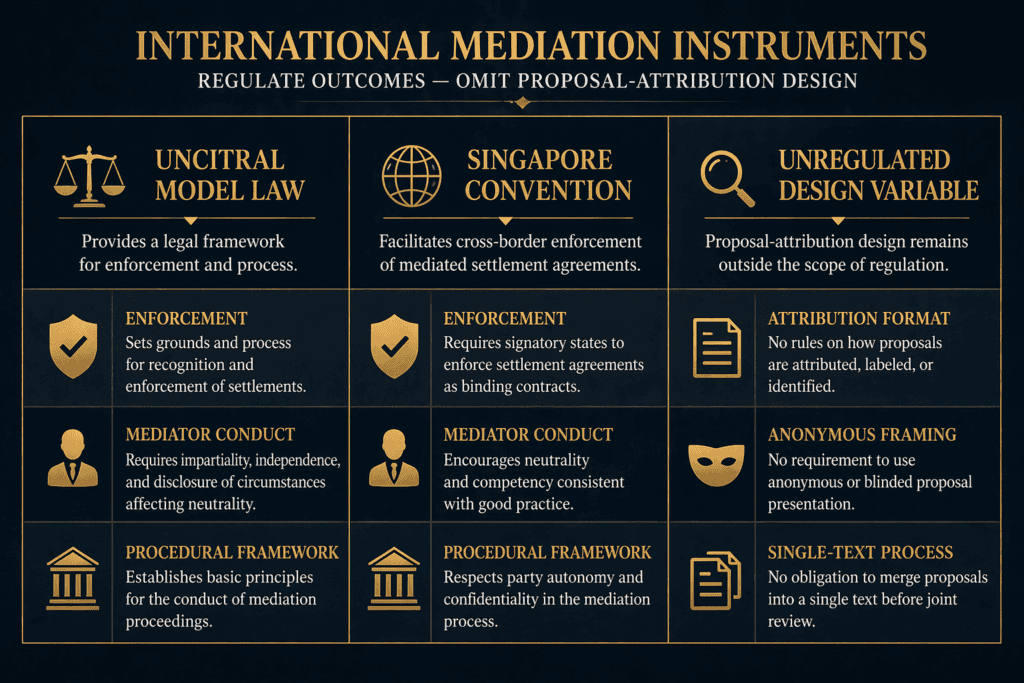
The UNCITRAL Model Law on International Commercial Mediation, as amended in 2018, governs the procedural framework for international commercial mediation and the enforcement of international settlement agreements. Its provisions address mediator appointment (Article 5), conduct of mediation (Article 6), confidentiality (Article 7), the mediator-as-arbitrator restriction (Article 12), and enforcement mechanisms. The 2018 amendments focused on terminology standardisation — replacing “conciliation” with “mediation” — and enforcement of settlement agreements resulting from mediation. No article, no provision, and no explanatory note addresses the cognitive architecture of proposal exchange. Whether proposals should be attributed, anonymous, or mediator-owned is not covered.
The United Nations Convention on International Settlement Agreements Resulting from Mediation (Singapore Convention, 2019) governs the cross-border recognition and enforcement of mediated settlement agreements. Article 5 establishes grounds for refusing enforcement, including mediator impartiality failure and breach of applicable standards. The Convention addresses the enforceability of outcomes but contains no provision addressing the cognitive architecture of the process that produces those outcomes. Proposal attribution format, cognitive bias mitigation, and single-text procedure requirements are absent from the text.
Both instruments regulate the downstream products of mediation — the enforceability of settlement agreements, the conduct of mediators, the procedural framework — while leaving the upstream cognitive variables that determine whether settlement is reached entirely unaddressed. A building code that specifies the tensile strength of structural steel but says nothing about where to pour the foundations.
Debiasing Mechanisms: What Exists, What Has Been Tested
Two principal debiasing mechanisms target reactive devaluation at the design level.
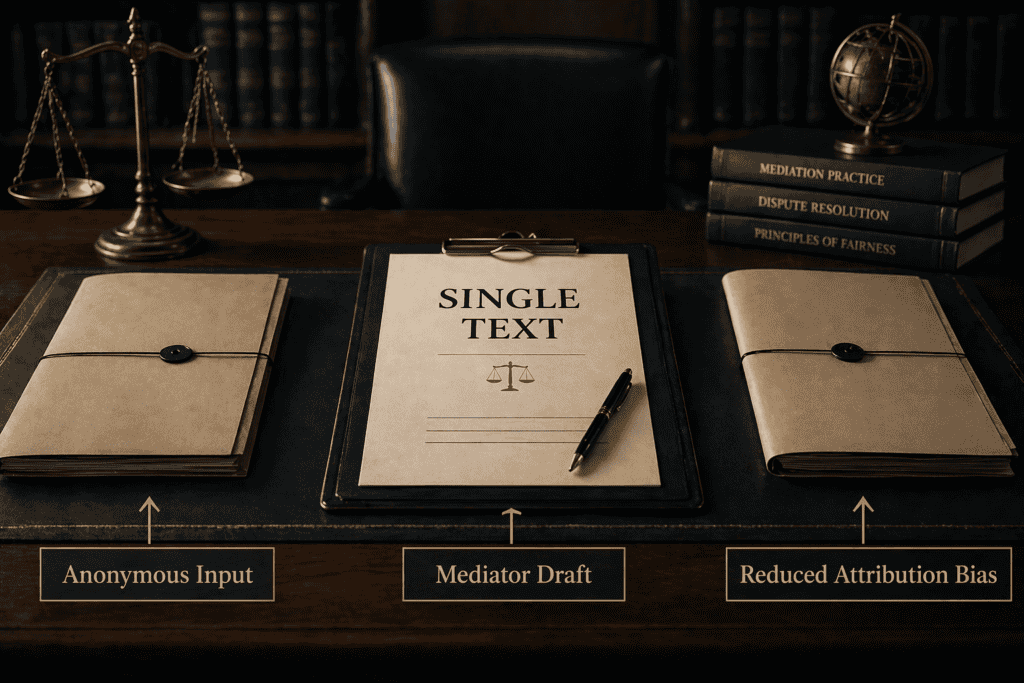
Anonymous framing removes counterparty attribution entirely. Proposals are submitted and presented without identifying which party originated them. The neutral evaluator receives both parties’ positions and presents options without source labels. This directly eliminates the cognitive trigger — if the disputant does not know who proposed the terms, the attribution-based discounting mechanism has no target.
Single-text procedure, formalised in Roger Fisher’s scholarship and operationalised most prominently at the Camp David negotiations (1978), takes a different structural approach. The mediator drafts and owns a single working document. Neither party is identified as the source of any specific term. The mediator revises the text iteratively based on each party’s input, but the document is always attributed to the mediator — never to either disputant. This neutralises reactive devaluation by ensuring that no term in the working text can be discounted based on counterparty attribution.
Camp David is the most prominent application. President Carter used a single-text process over 13 days of negotiation between Israeli and Egyptian delegations. Neither delegation proposed terms directly to the other. Carter’s team drafted and revised a single document — 23 successive drafts before the final version. The process produced a binding peace treaty. Fisher and Ury subsequently formalised the method in Getting to Yes (1981).
The limitation is clear: one case in an exceptional political context. No randomised comparison with attributed-proposal formats exists. The ecological validity for court-annexed ENE — where stakes are commercial rather than geopolitical, where parties are private litigants rather than sovereign states, and where time horizons are weeks rather than decades — is asserted by analogy rather than demonstrated by experiment.
ENE Program Efficiency and the Attribution Question
Empirical analysis of mandated ENE programs in US federal courts has found no discernible increase in settlement efficiency among courts that mandate ENE compared to those that do not. Citation reflects reported judicial practice. Verify with primary case law databases for specific authority. If mandatory ENE does not improve settlement rates, what design variables account for the underperformance?
The reactive devaluation literature suggests one candidate: the default attributed-proposal format. If ENE sessions present proposals with counterparty attribution, and the mechanism operates with the reliability the experimental record indicates, then settlement rates in attributed-proposal ENE would be systematically lower than those achievable under anonymous or single-text alternatives — even when all other programme variables are held constant.
No study in the accessible record has isolated proposal attribution format as an independent variable in a field study of court-annexed ENE settlement rates. That is the primary measurement gap.
Counterevidence and Boundary Conditions
Three qualifications apply.
A 2022 behavioural analysis published in the German Law Journal examined mediator role in international disputes and found that a biased mediator does not negatively affect settlement efficiency. This partially complicates the cognitive architecture argument: if mediator neutrality itself is less outcome-determinative than assumed, the claim that attribution-format design is the dominant variable requires closer examination. The study does not directly test reactive devaluation, but it introduces a competing hypothesis about which cognitive variables carry the most weight.
The laboratory-to-courtroom ecological validity gap remains unresolved. Every experimental replication used simulated disputes without legal counsel. Whether the effect attenuates when parties are legally represented — because counsel buffers direct counterparty attribution exposure — or persists at full magnitude is not established. Counsel may also amplify the bias by adopting adversarial framing on behalf of clients.
The record is silent on cultural moderation. Whether reactive devaluation operates with the same magnitude in civil law inquisitorial systems, where judicial mediation is structurally different from common law adversarial ENE, has not been tested. Cross-cultural replication is absent.
Jurisdictional Coverage and Evidence Gaps
The experimental and field evidence covers:
- United States — foundational social psychology experiments (Stillinger et al., 1990), legal negotiation laboratory replications (Korobkin & Guthrie, 1994, 2004), and federal ENE efficiency data
- Hong Kong / International — construction dispute practitioner evidence (Yam et al., 2020)
- France — laboratory conciliation experiment (HAL, 2023)
Missing from the record: the United Kingdom (no published study on reactive devaluation in CPR-governed ENE), the European Union (no study within the EU Mediation Directive 2008/52/EC framework), Australia (no study in court-annexed mediation under Federal Court or state court rules), Singapore, any civil law jurisdiction with a controlled attribution study, and any Global South jurisdiction.
Implications for ENE Program Design
Five conclusions for institutional decision-makers.
Reactive devaluation is the most empirically documented cognitive obstacle to voluntary settlement in adversarial dispute resolution. The mechanism replicates across contexts, and no published experiment reports a null finding.
The default attributed-proposal format used in court-annexed ENE programs activates this mechanism by design. The format is not cognitively neutral.
No binding international ADR instrument — including the UNCITRAL Model Law and the Singapore Convention — addresses proposal attribution format or cognitive architecture in procedure design.
Debiasing mechanisms exist. Anonymous framing and single-text procedures directly target the attribution trigger. Both are implementable as procedural design changes without legislative amendment.
The primary gap is not in the cognitive science — it is in the field evidence. No controlled comparison of attributed versus anonymous ENE settlement rates has been published. Until that study is conducted, the case for format change rests on laboratory evidence extrapolated to institutional settings. For any judicial council considering ENE programme reform, the threshold question is whether three decades of consistent laboratory findings justify a procedural design change that carries no downside risk and requires no legislative action.
About VeritasJPS
VeritasJPS provides evidence-based research and advisory at the intersection of jurisprudence, behavioural science, and dispute resolution design. Our work supports institutional decision-makers — judges, policymakers, and ADR programme administrators — with rigorous analysis grounded in empirical evidence and legal scholarship.
Learn more: [website URL]
Leave a Reply