Witness Credibility Assessment: Courts Still Trust Demeanor
Dr. Wasif Ali Shah
PhD Psychology · Barrister · Former Judge

Abstract
Witness credibility assessment remains anchored to demeanor observation — the belief that judges can detect deception by watching how witnesses behave on the stand. The empirical record contradicts this belief categorically. Meta-analytic evidence spanning four decades and tens of thousands of judgments places unaided human lie-truth discrimination at 54% accuracy — barely above coin-flip. The behavioral cues courts treat as deception indicators (gaze aversion, fidgeting, speech hesitation) carry near-zero diagnostic value, and professional experience does not improve detection rates. Yet no major jurisdiction has structurally retired demeanor-based credibility assessment from judicial training. This is not a training gap. It is a structural failure sustained by appellate deference doctrine, asymmetric admissibility standards, and a professional culture that rewards confident credibility findings. Comparative data from the Netherlands and Norway confirms that even jurisdictions with strong legal psychology integration continue embedding contested demeanor criteria in judicial reasoning. The question is no longer whether demeanor-based assessment works. It is why the institutions responsible for fact-finding accuracy continue to use a method the evidence has disqualified.
The Empirical Verdict on Witness Credibility Assessment
The foundational claim for demeanor-based witness credibility assessment is that experienced adjudicators develop reliable intuitions about witness honesty by observing behaviour. The data rejects this claim.
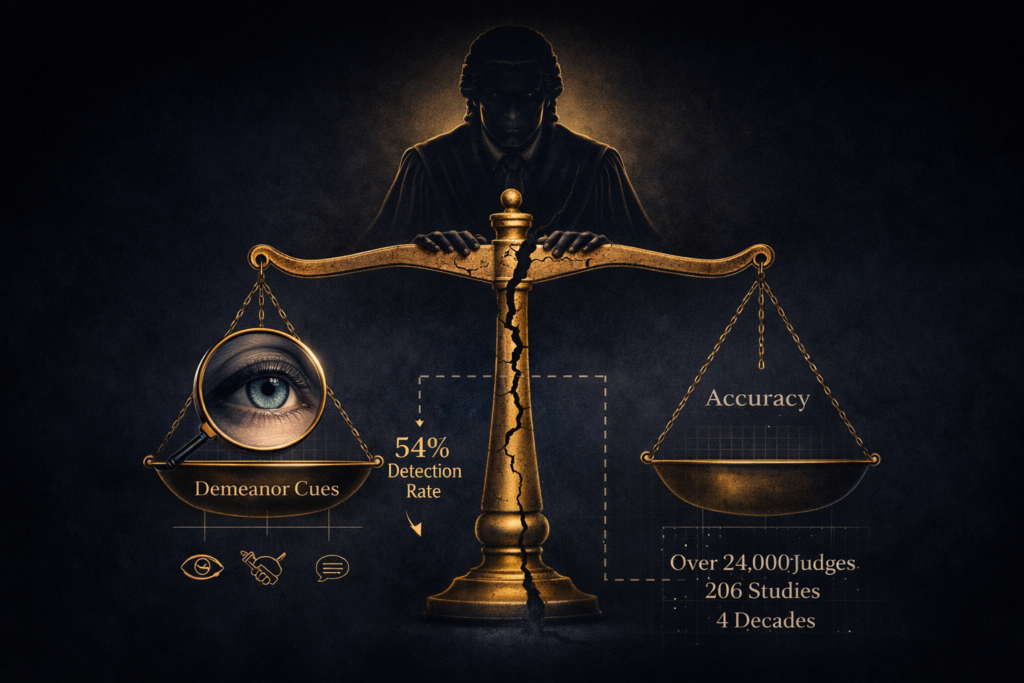
Bond and DePaulo’s 2006 meta-analysis, synthesizing 206 studies and over 24,000 judges, established that mean lie-truth discrimination accuracy sits at 54% — with truth identification marginally stronger (61%) than lie detection (47%). Variation between studies was small, pointing to a structural ceiling rather than a sampling artefact. The more damaging finding for demeanor-reliance advocates: accuracy was higher when judges heard statements without visual access to the speaker. The visual channel — the one courts privilege — actively degrades detection performance. [EXT-LINK: Bond and DePaulo’s 2006 meta-analysis → peer-reviewed study]
DePaulo and colleagues’ 2003 cue-level analysis reinforced this. Examining 158 potential deception indicators across 1,338 estimates, they found that the behavioural cues courts most commonly associate with dishonesty — gaze aversion, fidgeting, speech errors, postural shifts — show near-zero effect sizes. Several operate in the opposite direction from lay belief. Liars speak for shorter periods and include fewer details than truth-tellers, directly contradicting the “over-elaborating liar” model that underpins much judicial intuition about witness behaviour.
The 54% figure is not contested. It is the baseline from which every subsequent study departs.
Why Demeanor Evidence Fails as a Deception Signal
A common institutional defence is that deception detection is simply difficult — the cues too subtle for reliable identification. Hartwig and Bond’s 2011 lens model meta-analysis dismantled this. [EXT-LINK: Hartwig and Bond’s 2011 lens model meta-analysis → peer-reviewed study]
Applying Brunswik’s lens framework to separate “invalid cue use” from “absent cue” explanations, they showed that lie-catchers fail because they rely on wrong indicators — not because diagnostic information is unavailable. Professional credibility assessors report using cues that have no actual association with deception. The disconnect runs between institutional belief and empirical reality.
The implication is precise. Judges do not lack training in behavioural observation. The observational framework itself targets the wrong signals.
Hartwig and Bond’s 2014 follow-up sharpened this. Analysing 144 samples with over 26,000 messages, they found that algorithmic combination of multiple behavioural cues achieves approximately 70% detection accuracy — stable across forensic settings, motivated liars, and demographic variation. But that ceiling applies only to computational extraction. Human judges observing the same data do not approach it. [EXT-LINK: Hartwig and Bond’s 2014 follow-up → peer-reviewed study]
The diagnostic signal exists. Human cognition cannot reliably extract it through observation. That distinction is the entire case against training-based reform.
Appellate Deference Locks Demeanor-Based Reasoning in Place
If the scientific case is this settled, why has no major jurisdiction retired demeanor-based assessment?
Common law systems grant trial courts substantial deference on credibility findings. The rationale: trial judges see the witness — observe demeanor, tone, composure — and appellate courts, working from transcripts, cannot. This doctrine converts demeanor observation from an evidentiary method into a jurisdictional boundary. Challenging a credibility finding on appeal requires demonstrating that the trial court’s assessment was not merely wrong but unreasonable — a threshold that insulates demeanor-based reasoning from empirical scrutiny. [LINK: appellate deference doctrine → article on standards of appellate review in credibility findings]
The structural effect is circular. Deference protects demeanor findings from correction. Absence of correction reinforces institutional belief that the method works. Training curricula continue teaching witness observation because no higher court has formally repudiated it. The doctrine that shields the method is the same doctrine that prevents its evaluation within the system.

Why Daubert Does Not Regulate Judicial Credibility Assessment
A parallel failure operates through evidence admissibility. Under Daubert and its equivalents, expert testimony on witness credibility — forensic psychology evidence about deception cues, memory reliability, suggestibility — must satisfy reliability and relevance gates. Courts assess whether the expert’s methodology meets scientific standards, whether research has been peer-reviewed, whether error rates are known. [LINK: Daubert and its equivalents → explainer on admissibility standards for expert evidence]
No equivalent gate applies to the judge’s own credibility assessment. A forensic psychologist must demonstrate scientific validity before testifying about witness reliability. The judge evaluating the same witness from the bench faces no such requirement. One adjudicator applies an unvalidated method to the same factual question the other must validate before addressing.
This asymmetry has no principled justification. Admissibility doctrines were designed to regulate evidence placed before fact-finders, not the cognitive methods fact-finders themselves deploy. The Istanbul Protocol — revised in 2022 — provides structured forensic assessment standards for torture documentation, but its scope remains confined to that evidentiary domain. No equivalent protocol governs civilian witness credibility in domestic courts. [EXT-LINK: Istanbul Protocol — revised in 2022 → UN standard / protocol] [LINK: Istanbul Protocol → article on forensic assessment standards in torture documentation]
Comparative Evidence From the Netherlands and Norway
If demeanor-based assessment were merely an Anglo-American common law artefact, the structural failure might be contained. Comparative evidence from inquisitorial systems suggests otherwise.
Meijer and colleagues’ 2025 study examined Dutch legal professionals on two dimensions: stated credibility criteria (survey, n=79) and criteria appearing in actual court rulings (content analysis, n=518 sexual assault decisions). Content-based factors dominated stated practice — consistency (66%), accuracy (66%), detailedness (53%). But 28% of respondents also named non-verbal behaviour, emotion, or “authentic impression.” In actual rulings, authentic impression surfaced in 21% of decisions, emotionality in 13%, signs of trauma in 9.5%. No validated protocol governed which indicators were applied, how they were weighted, or how conflicts between content and demeanor signals were resolved.
The Netherlands operates an inquisitorial system with strong legal psychology integration. Contested credibility criteria persist there regardless. The failure is not jurisdiction-specific.
Bjørndal and colleagues’ 2020 survey of 98 Norwegian judges found no significant aggregate knowledge improvement over a decade — comparing 2019 scores against Magnussen and colleagues’ 2008 baseline. One item shifted dramatically: recognition that witness confidence does not reliably indicate accuracy moved from 31% correct to 78%. But gains on individual items were offset by declines elsewhere, producing flat aggregate scores. Judges grew more sceptical of others’ eyewitness knowledge while their own knowledge base stayed largely unchanged. [LINK: eyewitness knowledge → post on judicial misunderstanding of memory reliability]
Norway abolished jury trial in 2017, concentrating credibility-assessment responsibility on professional judges. The adjudicators now solely responsible for witness assessment have not, collectively, absorbed the science governing the methods they use.
How Scottish Directions Reinforce Demeanor Reliance
Clark, Keane, and Sheridan’s 2022 study added a procedural dimension from the Scottish adversarial context. Across 863 mock jurors in 64 jury deliberations, demeanor-based reasoning surfaced consistently — even when jurors also applied content-based criteria. Scottish judicial directions explicitly instruct jurors to consider manner of delivery. The directions do not caution against demeanor reliance. They endorse it.
This is how structural failure self-replicates. Directions are drafted from existing doctrine. Doctrine defers to trial-level demeanor findings. Trial-level practice treats demeanor observation as legitimate. Each layer validates the one below it. The empirical evidence has no formal entry point into this chain.
Why Training Alone Will Not Fix Witness Credibility Assessment
Most institutional discussion frames demeanor-reliance as a training gap — fixable by adding a cognitive bias module to judicial education curricula. The diagnosis is wrong.
The failure persists because institutional incentives actively sustain it. Confident credibility assessments produce clean judicial outcomes. Epistemic humility about witness reliability introduces uncertainty — it complicates decision-making, extends proceedings, may require additional procedural safeguards. Professional rewards flow toward confidence, not calibration.
Appellate deference amplifies this. A trial judge who states “I found the witness credible based on their demeanor” produces a virtually unreviewable finding. A judge who states “the behavioural evidence was equivocal, and I relied primarily on documentary corroboration” invites closer appellate scrutiny of the documentary record. The system rewards the less epistemically honest assessment.
Norway’s data confirms it. A decade of published memory science produced no aggregate improvement in judicial knowledge scores. Information transfer without incentive realignment does not change practice.
What Structural Reform Would Require
Replacing demeanor-based witness credibility assessment requires intervention at three institutional levels. [LINK: structured assessment frameworks → article on evidence-based judicial decision protocols]
First, appellate doctrine must permit empirical challenge to demeanor-based credibility findings. Not abandoning deference — but permitting evidence that the assessment method used by the trial court has no scientific validity. The same standard already applied to expert evidence under Daubert.
Second, judicial training curricula must formally repudiate demeanor observation as a credibility tool and replace it with structured assessment frameworks grounded in validated indicators. The Istanbul Protocol’s approach to forensic assessment in torture documentation provides a methodological template — not direct application, but proof that structured credibility protocols can be institutionalised.
Third, the professional incentive structure must change. Practice directions requiring judges to articulate which specific evidentiary factors supported credibility findings — and prohibiting reliance on demeanor alone — would create accountability mechanisms that do not currently exist. Reasoned credibility assessments, not conclusory ones, must become the institutional standard.
No jurisdiction has implemented all three. The question is which moves first — and whether the institutional culture of adjudication can accommodate the epistemic humility that evidence-based credibility assessment demands.
About VeritasJPS
VeritasJPS provides evidence-based research and advisory at the intersection of jurisprudence, behavioural science, and institutional governance. Our work supports institutional decision-makers — judges, policymakers, and compliance leaders — with rigorous analysis grounded in empirical evidence and legal scholarship.
Cite This Analysis
Shah, S. W. A. (2026). Witness Credibility Assessment: Courts Still Trust Demeanor. VERITAS Jurisprudence & Psychological Science. Published 24 January 2026. https://veritasjps.com/research-analysis/witness-credibility-assessment-demeanor/Published 24 January 2026 · Updated 18 March 2026
VeritasJPS — Law, Policy & Behavioral Research
Browse All Research & Analysis →Related Research

Automation Bias in AI Human Oversight Under the EU AI Act
Quick Answer: Automation bias is the cognitive mechanism Article 14 of the EU AI Act names but does not functionally regulate. The Act requires awareness of over-reliance, yet it does not mandate behavioral countermeasures such as cognitive forcing, override protocols, or audit trails for judicial AI oversight. Abstract The EU AI Act is the first […]

Optimism Bias and the Enforcement Communication Gap: Why Regulated Entities Discount Compliance Risk
Optimism bias in compliance risk helps explain why regulated entities discount enforcement exposure. This article analyses asymmetric belief updating, omission neglect, and the communication design gap that leaves paper-compliance structurally intact.

Physical Infrastructure Failure as Structural Denial of Access to Justice for Persons with Disabilities
Court accessibility under CRPD remains largely unverifiable because states acknowledge the right, document physical barriers, and still avoid independent audit of justice facilities, police stations, and detention sites.