When Lay Certainty Overrides Judicial Doubt: The Structural Failure of Mixed Court Deliberation
Dr. Wasif Ali Shah
PhD Psychology · Barrister · Former Judge

Abstract
Mixed courts — panels combining professional judges with lay assessors — are a constitutional fixture across Nordic, Germanic, and civil-law jurisdictions. The institutional justification is democratic legitimacy: citizens participate in adjudication as a check on professional insularity. But ethnographic research from Swedish courts, published in late 2024, documents a failure mode that no judicial council protocol currently addresses. When professional judges express uncertainty during deliberation and lay judges enter with confident pre-formed positions, the deliberation does not correct toward accuracy. It cascades toward the confident voice. The mechanism is not individual incompetence. It is structural: deliberation architectures that treat all expressions of certainty as equal input cannot distinguish between legally trained doubt and lay conviction. This article examines the evidence across five jurisdictions — Sweden, Germany, France, Japan, and the Netherlands — and argues that the absence of deliberation sequencing protocols in mixed panels constitutes an undiagnosed design defect in judicial institutions that claim to value both democratic participation and verdict accuracy.
The Cascade Mechanism: What the Swedish Evidence Shows
The clearest documentation of how lay certainty displaces professional judicial reasoning comes from Bergman Blix and Törnqvist’s 2024 ethnographic study of Swedish district and appellate courts. The researchers observed deliberations across more than seventy criminal cases — homicide, fraud, domestic abuse — with access to judicial chambers that is exceptionally rare in comparative legal research. Their method combined direct observation, shadowing, and semi-structured interviews with forty-seven judges across both court levels.
The finding that matters is not that lay judges sometimes disagree with professionals. Disagreement is the point of mixed panels. What matters is the form in which a professional judge expresses uncertainty — and whether that form produces collaborative reasoning or collapses into confidence-driven dominance.
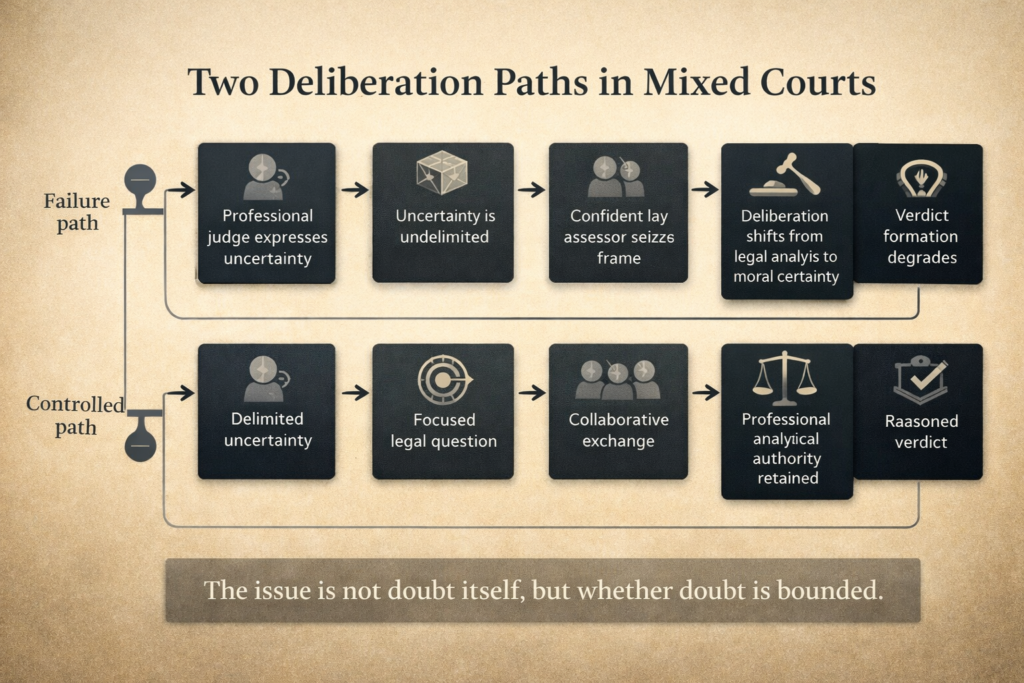
In one documented case — a domestic assault involving intoxication — the presiding judge expressed what the researchers term “undelimited uncertainty”: doubt not anchored to a specific legal question, radiating outward as general hesitation about the evidence. A lay judge who had displayed pre-formed confidence from the outset (no notes taken, arms folded throughout the trial) seized deliberative control. The deliberation shifted from evidentiary analysis to moral evaluation entirely detached from the applicable legal standard. The professional judge did not lose the argument. She lost the frame.
The contrast case matters. In a separate assault prosecution, the presiding judge expressed “delimited uncertainty” — doubt focused on a discrete legal question (whether the evidence met the threshold for a specific intent element). That bounded expression produced exactly the collaborative exchange mixed panels are designed to generate: lay judges contributed factual perspectives, the presiding judge retained analytical authority, and the panel reached a reasoned verdict.
Undelimited uncertainty triggers status degradation. Delimited uncertainty enables productive collaboration. No current judicial training programme or court protocol makes this distinction explicit.
Why This Is Not a Training Problem
The instinctive institutional response to deliberation failures is retraining. If judges lose control of deliberations, the assumed remedy is better communication skills. Bergman Blix’s earlier theoretical work (2022) demonstrates why that framing misdiagnoses the problem.
Professional judges enter mixed panels carrying what Bergman Blix describes as “constrained generalised trust” toward lay assessors — formally obligated to treat them as equals, while privately sceptical of their competence. This structural ambivalence is not a personality defect. It is a rational response to institutional design: the judge knows the assessors have no legal training, yet the rules require treating their input as equivalent.
Uncertainty expression becomes structurally dangerous. Revealing doubt risks confirming lay judges’ latent suspicion that the presiding judge is unsure — which, in the Swedish ethnographic data, triggers exactly the status inversion that degrades verdict quality. Training judges to “communicate uncertainty better” does not resolve this. It sharpens the vulnerability. The more openly a judge expresses doubt in an architecture that rewards confidence, the more exposed she becomes to displacement.
The German and French Evidence: Passivity as the Mirror Failure
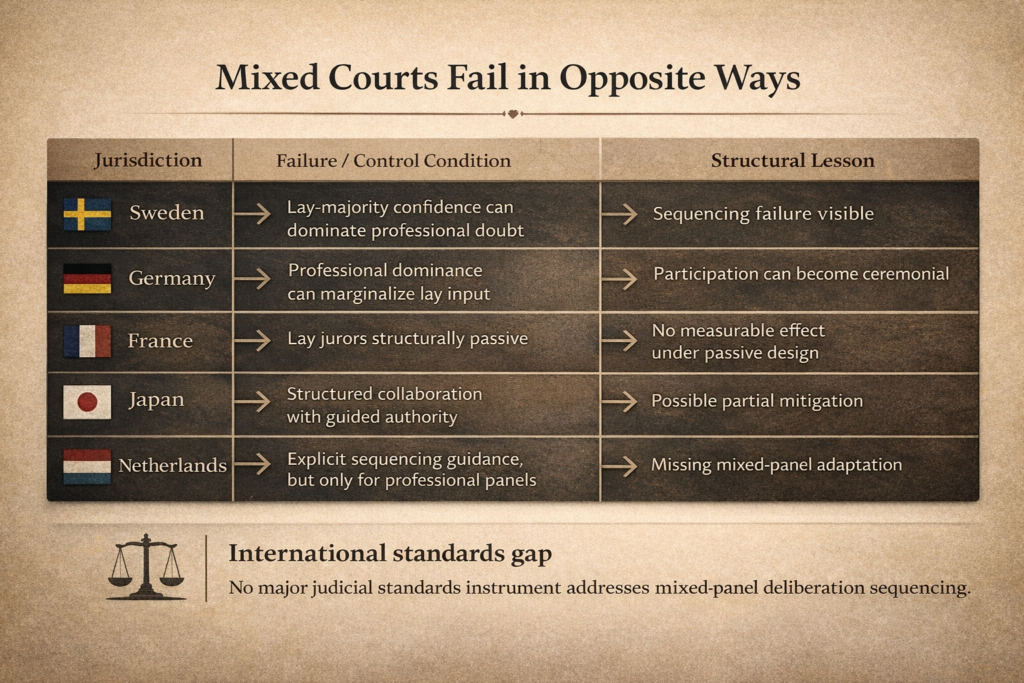
The Swedish evidence documents the active failure mode — lay certainty overriding professional doubt. German and French evidence documents the passive counterpart: lay judges so marginalised by professional dominance that their participation becomes ceremonial.
Machura’s survey of German Schöffen courts (2011), drawing on questionnaire data from approximately 469 lay assessors across Bochum and Frankfurt, found that professional judges in high-caseload courts routinely bypassed lay participation — compressing hearing and deliberation time, reaching agreements with parties without consulting assessors. Lay judges’ deliberation behaviour was heavily mediated by power-distance orientation: those who believe authority figures should not be questioned participated least. The legitimacy-generating function that justifies the system — informing the wider community about judicial reasoning — largely fails. Most Schöffen do not communicate their experience to others.
Rennig’s 1993 analysis of Schöffen deliberation dynamics records an asymmetric persuasion pattern: a lay assessor in the minority is readily persuaded by the majority, while a professional judge in the minority retains capacity to persuade lay assessors. Formally equal. Epistemically asymmetric.
Philippe’s quasi-experimental study of French courts (2017) provides the strongest causal evidence in this evidence base, though it points in a different direction. A 2011 law introduced two lay jurors into courts of three professional judges for specific offence categories in two appellate jurisdictions. The study analysed approximately 597,000 individual case observations using difference-in-differences and triple-difference regressions. No detectable change in conviction rates, imprisonment probability, sentence length, or sentence dispersion. The official evaluation report recorded that the jurors deferred entirely to professional judges.
This null result does not refute the cascade hypothesis. It documents the opposite failure condition. The French jurors were numerically outweighed (two against three professionals), did not receive investigation files in advance, and did not lead deliberation. They were structurally positioned for passivity. The Swedish evidence, where lay judges hold majority voting weight at the district court level, shows what happens when those structural conditions reverse.
The Group Dynamics Literature: Why Mixed Panels Are Vulnerable
The deliberation failures documented in Sweden and Germany are not unique to judicial settings. Sunstein’s synthesis of the group polarisation literature (2004) identifies three mechanisms that operate in any deliberating body, including judicial panels:
- Informational cascades: Early, confident speakers establish a dominant framing. Later speakers defer to apparent certainty rather than contributing independent analysis. In mixed panels, lay judges who arrive with confident pre-formed positions function as early anchors.
- Reputational cascades: Members suppress dissenting views to avoid disapproval. Professional judges constrained by norms of collegiality and respect for democratic participation are structurally positioned to absorb rather than challenge lay confidence.
- Group polarisation: Deliberating groups end in positions more extreme than the pre-deliberation individual mean. Where lay judges’ pre-deliberation positions are more punitive or morally charged than the legal standard warrants, polarisation amplifies that divergence.
Sunstein acknowledges that some deliberating groups outperform individual decision-makers — but only under specific structural conditions: genuinely diverse composition, explicit counter-argument protocols, and active surfacing of unshared information. These are design features. They demand architectural intervention, not exhortation.
The Counterevidence: Democratic Legitimacy and Net Positive Outcomes
The structural critique must be weighed against the institutional benefits. Marder’s 2024 comparative review in the Annual Review of Law and Social Sciences concludes that lay participation strengthens fact-finding through community knowledge exchange, increases the perceived legitimacy of outcomes, and promotes democratic governance. Mixed courts have the capacity to test interpretations of evidence through perspectives that professional judges alone cannot access.
This is not a minor consideration. Judicial systems without democratic participation mechanisms face different legitimacy risks — insularity, detachment from community norms, the appearance of technocratic self-governance. The question is not whether lay participation has value. It does. The question is whether that value can be preserved while addressing the specific failure mode the Swedish ethnographic evidence documents.
Japan’s saiban-in system offers a partial model. Since 2009, panels of three professional judges and six lay judges have adjudicated serious criminal cases. Research on the system’s first fifteen years documents sustained public legitimacy and instances of genuine collaborative decision-making. The design is instructive: professional judges lead evidence framing, deliberation is structured, and the lay majority is by number but not by institutional authority. Whether this architectural compromise successfully interrupts the epistemic cascade documented in Swedish courts remains empirically unresolved — direct deliberation process data from saiban-in proceedings is limited in the English-language literature.
The Missing Protocol: Deliberation Sequencing as Institutional Design
Only one jurisdiction in the evidence base has produced explicit guidance addressing the epistemic hierarchy problem in panel deliberations. The Netherlands Council for the Judiciary’s Professional Standards for three-judge decision-making directly identifies the “production block” effect — when one member speaks, others’ independent reasoning is suppressed — and prescribes a response: the presiding judge speaks last, less experienced members speak first, and a devil’s advocate role is explicitly recommended.
This protocol applies to professional-only panels. It does not address mixed professional-lay interaction. But the underlying principle — that who speaks when determines the quality of collective reasoning — is exactly what the Swedish evidence demonstrates for mixed courts.
No equivalent protocol exists anywhere for mixed professional-lay panels. The Bangalore Principles address individual judicial conduct — impartiality, integrity, competence — not the collective epistemic dynamics of panel deliberation. The UN Basic Principles on the Independence of the Judiciary address structural independence, not deliberation architecture. European judicial council guidance addresses lay assessor selection, training, and terms of service. None of it addresses the sequencing of uncertainty expression that determines whether lay participation improves or degrades deliberative quality.
Implications for Institutional Design
The evidence points toward specific architectural intervention, not a general recommendation for “better deliberation.”
Deliberation protocols in mixed courts should formally distinguish between delimited and undelimited uncertainty expression. The Swedish evidence demonstrates that the form of judicial doubt — not its presence — determines whether deliberation cascades. Professional judges need structural permission to express bounded uncertainty without risking status degradation.
Sequencing protocols that require professional judges to speak after lay assessors on factual matters — and before them on legal standards — would interrupt the confidence cascade at its activation point. The Netherlands protocol demonstrates this is institutionally feasible for professional panels. Extending it to mixed panels requires no new theory. Only adaptation.
The passive failure mode documented in Germany and France — lay judges who participate ceremonially — deserves equal institutional attention. Deliberation architectures that produce either active displacement or passive marginalisation are failing the same design test from opposite directions.
The gap in outcome data is itself an institutional failure. No jurisdiction has linked specific deliberation process dynamics to measurable verdict quality metrics — appeal rates, reversal rates, sentence consistency. Until that evidence exists, the cascade mechanism is documented at the process level but not confirmed at the outcome level. Judicial councils designing deliberation reforms should build evaluation into the protocol from inception.
The democratic legitimacy of lay participation is not in question. What is in question is whether judicial institutions can design deliberation architectures that extract the democratic benefits of lay participation while structurally interrupting the epistemic cascades that degrade professional judicial reasoning. The evidence says the problem is architectural. The remedy should be too.
About VeritasJPS
VeritasJPS provides evidence-based research and advisory at the intersection of jurisprudence, behavioural science, and institutional governance. Our work supports institutional decision-makers — judges, policymakers, and compliance leaders — with rigorous analysis grounded in empirical evidence and legal scholarship.
Cite This Analysis
Shah, S. W. A. (2026). When Lay Certainty Overrides Judicial Doubt: The Structural Failure of Mixed Court Deliberation. VERITAS Jurisprudence & Psychological Science. Published 22 January 2026. https://veritasjps.com/research-analysis/lay-certainty-mixed-court-deliberation-failure-to-lay-judge-deliberation-mixed-courts/Published 22 January 2026 · Updated 17 March 2026
VeritasJPS — Law, Policy & Behavioral Research
Browse All Research & Analysis →Related Research

Automation Bias in AI Human Oversight Under the EU AI Act
Quick Answer: Automation bias is the cognitive mechanism Article 14 of the EU AI Act names but does not functionally regulate. The Act requires awareness of over-reliance, yet it does not mandate behavioral countermeasures such as cognitive forcing, override protocols, or audit trails for judicial AI oversight. Abstract The EU AI Act is the first […]

Optimism Bias and the Enforcement Communication Gap: Why Regulated Entities Discount Compliance Risk
Optimism bias in compliance risk helps explain why regulated entities discount enforcement exposure. This article analyses asymmetric belief updating, omission neglect, and the communication design gap that leaves paper-compliance structurally intact.

Physical Infrastructure Failure as Structural Denial of Access to Justice for Persons with Disabilities
Court accessibility under CRPD remains largely unverifiable because states acknowledge the right, document physical barriers, and still avoid independent audit of justice facilities, police stations, and detention sites.