When Judicial Reform Mandates Die at Implementation: Structural Friction in Self-Governance Bodies
Dr. Wasif Ali Shah
PhD Psychology · Barrister · Former Judge

Abstract
Judicial reform mandates are routinely issued — and routinely fail at implementation. South Africa’s 2023 Judges’ Conference directed a complete overhaul of the judicial misconduct system. By January 2026, no implementation document had been released. This is not an isolated failure. The Parker misconduct complaint ran nearly six years from filing to determination. The Maumela Tribunal entered its fourth year without producing findings — against a three-month statutory reporting deadline. This analysis examines the structural friction inside judicial self-governance bodies that converts judicial reform mandates into multi-year inaction, drawing on South African, Kenyan, and English institutional evidence alongside the Bangalore Principles framework. The central design defect is identifiable: reform mandates issued without mandatory implementation timelines, public accountability triggers, or external monitoring are structurally indistinguishable from aspirational statements. The question is whether judicial governance architecture should treat them differently.
The South African Record: From Mandate to Silence
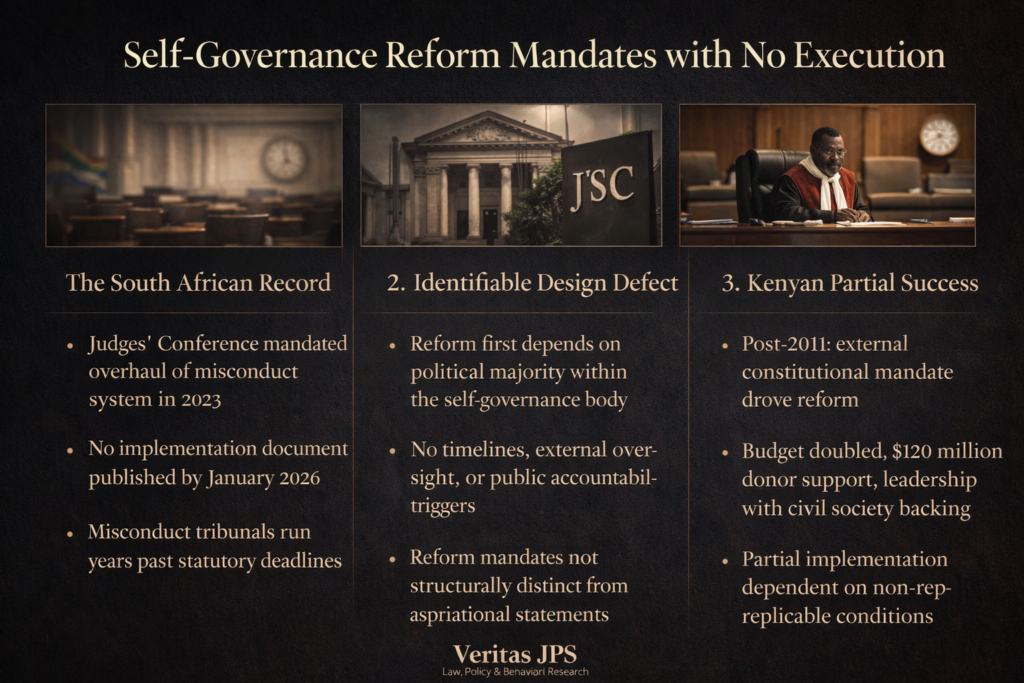
In 2023, the Judges’ Conference — the judiciary’s own deliberative forum — mandated an overhaul of the misconduct system. Chief Justice Maya confirmed that a Code of Judicial Conduct review was underway. By January 2026, as documented by [EXT-LINK: Judges Matter’s institutional review → institutional review], nothing had been made public. No draft code. No implementation timeline. No progress report. A mandate generated by the judiciary’s own conference, directed at its own governance infrastructure, had produced zero public output in over a year.
The same architecture produced the Parker Tribunal timeline: a complaint filed in March 2020 that reached a JSC gross misconduct determination only in [EXT-LINK: January 2026 → institutional case report]. Nearly six years. The Maumela Tribunal, documented in [EXT-LINK: Judges Matter’s December 2025 review → institutional review], entered its fourth year with hearings still subject to rolling postponements. The statutory deadline for a tribunal finding is three months. Maumela exceeded that by a factor of twelve.
These are not delays in the ordinary sense. They are the predictable output of a governance architecture that assigns reform responsibility to the bodies that benefit from the status quo, imposes no enforceable timelines, and provides no external trigger when mandates stall.
The Structural Design Defect
The Helen Suzman Foundation’s [EXT-LINK: analysis of JSC composition → policy report] identifies the architecture that enables this. The JSC has up to fifteen members from political spheres against eight from non-political backgrounds — judiciary, legal profession, academia. No code of conduct governs commissioner behaviour during interviews or deliberations. The JSC does not meet its own annual reporting obligations. Eleven reform proposals catalogued in the HSF report share a single structural feature: none require binding timelines or external enforcement. All depend on JSC self-implementation.
This is not a South African peculiarity. It is a design feature of judicial self-governance wherever the Bangalore Principles model operates.
The [EXT-LINK: Bangalore Principles of Judicial Conduct (2002) → international standard] — the nearest thing to a universal normative framework for judicial accountability — establish that the judiciary should assume an active role in strengthening judicial integrity by effecting systemic reforms within its competence. The [EXT-LINK: Commentary → interpretive guidance] confirms: judges are accountable to appropriate institutions established to maintain judicial standards.
The defect is embedded in the accountability architecture itself. The Principles presuppose that judges will design, constitute, and operate their own accountability institutions. They contain no mechanism for external intervention when those institutions fail to act on their own mandates. The framework is self-referential. When the self-governance body does not implement its own reform mandate, the Principles provide no consequence, no escalation path, no trigger for external review.
That gap between normative obligation and enforcement architecture is not a bug in the Bangalore framework. It is the framework.
Comparative Evidence: Kenya’s Partial Reform and Its Conditions
Kenya’s post-2010 judicial overhaul offers the most instructive comparison — not because it succeeded, but because the conditions under which it partially succeeded are absent from most self-governance contexts.
Maya Gainer’s [EXT-LINK: Princeton ISS case study (2015) → case study] documents that by 2010, Kenya had accumulated thirteen separate prior reports on judicial reform. None implemented. The explanation was structural: no political will at leadership level, and an institutional culture characterised by unaccountability, distance, hierarchy, opacity — sometimes driven by a self-serving invocation of the principle of independence.
Post-2011, partial implementation occurred under a specific combination: an external constitutional mandate; a reform-credentialled Chief Justice (Willy Mutunga) with civil society legitimacy; a judiciary budget that doubled from KSh 3.9 billion to KSh 7.5 billion in a single year; $120 million in World Bank support; thirty-eight nationwide workshops designed to build bottom-up ownership.
Even then, implementation was incomplete. ICT reforms mandated from the centre failed where internal buy-in was absent. The principal-agent problem persisted — central leadership lacked reliable information about what judicial officers around the country were doing. Many reforms remained in early stages four years in. No post-2015 data tracks whether gains survived Mutunga’s departure.
Two conclusions follow. Voluntary reform implementation can work — under conditions that include external constitutional mandate, dedicated leadership, doubled budget, and substantial donor support. Those conditions are not replicable by institutional design alone. Where they are absent — as in South Africa’s JSC misconduct reform — the default outcome is the one structural friction predicts: indefinite deferral.
The HMCTS Counter-Case: External Audit Without Enforcement
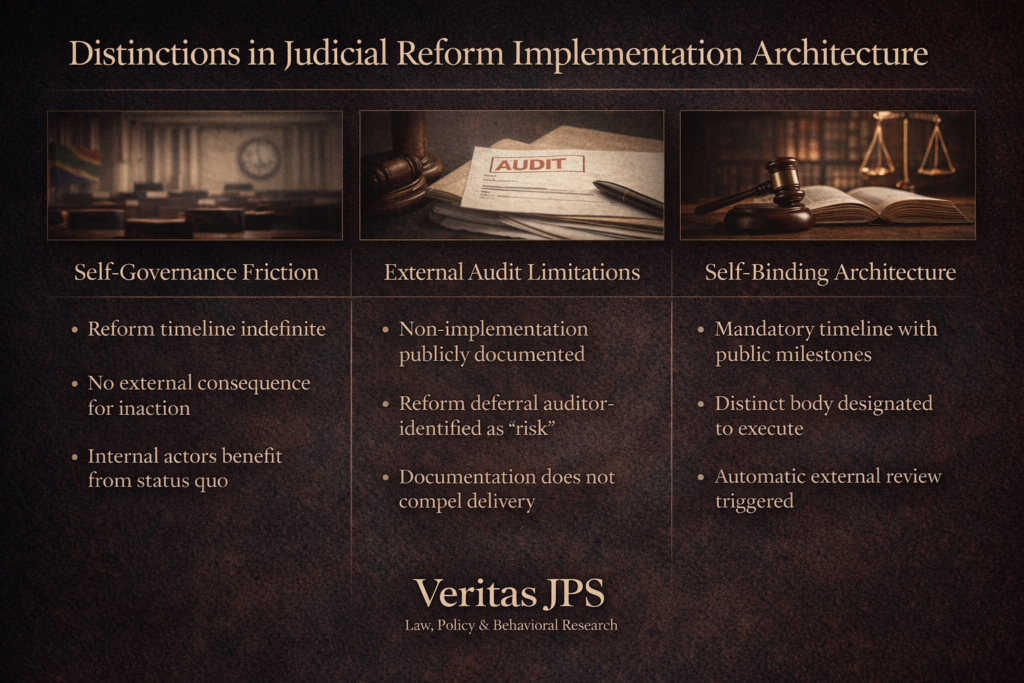
England and Wales offer a different lesson. The HMCTS court and tribunals reform programme — £1.3 billion, multi-year — was subject to independent public audit by the [EXT-LINK: National Audit Office → public audit report]. The 2023 report found that after seven years, HMCTS had completed fifty-five percent of reform projects. The 2018 audit had already identified successful delivery as a significant risk. Four years passed between those two findings.
The HMCTS case involves operational-technical reform, not judicial conduct governance. The relevance is structural: even with external audit monitoring, programme targets were repeatedly revised without enforcement consequence. The NAO could identify underperformance. It could not compel delivery. Scope reductions and timeline extensions proceeded with no binding accountability trigger at intermediate milestones.
External monitoring without enforceable consequence functions as documentation, not accountability. Publishing a reform mandate creates a record. Publishing an audit of non-implementation creates a better record. Neither creates a mechanism for compelling action.
The Counterevidence: When Timelines Become Instruments of Capture
The strongest argument against mandatory implementation timelines comes from Mexico. López Nachón’s [EXT-LINK: analysis in the Yale Journal of International Law (2025) → legal analysis] documents the 2024 constitutional judicial reform — passed in record time without deliberation by state legislatures. Popular election of judges, terms synchronised to presidential electoral cycles.
Speed-forcing in judicial reform, when controlled by an executive branch with consolidation objectives, becomes an instrument of authoritarian capture. The absence of deliberation — the condition mandatory timelines could create if politically weaponised — is the mechanism by which reform quality deteriorates and institutional legitimacy erodes.
That is the legitimate constraint on the mandatory timeline thesis. Timelines imposed from outside the judiciary risk the pathology Mexico demonstrates. The [EXT-LINK: American Progress analysis (2024) → policy analysis] adds a secondary qualification: where the only enforcement mechanism is congressional impeachment — a politically prohibitive threshold — mandatory commitments without functional enforcement create compliance theatre.
These cases qualify the proposal but do not defeat it. Mexico involves externally imposed reform by an executive branch. South Africa’s problem is the reverse: a self-governance body failing to implement its own mandate. The design variable is who controls the timeline and whether deliberation is preserved. Self-binding timelines — where the governance body commits itself to deadlines with public reporting obligations — sit in a different category from externally imposed political compression.
The Unaddressed Design Variable: Self-Binding Implementation Architecture
The evidence across jurisdictions converges. Judicial reform mandates issued without implementation architecture are structurally inert. South Africa documents this. Kenya shows the conditions under which it can be partially overcome. HMCTS shows that monitoring without enforcement is insufficient. Mexico shows that externally imposed speed-forcing creates its own pathologies.
What no jurisdiction has systematically tested is self-binding implementation architecture: a model in which the governance body that issues a reform mandate simultaneously commits to a public implementation timeline, designates a responsible implementation body distinct from the deliberative body, establishes intermediate milestones with public reporting obligations, and triggers automatic external review — not intervention — when milestones are missed.
This model preserves judicial independence. The governance body sets its own timeline and milestones. It eliminates the structural permission for indefinite deferral — public reporting and automatic external review create reputational and institutional cost for non-implementation. It is distinct from both the Mexico model (externally imposed, no deliberation) and the current Bangalore model (normatively aspirational, no enforcement).
The [EXT-LINK: Oslo Law Review analysis (2023) → legal scholarship] identifies one reason this model is underexplored: legal frameworks governing judicial accountability focus almost exclusively on institutional independence, structurally underaddressing individual and internal dimensions. Reform mandates that presuppose individual-level compliance — a code of conduct requiring each judge to act in specified ways — cannot be enforced through institutional accountability frameworks alone. Self-binding implementation architecture would need to operate at both levels.
Institutional Implications
Five conclusions for institutional decision-makers.
Judicial reform mandates issued without implementation timelines, designated implementation bodies, and public reporting obligations are structurally equivalent to aspirational statements. The South African record from 2023 to 2026 documents this with precision.
The Bangalore Principles framework contains a design-level gap. It establishes the normative obligation for self-governance bodies to implement reform but provides no architecture for accountability when they do not. The gap is inherent to the self-referential accountability model.
External audit without enforcement authority — the HMCTS model — documents non-implementation but does not remedy it. Monitoring creates transparency. Only enforceable timelines create accountability.
Mandatory timelines imposed by external political actors — the Mexico model — risk authoritarian capture and deliberation collapse. The design challenge is self-binding architecture, not externally imposed deadlines.
Kenya’s partial success under specific non-replicable conditions demonstrates that voluntary implementation can work but cannot be relied upon as a structural default.
The structural question is not whether judicial reform mandates should have implementation timelines. The evidence that undated mandates produce indefinite deferral is consistent across jurisdictions. The question is whether judicial governance bodies will adopt self-binding implementation architecture voluntarily — or whether the structural friction documented here will continue to convert conference-level reform mandates into multi-year inaction.
About VeritasJPS
VeritasJPS provides evidence-based research and advisory at the intersection of judicial governance, policy design, and institutional accountability. Our work supports institutional decision-makers — judges, policymakers, and compliance leaders — with rigorous analysis grounded in empirical evidence and legal scholarship.
Cite This Analysis
Shah, S. W. A. (2026). When Judicial Reform Mandates Die at Implementation: Structural Friction in Self-Governance Bodies. VERITAS Jurisprudence & Psychological Science. Published 12 February 2026. https://veritasjps.com/research-analysis/judicial-reform-mandates-implementation/Published 12 February 2026 · Updated 18 March 2026
VeritasJPS — Law, Policy & Behavioral Research
Browse All Research & Analysis →Related Research

Automation Bias in AI Human Oversight Under the EU AI Act
Quick Answer: Automation bias is the cognitive mechanism Article 14 of the EU AI Act names but does not functionally regulate. The Act requires awareness of over-reliance, yet it does not mandate behavioral countermeasures such as cognitive forcing, override protocols, or audit trails for judicial AI oversight. Abstract The EU AI Act is the first […]

Optimism Bias and the Enforcement Communication Gap: Why Regulated Entities Discount Compliance Risk
Optimism bias in compliance risk helps explain why regulated entities discount enforcement exposure. This article analyses asymmetric belief updating, omission neglect, and the communication design gap that leaves paper-compliance structurally intact.

Physical Infrastructure Failure as Structural Denial of Access to Justice for Persons with Disabilities
Court accessibility under CRPD remains largely unverifiable because states acknowledge the right, document physical barriers, and still avoid independent audit of justice facilities, police stations, and detention sites.