
Abstract
Constitutional amendment — not military coup, not executive decree — has become a dominant contemporary instrument for dismantling judicial independence across democracies with weak insulation mechanisms. Pakistan’s 26th Constitutional Amendment (2024) and 27th Constitutional Amendment (2025) represent the most structurally complete recent execution of this pattern, transferring apex court jurisdiction to an executive-appointed Federal Constitutional Court. Parallel trajectories in Hungary, Poland, and Indonesia confirm a replicable escalation sequence: appointment capture, composition shift, jurisdictional transfer. The UN Basic Principles on the Independence of the Judiciary (1985) and the Bangalore Principles of Judicial Conduct (2002) — the two primary international instruments governing judicial independence — were designed to protect individual judges, not court architectures. They contain no provisions addressing structural court bifurcation, minimum procedural thresholds for constitutional amendments restructuring courts, or jurisdictional transfer as a delegitimization vector. This gap leaves constitutional redesign as a fully documented but underregulated pathway to institutional collapse.
The Pattern: Amendment as an Insulation-Bypassing Tool
The conventional account of judicial independence threats centres on dramatic ruptures — military coups, emergency decrees, the outright abolition of courts. That account is outdated. The dominant mechanism now operates inside constitutional frameworks, exploiting the ordinary amendment process to reconstruct courts in ways that strip the institutional preconditions for independence before any individual judge is touched.
The logic is structural, not personal. Four mechanisms should be distinguished at the outset. Court-packing changes who decides by altering appointments or bench composition. Jurisdiction-stripping changes what an existing court is allowed to decide by removing categories of cases from its reach. Court bifurcation creates a parallel judicial body and reallocates core constitutional functions to it. Apex replacement is the terminal form of the sequence: the formal supreme court remains, but a newly created body becomes the effective final constitutional authority. These mechanisms can occur separately, but in contemporary democratic backsliding they often appear sequentially.
Court-packing through appointment control shifts the composition of a bench. Court bifurcation goes further: it manufactures an entirely new apex body, transfers constitutional jurisdiction to it, and subordinates the original court — all through amendments that satisfy formal procedural requirements. The existing court retains its name but loses its function. The legitimacy question shifts from “Did the court decide correctly?” to “Does the court still exist in any meaningful operational sense?”
Across jurisdictions, the pattern holds, though not in identical doctrinal form. What is shared is not institutional identity but structural logic: formal legal redesign used to neutralize courts without formally abolishing them. V-Dem data across Hungary and Poland documents measurable judicial independence erosion following amendment-based restructuring. Indonesia’s Constitutional Court has faced parallel regression through formal instruments, as documented in a 2024 three-country comparison examining court-packing across post-democratic-transition systems. The sequence is consistent: appointment control leads to composition capture, which enables jurisdictional subordination.
Pakistan: The 26th Amendment (2024)
Pakistan’s 26th Constitutional Amendment, passed on October 20–21, 2024, overhauled the judicial appointment and tenure architecture of the Supreme Court through ordinary parliamentary majority. Three changes matter.
First, the Chief Justice of Pakistan is no longer the most senior judge by automatic succession. A Special Parliamentary Committee — eight members from the National Assembly, four from the Senate — now nominates the CJP from the three most senior judges. The government commands a built-in majority on that committee.
Second, the Judicial Commission of Pakistan was recomposed. Political members — the law minister, attorney general, and parliamentary nominees — now outnumber judicial members on appointment decisions.
Third, a Constitutional Bench was created within the Supreme Court, carrying exclusive suo motu and advisory jurisdiction. A court within a court, with its own presiding judge nominated by the reconstituted JCP. The bench exercises the most constitutionally sensitive work — the kind that tests executive power — under an appointment architecture in which the executive holds the deciding vote.
The International Commission of Jurists assessed this as a blow to judicial independence, citing the UN Basic Principles requirement that appointing bodies remain independent of executive control.
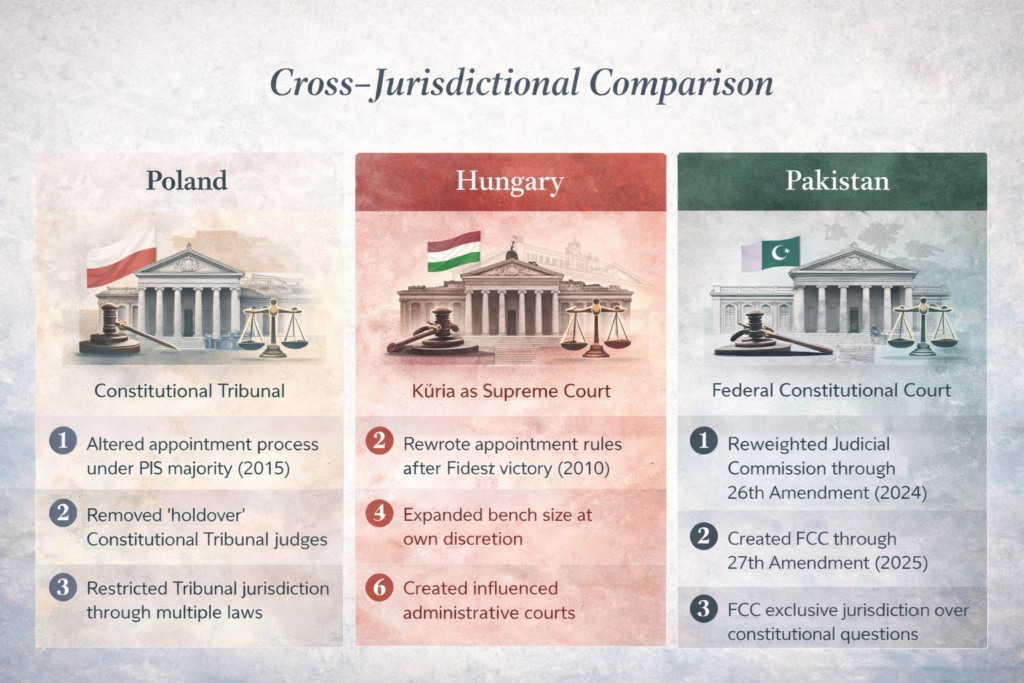
Pakistan: The 27th Amendment (2025) — Court Bifurcation as the Endgame
The 27th Constitutional Amendment, passed in November 2025, completed what the 26th began. Where the 26th captured appointments, the 27th captured jurisdiction.
The amendment established a Federal Constitutional Court as a new apex body with exclusive authority over constitutional interpretation, federal-provincial disputes, fundamental rights enforcement, and any substantial question of law involving constitutional interpretation. FCC judgments bind all courts, including the Supreme Court. The Supreme Court was reduced to a non-constitutional appellate body — retaining its name, losing its constitutional role.
The appointment mechanism for the FCC’s inaugural bench was stripped bare. The first Chief Justice and first batch of judges are appointed by the President on the advice of the Prime Minister. No selection criteria. No transparency requirement. No judicial-body consent. Subsequent appointments run through the JCP and Special Parliamentary Committee — the same bodies already captured by the 26th Amendment, in which judicial members hold a 5-of-13 minority.
The circularity is documented and deliberate. The 27th Amendment designates the FCC itself as the forum for challenges to its own constitutionality. Court officials refused to accept petitions contesting the amendment. A body created by executive appointment adjudicates challenges to its own creation — a design that forecloses external review by definition.
Additional provisions reinforced the shift. High Court judges can be forcibly transferred without consent; refusal within 30 days triggers disciplinary proceedings and a bar from judicial functions. Lifetime criminal immunity was extended to the President and to the holder of the Field Marshal rank — currently the Chief of Army Staff.
The ICJ’s Secretary-General described the 27th Amendment as “dismantling justice” and “a full-frontal assault on the rule of law,” invoking UN Basic Principles 10, 12, 14, 18, and 19: the requirement that appointing bodies be independent, that objective criteria govern selection, and that removal occur only for serious misconduct through appropriate procedure.
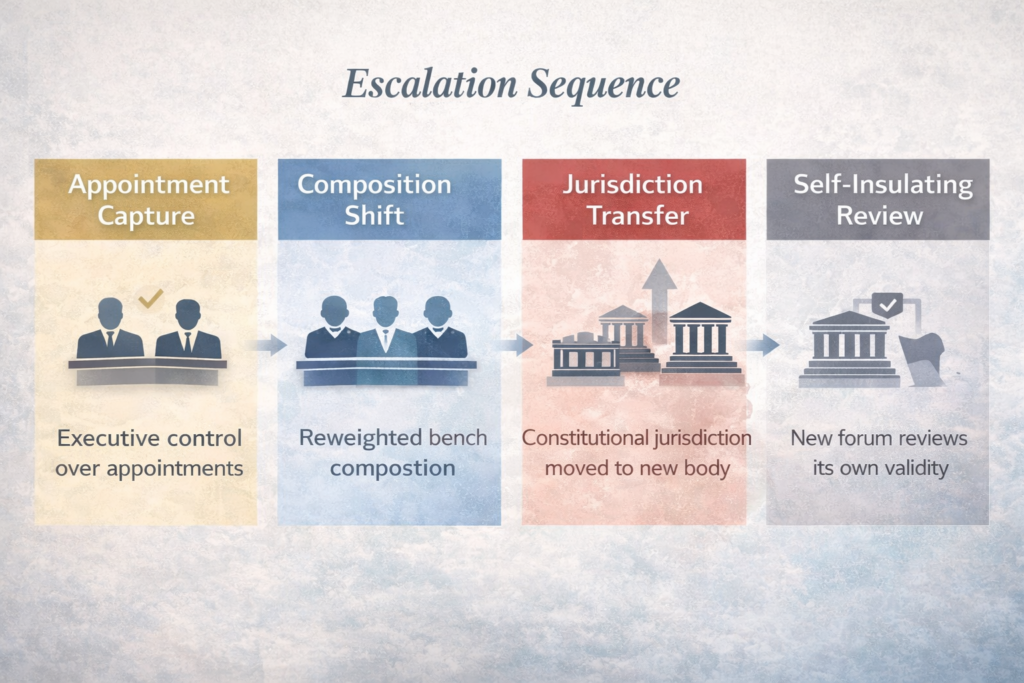
The Escalation Sequence: Replicable Preconditions Across Jurisdictions
Pakistan’s 26th-to-27th trajectory is not improvised. It mirrors a documented escalation observable across jurisdictions.
Stage 1 — Appointment capture. The executive gains effective control over who sits on the bench. In Hungary, Fidesz’s constitutional supermajority restructured the nomination process after 2010. In Poland, PiS used its parliamentary majority to alter the composition of the Constitutional Tribunal from 2015. In Pakistan, the 26th Amendment achieved this through JCP recomposition and the Special Parliamentary Committee.
Stage 2 — Jurisdictional transfer. Once composition is controlled, jurisdiction gets redirected. Pakistan’s Constitutional Bench (26th Amendment) and then the FCC (27th Amendment) are the clearest recent examples — but the pattern echoes Hungary’s creation of the Kúria as the new supreme court body and the subsequent establishment of administrative courts designed to handle politically sensitive cases.
Stage 3 — Structural insulation of the new architecture. The reformed body is made self-referential: challenges to its constitutionality route through itself. Pakistan’s 27th Amendment is the most explicit contemporary example, but the principle holds wherever the new court controls the forum for reviewing its own validity.
A synthetic control study of Hungary and Poland published in the Journal of European Public Policy found a counterintuitive result: Hungary’s formal constitutional redesign — conducted through a supermajority — eroded judicial independence more severely than Poland’s explicit court-packing through simple majority. Hungary’s V-Dem rule-of-law index dropped from 0.89 to 0.71; Poland’s from 0.96 to 0.83 over the 2009–2019 window. Formal process did not legitimize the change. It may have insulated it from challenge. Citation reflects reported judicial practice. Verify with primary case law databases for specific authority.
What Enables the Pattern: Bilateral Preconditions
The structural-attack narrative — governments dismantling independent courts — is incomplete. Kureshi (2025), writing in Government and Opposition, identifies a bilateral precondition: judiciaries that adopt what he terms a “representation-replacement approach” — treating themselves as more representative than elected institutions — create the political conditions for structural dismantling. When courts appropriate executive and legislative functions, they hand populist governments rhetorical cover for counter-restructuring.
This does not excuse constitutional capture. It exposes a second vulnerability: the pattern is not solely about executive overreach but also about institutional overextension by courts themselves. Pakistan’s Supreme Court had, in the decades preceding the 26th Amendment, expanded its reach into territory conventionally occupied by elected branches — a trajectory that Pakistan’s legislative actors subsequently cited as justification for rewriting the rules.
Separately, Aydin-Cakir and Akarçay (2025) document in the International Review of Law and Economics that verbal government attacks on the judiciary intensify as political corruption rises, specifically in countries with independent media. The mechanism is exposure avoidance: governments go after courts when courts threaten to expose corruption. While this study addresses verbal confrontation rather than structural redesign, it identifies the upstream trigger — corruption-driven accountability avoidance — that precedes the escalation to constitutional amendment.
The Legitimacy Consequence: What the Evidence Measures
Gibson’s body of work on judicial legitimacy — the most extensive empirical programme on the subject — supplies the theoretical framework for understanding what constitutional redesign destroys. His 2024 analysis in Science Advances found that the U.S. Supreme Court’s post-Dobbs legitimacy impact may have been the largest documented blow to court legitimacy, with approval polarizing along partisan lines for the first time in decades. His 2025 follow-up in the Annals of the American Academy of Political and Social Science tracked whether those effects persisted — and found evidence they did.
The critical distinction is between decision-based erosion and structural erosion. Gibson’s work measures legitimacy shifts after controversial rulings — a court that exists and functions but decides unpopularly. Constitutional redesign operates on a different plane. It removes the institutional conditions for diffuse support before any individual ruling can be contested. When Pakistan’s 27th Amendment transferred constitutional jurisdiction to a body appointed by the Prime Minister, the question was no longer “Did the court get it right?” but “Is there a court capable of getting it right at all?”
Gibson’s own positivity theory — that courts enjoy deep reservoirs of goodwill and institutional loyalty is substantially resilient — provides a partial counterweight. But the theory was developed and tested in the U.S. context, where institutional legitimacy reserves run deep. Whether positivity theory holds in younger democracies with shallower reserves — Pakistan, Hungary, Indonesia — is empirically untested at the structural-redesign level.
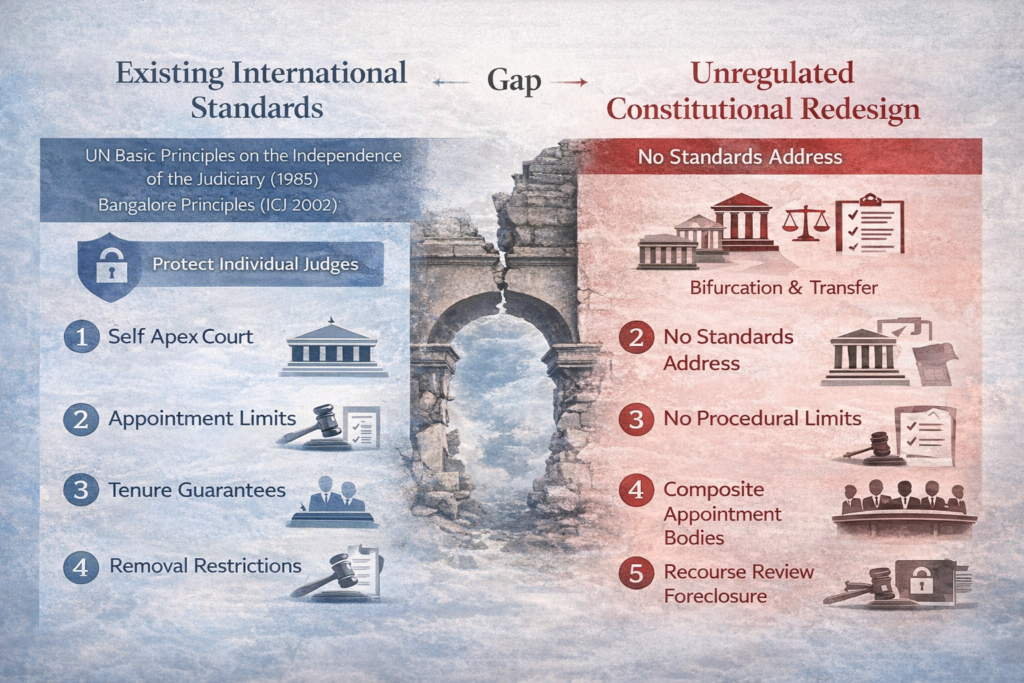
The International Standards Gap
The two primary international instruments governing judicial independence — the UN Basic Principles on the Independence of the Judiciary (1985) and the Bangalore Principles of Judicial Conduct (2002) — were designed for a different threat model.
The UN Basic Principles address what can be done to individual judges: Principle 10 governs appointment integrity, Principle 12 secures tenure, Principle 14 protects case assignment, Principle 18 restricts removal. The Bangalore Principles address how judges should conduct themselves: independence, impartiality, integrity, propriety, equality, competence.
Neither instrument addresses what can be done to courts as institutions. No provision governs structural court bifurcation — the creation of a parallel apex body that displaces an existing court’s jurisdiction. No minimum procedural threshold exists for constitutional amendments that restructure court systems: no requirement for a supermajority, a referendum, or judicial-body consent. No prohibition covers jurisdictional transfer as a mechanism for reducing a court’s scope without formally abolishing it. No standard addresses composite appointment bodies in which judges hold a permanent minority.
By invoking these instruments against Pakistan’s 27th Amendment, the ICJ exposes their limits. The ICJ can point to principles governing appointment criteria and judge-level conduct. It cannot point to any binding standard that prohibits what Pakistan did: creating a new court, transferring constitutional jurisdiction to it, and appointing its judges without institutional constraint. The instruments were written to protect judges. The threat has moved to court architectures.
Whether the insulation question — should judicial appointment frameworks be shielded from ordinary legislative amendment? — can be answered through international standard reform remains unclear. León (2024), writing in Global Constitutionalism, examines supermajority rules in judicial decision-making — but no retrieved study evaluates whether requiring supermajority or referendum approval for court-restructuring amendments produces measurably higher judicial independence or legitimacy scores. The design question is real. The evidence base for answering it does not yet exist.
What This Means for Institutional Decision-Makers
Five implications follow.
First, the threat model for judicial independence must expand beyond individual-judge protections. Court bifurcation — creating new bodies that absorb constitutional jurisdiction — is a distinct attack vector that existing international instruments do not cover.
Second, the escalation from appointment capture to jurisdictional transfer to self-referential insulation is a documented sequence, not a theoretical construct. Monitoring systems that fixate on appointment processes alone will miss the later stages until they are constitutionally entrenched.
Third, formal constitutional procedure does not legitimate structural dismantling. The Hungary-Poland comparison suggests that constitutional-supermajority redesign may produce deeper independence erosion than simple-majority court-packing — because it is harder to challenge and carries the procedural imprimatur of constitutional legitimacy.
Fourth, bilateral preconditions matter. Judicial overextension — courts appropriating executive or legislative functions — creates the political conditions for counter-restructuring. Institutional self-restraint is not weakness; it is structural defence.
Fifth, the absence of empirical measurement is itself a governance failure. No public-opinion instrument has been deployed to measure diffuse support for judicial institutions before and after constitutional court bifurcation in any of the affected jurisdictions. The legitimacy consequences of Pakistan’s amendments, Hungary’s Kúria restructuring, and Indonesia’s Constitutional Court regression are inferred from structural analysis and expert assessment — not from population-level data. That gap must close before evidence-based institutional design can proceed.
About VeritasJPS
VeritasJPS provides evidence-based research and advisory at the intersection of jurisprudence, behavioural science, and institutional governance. Our work supports institutional decision-makers — judges, policymakers, and compliance leaders — with rigorous analysis grounded in empirical evidence and legal scholarship.
Leave a Reply