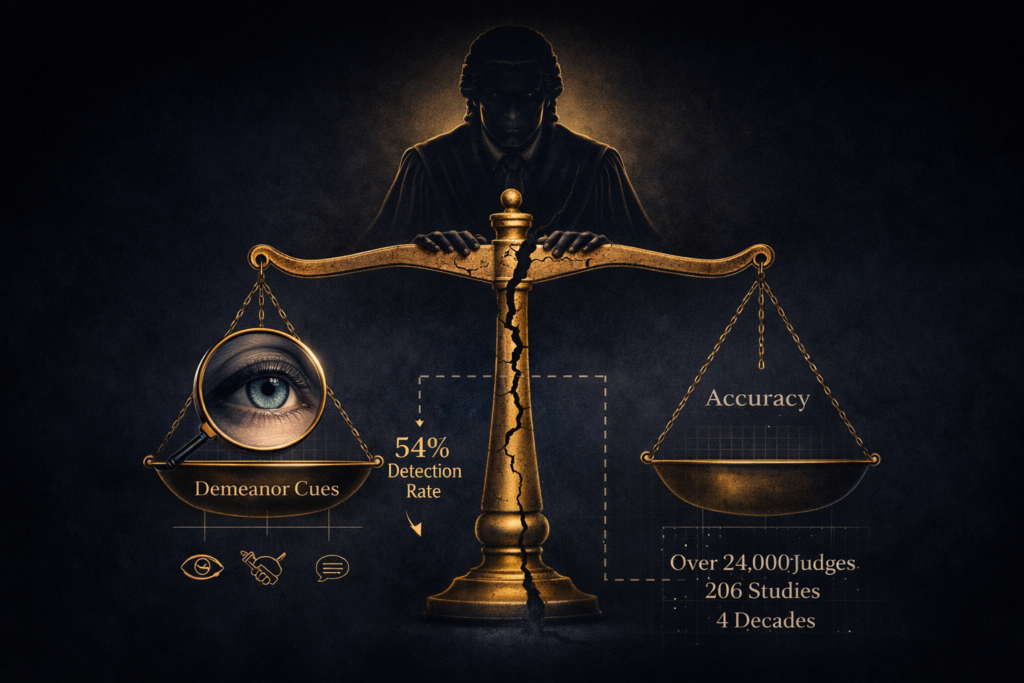
Abstract
Three decades of cognitive science establish that eyewitness confidence and identification accuracy are separate variables, that the specific mechanisms producing confident but inaccurate testimony are well-documented, and that jurors persistently treat confidence as a proxy for accuracy despite scientific consensus to the contrary. This analysis examines the eyewitness confidence-accuracy dissociation as the primary cognitive mechanism responsible for wrongful convictions based on mistaken identification, maps the procedural responses adopted across four jurisdictions — the United States (New Jersey and New York), England and Wales, Canada, and Australia — and argues that while partial reforms have addressed identification procedures and expert witness admissibility, no jurisdiction has implemented mandatory judicial instruction specifically targeting the confidence-accuracy dissociation as the cognitive variable most directly responsible for wrongful conviction risk. The gap between settled science and procedural design remains the central institutional failure in eyewitness evidence governance.
Memory Is Reconstructive, Not Reproductive
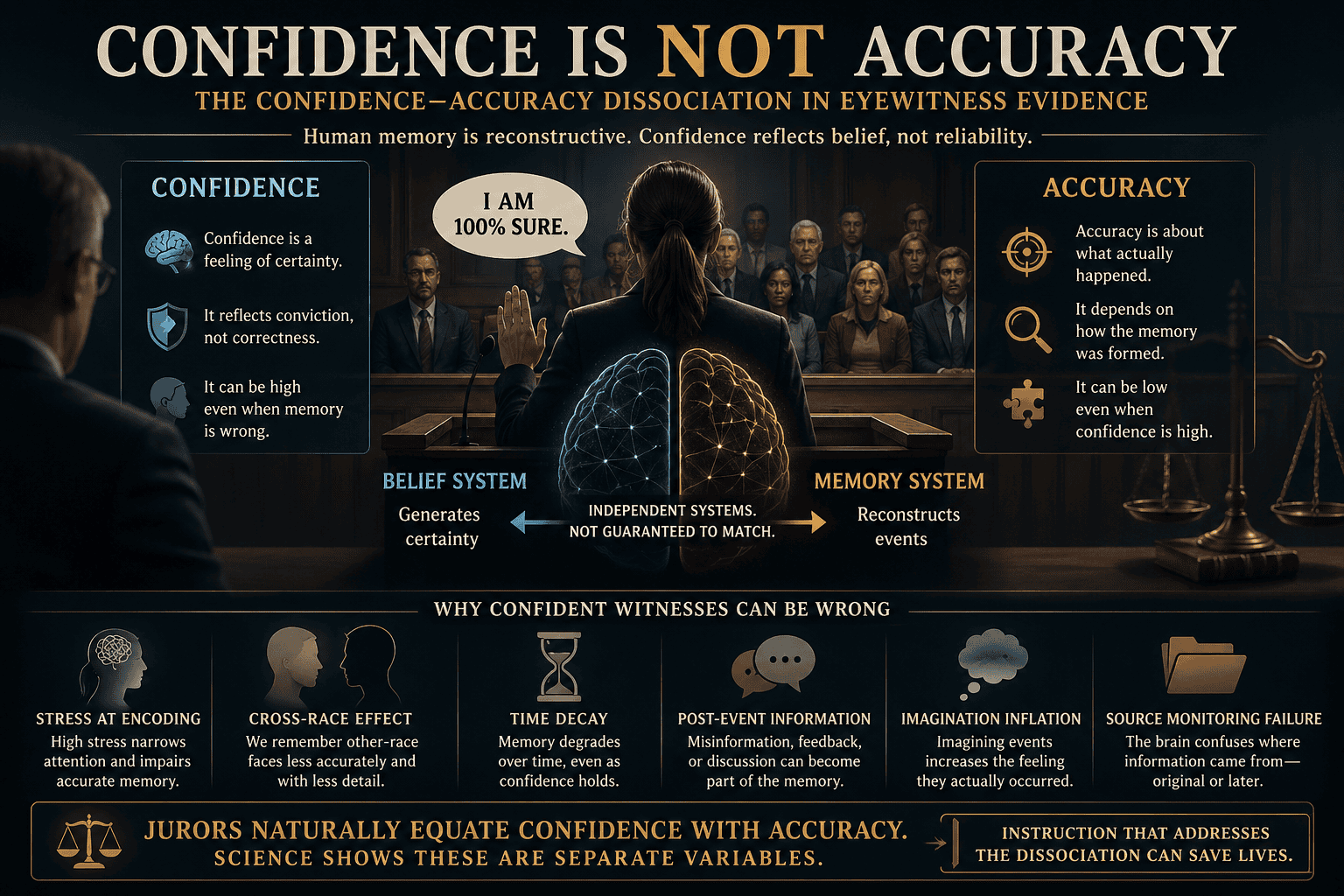
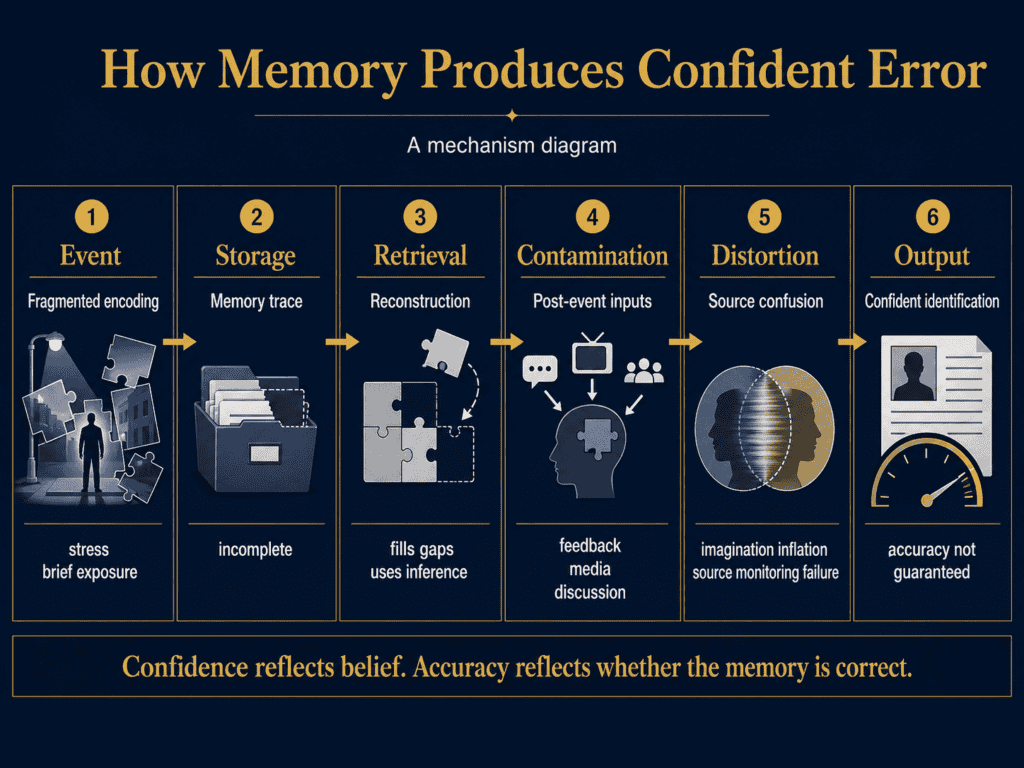
The foundation of the confidence-accuracy dissociation lies in a basic property of human memory that cognitive science established decades ago and that courtroom procedure has not yet absorbed: memory is reconstructive. The brain does not record events like a camera and play them back on demand. It encodes fragments — sensory impressions, spatial relationships, emotional states — and reassembles them at retrieval, filling gaps with inference, expectation, and post-event information.
This reconstruction process is not random. It is systematic and predictable. Source monitoring failure — the inability to distinguish between information acquired during the original event and information acquired afterwards — produces false memories that the witness genuinely believes are original perceptions. Imagination inflation compounds this: the act of imagining an event increases the subjective probability that the event occurred. Post-event misinformation — from media coverage, investigator feedback, co-witness discussion, or repeated questioning — integrates into the memory trace and becomes indistinguishable from the original encoding.
The neurological evidence is particularly consequential for courts. False memories activate the same neural pathways as true memories. A witness who is genuinely confident in a false identification is not lying. The brain has reconstructed a memory that feels, neurologically, identical to a true one. Cross-examination cannot reach this mechanism. A confident witness will present as credible under questioning precisely because the confidence is real, even when the identification is wrong.
The Confidence-Accuracy Relationship: What the Science Shows
The peer-reviewed literature on the confidence-accuracy relationship has reached a position that is both more nuanced and more consequential than popular summary suggests. Moore, Wise, and Lampinen (2024), writing in Policy Insights from the Behavioral and Brain Sciences, report scholarly consensus on what they describe as a “strong but imperfect” relationship under pristine conditions — defined as immediate assessment, properly administered lineups, low stress, no post-event contamination. Outside those conditions, confidence “cannot provide definitive information about accuracy.”
The qualifier matters more than the headline. Pristine conditions assume that the witness was not stressed during encoding, that the identification was conducted promptly using a properly designed lineup, that no investigator feedback occurred between identification and testimony, and that the witness had adequate opportunity to observe the suspect under conditions conducive to accurate encoding. Criminal investigations routinely violate multiple conditions on this list.
Wixted, Mickes, and Fisher (2025), writing in Memory, advance a revisionist position: initial confidence on a properly conducted first identification test is a strong predictor of accuracy, and many wrongful convictions documented through DNA exoneration involved witnesses who were not highly confident at initial identification but became confident by trial. If correct, this reframes the problem. The institutional intervention becomes preserving and presenting initial-test confidence data — a recording and disclosure failure rather than a cognitive reliability failure.
That reframing is itself contested. A contemporaneous six-claims review in Memory (2025) challenges the empirical basis for the Wixted position by documenting how features common to real criminal events — high stress, cross-race observation, brief encoding exposure — degrade the confidence-accuracy correlation. The frequency with which actual criminal cases meet the “pristine condition” threshold is an unresolved empirical dispute. Courts cannot currently rely on the revisionist position to justify treating confidence as a reliable accuracy signal at trial, because the precondition for that reliability — pristine encoding and identification conditions — is not systematically verified or recorded in most jurisdictions.
The practical consequence for institutional decision-makers is straightforward. The scientific debate concerns scope and conditions, not existence. No credible researcher argues that confidence reliably predicts accuracy across the range of conditions present in criminal investigations and trials. The disagreement is whether the problem can be solved by preserving initial-test confidence (Wixted) or whether it is inherent to the gap between laboratory conditions and courtroom conditions (the dominant literature). Either way, the juror who equates trial-stage confidence with accuracy is applying a cognitive model that the entire field agrees is wrong.
Why Jurors Persist in the Recording-Device Schema
The confidence-accuracy dissociation is a scientific finding. Its conversion into wrongful convictions requires a second mechanism: the juror’s folk-psychological model of memory as a recording device — the belief that memory faithfully captures and stores events, that confidence reflects the clarity of the recording, and that an honest, confident witness is almost certainly accurate.
Research on lay beliefs about memory consistently finds that this schema diverges from expert consensus across multiple dimensions. Jurors overestimate memory reliability, underestimate the influence of post-event information, and treat confidence as the primary credibility signal — precisely the signal that the scientific literature identifies as unreliable under real-world conditions.
The persistence is not a knowledge problem in the conventional sense. The information exists. Expert witnesses are increasingly admitted to testify about memory limitations. Judicial instructions in some jurisdictions caution against over-reliance on identification evidence. What fails is the delivery mechanism. Information delivery — whether through expert testimony or judicial instruction — operates against a pre-existing cognitive framework that actively resists revision. The recording-device model is intuitive, experientially reinforced, and culturally embedded. Correcting it requires overcoming a schema that filters how new information is processed, not simply providing the information.
Deck, Paterson, and Frowd (2025), studying 222 mock jurors in New South Wales, demonstrated this resistance directly. Expert testimony shifted credibility assessment ratings for a reminiscent eyewitness but did not shift guilty verdicts. Jurors adjusted how credible they found the witness without adjusting the weight they gave to the identification in reaching a verdict. If replicated, this finding carries a sharp implication: expert testimony alone is insufficient to correct the recording-device schema at the decision point that matters.
The instrument most likely to reach the verdict-level cognitive error is not expert testimony — discretionary, expensive, and verdict-insensitive in the available data — but mandatory judicial instruction that directly names the dissociation, explains the reconstructive nature of memory, and directs jurors to treat confidence and accuracy as independent variables. The mechanism-specific “training direction” model proposed in the Frontiers in Psychology literature — naming the cognitive phenomenon and contextualising it for jurors rather than issuing an abstract warning — has not been tested in real trial conditions. It offers a more targeted intervention than either general caution directions or discretionary expert testimony. Whether it shifts verdicts remains an open question.
Jurisdictional Mapping: Who Instructs on Eyewitness Confidence
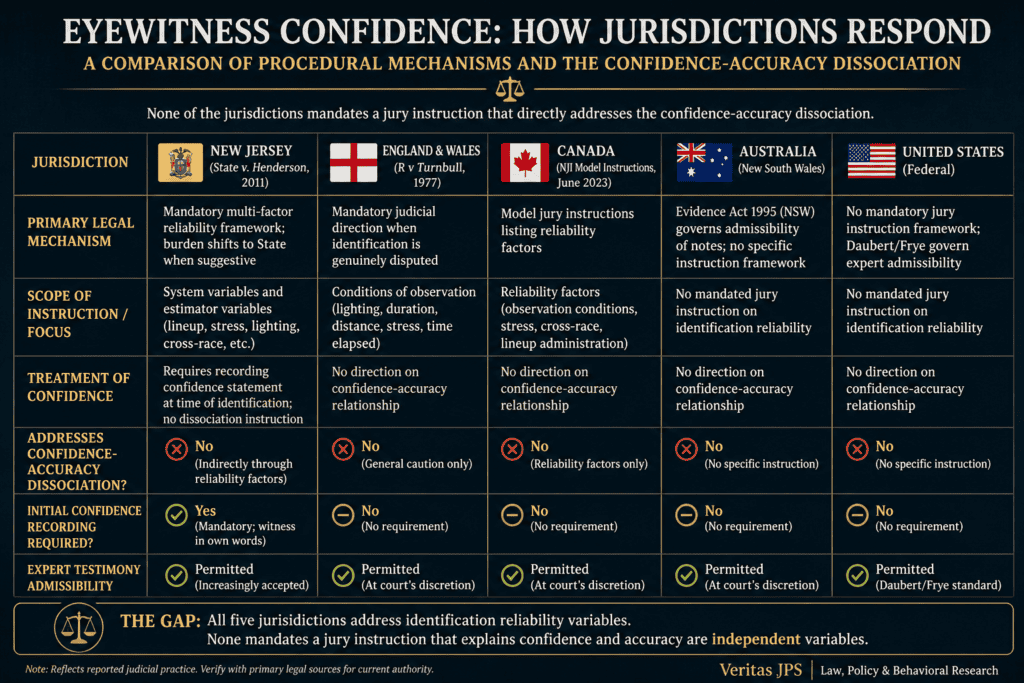
The procedural response to the confidence-accuracy dissociation varies substantially across jurisdictions. None has implemented a mandatory, mechanism-specific instruction that directly addresses the cognitive variable responsible for the dissociation.
New Jersey (State v. Henderson, 2011): The most comprehensive US response. Henderson established a mandatory multi-factor framework requiring courts to instruct juries on both system variables (lineup administration, investigator conduct) and estimator variables (lighting, distance, stress, cross-race effect). It requires recording the witness’s confidence statement in their own words at the time of identification and shifts the burden to the State to demonstrate reliability when the defendant establishes suggestive procedure. Henderson does not mandate a standalone instruction on the confidence-accuracy dissociation as a distinct cognitive mechanism. The instruction addresses reliability variables without directly telling jurors that confidence and accuracy are independent.
England and Wales (R v Turnbull, 1977): Turnbull requires a mandatory judicial direction whenever identification is genuinely disputed. The judge must warn that a mistaken witness can be a convincing one and direct the jury to scrutinise the circumstances of identification — lighting, duration, distance, stress, time elapsed. Where the identification evidence is poor and unsupported, the judge must withdraw the case or deliver a strong warning. Turnbull operates at the conditions-of-observation level. It does not address post-encoding memory contamination, imagination inflation, source monitoring failure, or the neuroscience of false memory. A Turnbull direction warns jurors to be cautious. It does not explain why they should be cautious in terms that address the specific cognitive mechanism producing the error.
Canada (National Judicial Institute Model Instructions, revised June 2023): The NJI model instructions provide a list of reliability factors — observation conditions, stress, cross-race effect, lineup administration — and instruct jurors that reliability depends on the basis for the witness’s observations. The model does not include a confidence-accuracy dissociation instruction and does not direct jurors that confidence and accuracy are independent variables. Adoption is discretionary at the trial level, with provincial variation.
Australia (New South Wales): Deck, Paterson, and Frowd’s (2025) study operates within the Evidence Act 1995 (NSW), which governs admission of contemporaneous notes (ss.32, 34) but does not address the confidence-accuracy relationship in eyewitness identification. Australian jurisdictions lack a Henderson-equivalent mandatory instruction framework or a Turnbull-equivalent caution direction specifically for identification evidence.
United States (Federal): No federal circuit mandates a confidence-accuracy jury instruction. The Daubert standard (509 U.S. 579 (1993)) and the older Frye standard (293 F. 1013 (D.C. Cir. 1923)) govern expert testimony admissibility — whether an expert may testify about memory science, not whether a judge must instruct the jury about it. Different instruments, different procedural stages, same cognitive error.
The Structural Gap: Admissibility Standards and the Missing Mandate
Neither the Daubert/Frye admissibility framework nor the Istanbul Protocol (1999, revised 2022) addresses the confidence-accuracy dissociation as a basis for mandatory judicial instruction on lay eyewitness testimony. Both operate at the expert evidence gatekeeping threshold. Daubert/Frye determines whether expert testimony on memory science meets scientific validity and general acceptance standards. The Istanbul Protocol establishes documentation standards for testimony in human rights proceedings, governing how evidence is recorded rather than how juries are instructed to evaluate it.
The gap is explicit. Expert admissibility reform tells courts that they may allow a psychologist to testify about memory limitations. It does not tell courts that they must instruct juries about the confidence-accuracy dissociation before eyewitness identification evidence is considered. The reform trajectory since Henderson (2011) has expanded expert admissibility — New York’s 2024 Court of Appeals quartet is the most recent example — without converting that expansion into mandatory instruction requirements.
DNA exoneration operates post-conviction. Lineup reform operates pre-trial. Expert admissibility reform operates at the evidence gatekeeping stage. None of these interventions reaches the cognitive mechanism that produces the verdict: the juror’s equation of confidence with accuracy, operating within a recording-device schema that the entire scientific field has rejected.
Institutional Implications
The confidence-accuracy dissociation is not new science. The failure to convert it into mandatory procedural design is not a knowledge gap. It is an institutional failure of translation from established evidence to procedural rule.
First, court rules committees should evaluate whether mandatory judicial instruction on the confidence-accuracy dissociation — as distinct from general caution directions or reliability-factor instructions — is warranted as a condition of admitting eyewitness identification evidence. The Henderson model provides the most developed framework but stops short of a standalone confidence-accuracy instruction.
Second, judicial academies should incorporate memory science training that specifically addresses the recording-device schema, the reconstructive nature of memory, and the neurological indistinguishability of true and false memories. Bench training on these mechanisms is a prerequisite for judges to exercise identification evidence gatekeeping with scientific literacy.
Third, the Wixted revisionist position — that initial-test confidence is reliable if preserved — has practical implications for evidence recording requirements regardless of whether it ultimately prevails in the scientific debate. Courts that require recording of initial confidence statements (as Henderson does) provide a stronger evidence base than courts that do not.
Fourth, the Deck et al. (2025) verdict-insensitivity finding — expert testimony shifts credibility ratings without shifting verdicts — should be treated as a serious methodological caution against reliance on expert testimony alone as the corrective mechanism. If replicated with larger samples and cross-jurisdictional populations, this finding undermines the assumption that admitting expert testimony is a sufficient institutional response.
Fifth, the mechanism-specific “training direction” model — naming the cognitive phenomenon and contextualising it for jurors rather than issuing abstract warnings — requires controlled testing in real trial conditions. The available mock-juror data is suggestive but insufficient to support policy adoption without field validation.
Citation reflects reported judicial practice. Verify with primary case law databases for specific authority.
About VeritasJPS
VeritasJPS provides evidence-based research and advisory at the intersection of jurisprudence, behavioral science, and cognitive psychology. Our work supports institutional decision-makers — judges, judicial academies, policymakers, and court rules committees — with rigorous analysis grounded in empirical evidence and legal scholarship.
Learn more: veritasjps.com