
Abstract
Cross-institutional coordination protocols for gender-based violence response exist across most jurisdictions that have committed to prevention frameworks. They are also, by every available measure, operationally inert. In Tanzania, direct observation found that only 16.4% of health care providers adhered to GBV screening protocols — with more than 95% failing to complete the chain-of-custody documents that enable cross-institutional evidence transfer. In South Africa, 85% of GBV survivors reported police incompetence, with officials consistently failing to follow established procedures for inter-agency case handling. The consequence is structural: survivors are forced to act as their own case managers, carrying information between police, medical, and judicial institutions that should be sharing it automatically. This analysis examines why the gap between protocol existence and protocol operation persists, what design standards have been shown to reduce it, and why no binding international framework mandates the minimum requirements — shared case identifiers, designated liaisons, joint referral protocols — that would make written commitments operational.
Why the GBV Protocol-to-Operation Gap Is Systemic
Most GBV reform discourse assumes the problem is attitudinal — that training, awareness campaigns, and cultural change will close the gap between law on paper and law in practice. The evidence suggests otherwise. The failure is architectural.
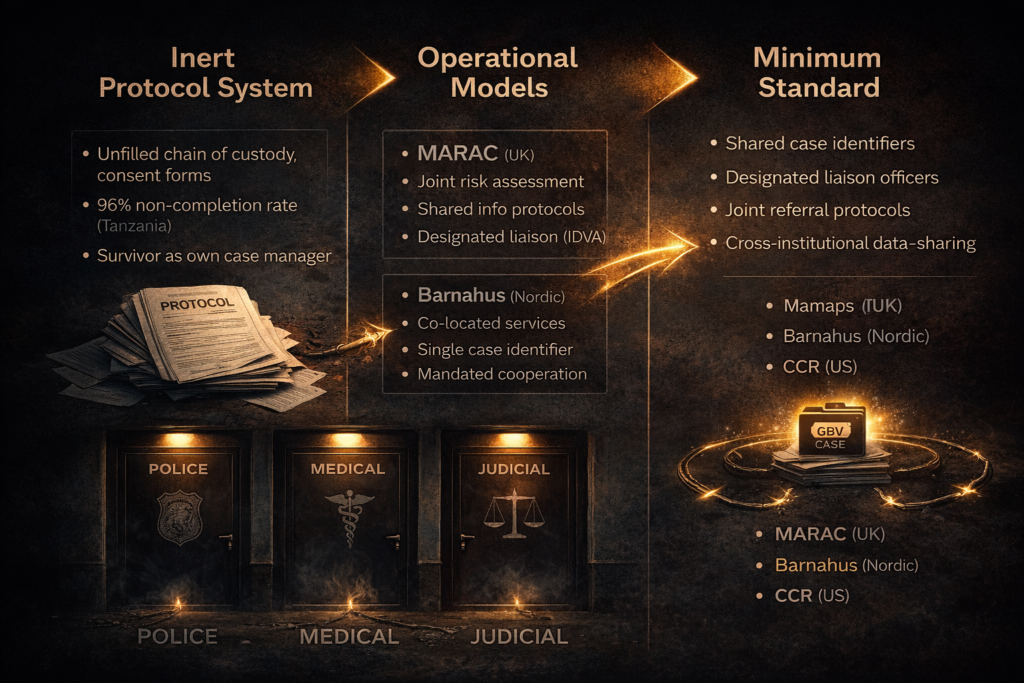
In Dodoma Region, Tanzania, Mtaita et al. conducted direct observational measurement of health care provider adherence to GBV screening protocols using the WHO/CDC Gender Based Violence Quality Assurance tool — a 12-item checklist applied in health facilities. The result: only 16.4% of providers adhered to established protocols and procedures. More than 95% did not complete chain-of-custody forms, consent forms, or GBV medical forms — the exact documents that enable evidence to move between health, police, and judicial systems. Providers without GBV-specific training were significantly less likely to comply than trained staff, but even among trained providers, completion rates for cross-institutional documentation remained negligible.
This is not a training deficit alone. It is a system design failure. The protocols exist. The forms exist. The institutional expectation exists. What does not exist is any enforcement mechanism, accountability structure, or feedback loop that makes non-compliance visible or consequential.
At scale, the pattern holds. The Centre for Justice’s 2025 study of GBV survivors in South Africa reported that 85% experienced police incompetence, with officials consistently failing to follow established cross-agency case-handling procedures. Eighty-three percent of survivors did not know what resources were available to them. Seventy-nine percent cited lack of police resources, and 87% lacked the financial means to access services independently. The burden of managing handoffs between police stations, hospitals, courts, and social services fell on survivors themselves.
Citation reflects reported judicial practice. Verify with primary case law databases for specific authority.
How Survivors Become Their Own Case Managers
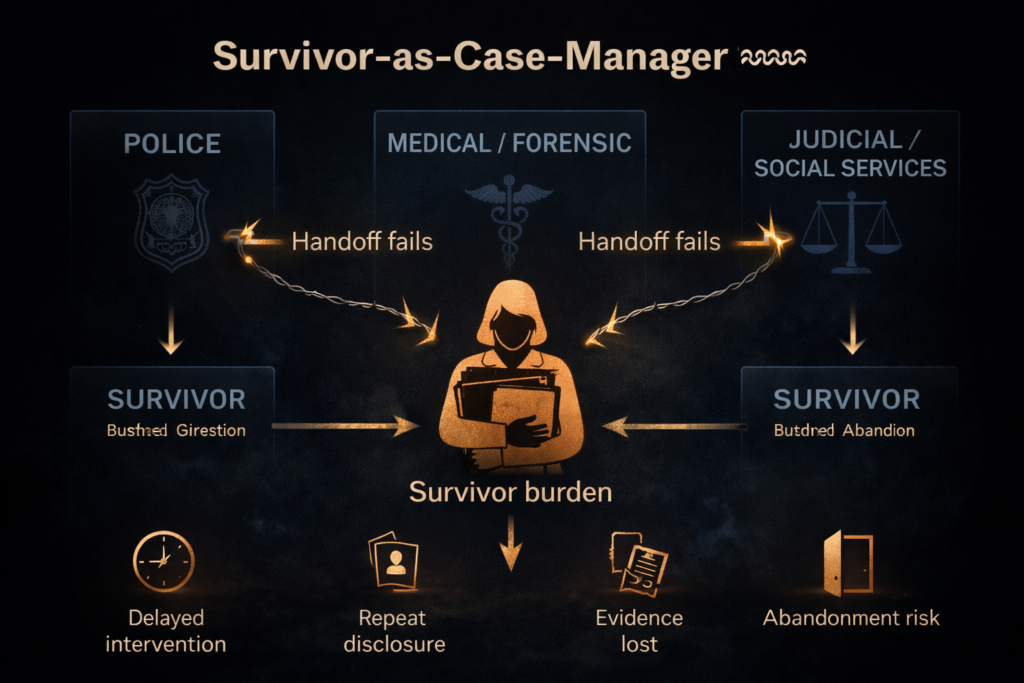
When inter-agency case handling collapses, the failure does not produce a vacuum. It produces a transfer of labour. The administrative, evidentiary, and relational work that a functioning referral system should perform automatically shifts to the person least equipped to perform it: the survivor.
CFJ’s data documents this transfer directly. Survivors reported facilitating required paperwork and interactions between police, medical, judicial, and social service systems — work that presupposes familiarity with institutional processes, physical mobility between dispersed service points, emotional capacity to repeat disclosures across agencies, and time that competing survival needs do not spare.
The International Development Law Organization’s 2022 multi-country analysis of GBV justice delivery in conflict and fragile-state settings identified the same structural pattern at system level. IDLO reported that functional, accessible referral pathways were absent, with gaps between state services, humanitarian actors, and local organizations going unaddressed. Roles and responsibilities in case handling remained undefined across agencies. Without a designated authority responsible for implementing a multisectoral framework, no institution owned the handoff function — and survivors filled the gap by default.
This is not merely inconvenient. It is structurally destructive to early intervention. Each failed handoff delays evidence collection, erodes forensic value, forces repeat disclosure (with documented re-traumatisation effects), and increases the probability of case abandonment. The model is also self-defeating: the individuals most likely to abandon a justice process are those required to manage it themselves while simultaneously recovering from the violence that initiated it.
Three GBV Coordination Models with Measurable Outcomes
The evidence is not uniformly bleak. Three models — each operating in different institutional contexts — have demonstrated measurable improvements in survivor outcomes by building referral and accountability architecture into institutional structure rather than relying on individual compliance.
The UK Multi-Agency Risk Assessment Conference (MARAC)
Evaluated by SafeLives across England and Wales, the MARAC model operates on a core design premise: no single agency can see the complete picture of a survivor’s risk, but each holds information critical to safety assessment. MARACs bring police, health, housing, children’s services, probation, and specialist domestic violence services into structured information-sharing meetings. A standardised risk identification checklist (DASH) determines referral thresholds.
SafeLives’ pilot evaluation showed that 40% of survivors suffered no further abuse one year after their MARAC case. Design features include shared information-sharing protocols, an Independent Domestic Violence Adviser (IDVA) who represents survivor voice without requiring survivor attendance, and agency-specific action plans with designated accountability.
Replicated in Scotland, Ireland, Australia, and Canada, the MARAC model is not self-sustaining. SafeLives’ own quality assurance data shows that MARACs fail their operational standards when agency representatives lack authority to commit resources, or when agencies under-resource their participation. The 40% figure derives from pilot conditions — national rollout data shows significant variation in case quality and safety-plan follow-through. Where the model’s structure is enforced, it works. Where it is treated as an optional inter-agency courtesy, it degrades.
The Nordic Barnahus (Children’s House) Model
Evaluated nationally in Norway by Bakketeig et al. and reviewed comparatively across Nordic states by Kaldal for the Council of Europe, the Barnahus model addresses a different but structurally parallel problem: the fragmentation of institutional responses to child victims of sexual abuse and violence.
Barnahus centres integrate forensic interviewing (police), medical examination, therapeutic support, and legal process into a single physical location. Norway’s national evaluation showed that children interviewed at Barnahus received better care outcomes than those interviewed at police stations. In Iceland, forensic interviews were conducted within one week of allegation, with recorded interviews used directly as court evidence — eliminating repeat disclosure entirely.
The architectural insight is simple: shared physical location functions as a shared case identifier by design. When all agencies operate from the same site, information exchange is a byproduct of proximity rather than a protocol that must be separately policed.
A significant limitation applies. The Barnahus model was designed for child victims, and no formally evaluated adult-GBV equivalent exists. Its success depends on Nordic welfare-state conditions — high inter-agency trust, stable funding, professionalized and relatively low-corruption agencies, and legislative frameworks that require cooperation. Documented tension between therapeutic and forensic objectives (therapeutic support can only begin after the forensic interview concludes) remains unresolved across implementations.
The US Coordinated Community Response (CCR/Duluth Model)
Originating from the Duluth Domestic Abuse Intervention Program and synthesised in a 2021 N8 Policing Research Partnership analysis, the CCR model builds accountability into each point of case processing — not just at intake. Administrative data tools track context, risk, and relationship history across agencies. Advocacy organizations are positioned as inter-agency connectors, not add-on services, enabling survivor input to identify system gaps in real time.
Victim safety and offender accountability are treated as co-equal mandates, distributed across all participating agencies rather than concentrated in any single gatekeeping institution.
Replication evidence is mixed. Communities with strong advocacy sector capacity show higher fidelity; communities where advocacy organizations are under-resourced or where law enforcement resists non-statutory actor involvement in case processing show lower fidelity and degraded outcomes. No randomised controlled trial has evaluated the model, and effect sizes for survivor attrition reduction are not consistently documented across sites.
The International Normative Gap: CEDAW Mandates Outcomes, Not Architecture
All three models share common design elements: standardised risk assessment instruments, shared information exchange (whether by protocol or physical co-location), designated cross-agency representatives with decision-making authority, and accountability mechanisms for non-participation. None is mandated by binding international law.
The CEDAW Committee’s General Recommendation No. 35 (2017), updating GR 19 (1992), obliges States Parties to adopt diverse institutional measures “in coordination with the relevant State branches” — including public policy design, monitoring mechanisms, and competent national tribunals. GR 35 establishes the prohibition of gender-based violence as a norm of international customary law and defines levels of State liability for acts, omissions, and failure to act with due diligence.
What GR 35 does not do is specify minimum inter-agency design standards. No mandate for shared case identifiers. No requirement for designated liaison officers between police, medical, and judicial institutions. No specification of joint referral protocol standards. No minimum data-sharing requirements between agencies handling the same survivor’s case.
GR 35 requires coordination outcomes — prevention, investigation, prosecution, and reparation. It does not prescribe the operational architecture through which those outcomes must be achieved. That gap — between normative obligation and implementation specification — is precisely what permits jurisdictions to maintain nominally compliant frameworks that are, in practice, operationally inert. Tanzania and South Africa are not outliers. They are the pattern.
The Crisis Multiplier: When Institutional Capacity Collapses, Impunity Scales
The silo failure documented in stable-state jurisdictions compounds exponentially in conflict and crisis settings. UN Women’s 2026 report on access to justice for women and girls — released March 5, 2026 — reported that 676 million women and girls lived within 50 kilometres of a deadly conflict in 2024, the highest figure since the 1990s. Reports of conflict-related sexual violence increased by 87% that year. Nearly 70% of countries surveyed maintained discriminatory legal frameworks preventing equal justice access for women, and 54% lacked consent-based definitions of rape.
In these settings, collapsed or disrupted capacity functions as a structural multiplier of impunity. The referral mechanisms that are merely dysfunctional in stable states are entirely absent in crisis zones. IDLO’s 2022 analysis of Honduras, Afghanistan, and comparable fragile-state jurisdictions documented corruption, limited forensic specialist capacity, poor information systems, and absence of national data collection as compounding inhibitors — structural conditions under which even well-designed protocols cannot operate.
A concurrent funding crisis accelerates the collapse. UN Women’s 2026 data reports that 90% of organizations working to end violence against women face cuts to essential services, and only 5% believe they can sustain operations beyond two years without increased funding. Designing minimum inter-agency standards is therefore inseparable from a documented collapse in the capacity to operate any framework at all.
Toward a Minimum Standard
The evidence points to a specific, addressable gap. GBV inter-agency response is not impossible — the MARAC, Barnahus, and CCR models demonstrate measurable success where referral and accountability structures are built into institutional operation. What is missing is a binding framework that mandates the minimum design elements separating operational systems from nominal ones.
A minimum standard — applicable across police, medical, and judicial institutions — would require at least:
- Shared case identifiers that follow a survivor’s case across all institutions handling it, eliminating the requirement for survivors to re-establish their case at each contact point.
- Designated liaison officers in each participating institution with cross-agency authority to share information and commit resources — not discretionary representatives who attend meetings without decision-making power.
- Joint referral protocols with specified timeframes, documentation requirements, and accountability mechanisms for non-compliance — enforced through institutional performance metrics, not voluntary goodwill.
- Cross-institutional data-sharing agreements that are operationally active (not merely signed), with audit mechanisms to measure actual information flow.
None of these elements requires new legal theory. Each exists in at least one evaluated model. The gap is that no international or regional instrument compiles them into a binding minimum that domestic judicial and administrative systems must meet.
The CEDAW Committee is positioned to issue such technical guidance — building on GR 35’s normative framework with architecture-level specification. Until it does, the pattern will persist across South Africa, Tanzania, Honduras, Afghanistan, and the 676 million women living within reach of armed conflict: protocols that exist on paper, institutions that do not follow them, and survivors forced to manage their own cases through systems designed to serve them.
About VeritasJPS
VeritasJPS provides evidence-based research and advisory at the intersection of jurisprudence, behavioral science, and institutional governance. Our work supports institutional decision-makers — judges, policymakers, and compliance leaders — with rigorous analysis grounded in empirical evidence and legal scholarship.