Tag: design-framework

  • Automation Bias in AI Human Oversight Under the EU AI Act

    Automation Bias in AI Human Oversight Under the EU AI Act

    Quick Answer: Automation bias is the cognitive mechanism Article 14 of the EU AI Act names but does not functionally regulate. The Act requires awareness of over-reliance, yet it does not mandate behavioral countermeasures such as cognitive forcing, override protocols, or audit trails for judicial AI oversight.

    Abstract

    The EU AI Act is the first binding regulatory instrument to name automation bias as a risk to human oversight of AI systems. Article 14 requires providers of high-risk AI to enable human reviewers’ “awareness” of the tendency to defer to automated outputs over independent judgment. Yet the Act establishes no legal standard for what constitutes an adequate behavioral countermeasure against the risk it identifies. This gap matters because the behavioral science evidence consistently demonstrates that awareness-based interventions are the weakest available tool for suppressing over-reliance in high-stakes environments. Across jurisdictions — EU, US, and Global Majority — no regulatory framework currently requires documented behavioral override protocols as an authorization condition for judicial AI systems, leaving human oversight at the level of procedural description rather than functional specification. This analysis examines the evidence base, maps the jurisdictional gap, and identifies what institutional decision-makers need to address before “meaningful human oversight” can mean anything more than a signature on a compliance form.

    The Regulatory Promise and Its Behavioral Contradiction

    Article 14 of the EU AI Act represents a genuine regulatory advance. It requires providers of high-risk AI systems to design those systems so that human oversight is possible, and it imposes on deployers a duty to assign oversight to competent persons. Critically, Article 14(4)(b) specifically references automation bias — the only binding AI regulation globally to name the phenomenon in statutory text.

    What follows the naming is the problem. Laux and Ruschemeier (2025), writing in the European Journal of Risk Regulation, identify a structural asymmetry at the core of Article 14: the Act places the awareness obligation on providers, but the organizational and contextual conditions that generate over-reliance — task design, interface architecture, time pressure, institutional incentive structures — reside with deployers. The Act does not directly bind deployers on behavioral countermeasure standards. A regulatory framework that diagnoses the disease and prescribes the treatment to the wrong party.

    This is not a marginal drafting point. If the cognitive mechanism operates — as the foundational literature established and current research confirms — below the threshold of conscious awareness, then mandating that providers “enable awareness” of the bias is a category error. You cannot instruct someone to be aware of a process that, by definition, evades conscious detection without structural intervention.
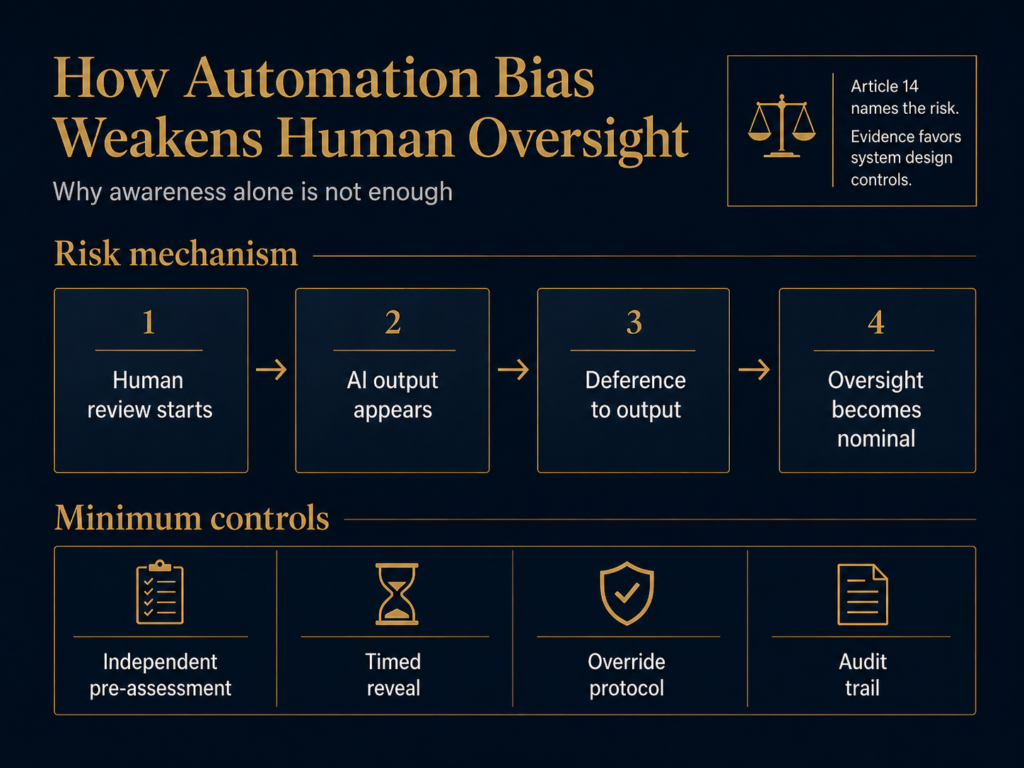
    Automation bias flowchart linking AI output, deference, nominal oversight, and four control measures.

    What Does the Evidence Show About Awareness-Based Interventions?

    The European Data Protection Supervisor’s TechDispatch #2/2025 put the point bluntly: the mechanism renders nominal human oversight functionally equivalent to automated decision-making. When a human reviewer accepts an AI output primarily because it was produced by an automated system, the oversight step adds procedural cost without adding decisional independence. The TechDispatch cited radiological evidence — a 2023 study in which 27 radiologists reviewing 50 mammograms showed significantly reduced accuracy when exposed to incorrect AI suggestions. The reviewers did not simply agree with the AI. They actively performed worse than they would have without it.

    A systematic review published in Human Factors by Crockett, Stanton, and colleagues (2024) examined 80 articles covering 100 debiasing investigations across 91 cognitive bias types. The review found that approximately 80% of identified technological debiasing strategies were reportedly effective. That finding might seem to undercut the concern — debiasing works, so what is the problem?

    Category specificity. The strategies that show effectiveness are predominantly information-design and procedural interventions: restructuring how information is presented, introducing mandatory delays, requiring independent pre-commitment before AI output is revealed. These are system-design countermeasures. The dominant intervention deployed in institutional practice remains awareness-based training — precisely the approach the Article 14 framework defaults to. The systematic review confirms that the tools exist. The regulatory architecture chooses not to mandate them.

    Cognitive Forcing: The Intervention That Works but Nobody Requires

    Alberdi and colleagues (2025), publishing in Nature Scientific Reports, tested cognitive forcing interventions — structured delays in AI information presentation designed to compel independent assessment before automated output is available. Their experimental findings showed that cognitive forcing reduced over-reliance under measured conditions. Need-for-cognition moderated outcomes: individuals with higher dispositional engagement with effortful thinking benefited more. Combined cognitive forcing with structural delay outperformed awareness training alone.

    Citation reflects reported judicial practice. Verify with primary case law databases for specific authority.

    Two boundary conditions matter here. The study population was not drawn from judicial or regulatory professionals — transfer from clinical and laboratory settings to adjudicative environments is assumed, not tested. And cognitive forcing requires system-level implementation. It is an interface design choice, not a training module. Requiring it means mandating how AI systems present information to human reviewers, a technical specification that Article 14’s current text does not contemplate.

    The foundational automation-bias literature — Parasuraman and Manzey’s experimental work across aviation, process control, and medical diagnosis — established decades ago that awareness training does not reliably suppress reliance on incorrect AI outputs in time-pressured, high-stakes environments. The core finding has been replicated across domains. What remains absent is judicial-specific replication: no published experimental study has measured incidence in judges, magistrates, or regulatory adjudicators using AI tools in live settings.
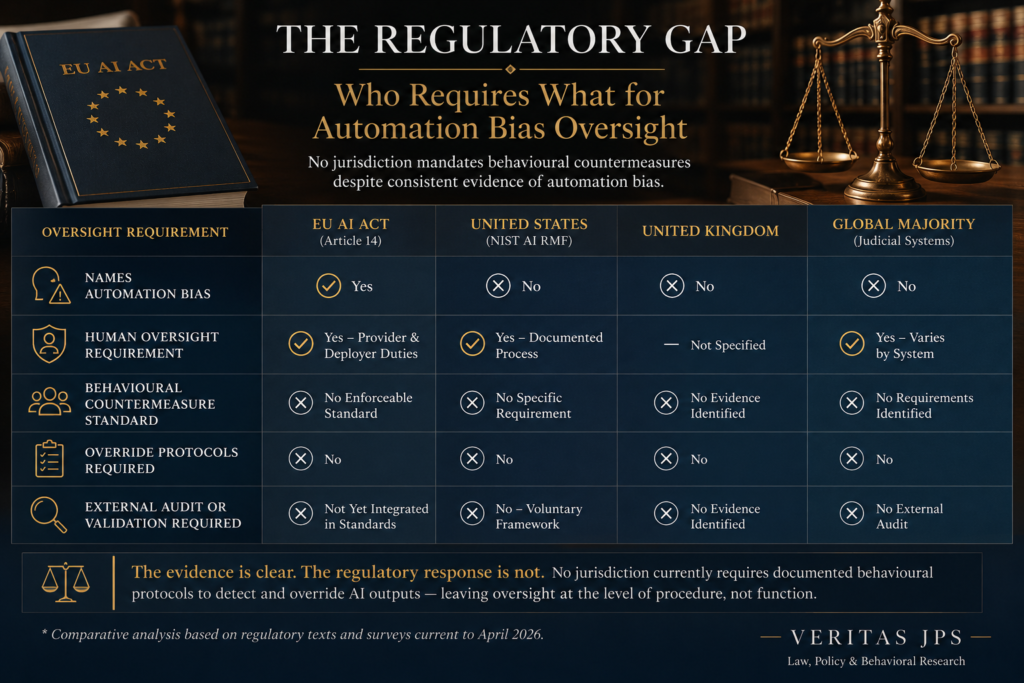
    Regulatory gap matrix comparing automation bias oversight requirements across EU, US, UK, and Global Majority systems

    The Global Majority Gap: Oversight Without Architecture

    The Stimson Center’s 2026 survey of AI deployments across Global Majority judicial systems — covering Egypt, China, Brazil, UAE, Argentina, Colombia, Singapore, Türkiye, and India — documents a starker version of the same problem. Only 9% of surveyed judges’ organizations have issued any AI usage guidelines or provide training resources. External audit requirements for AI systems are absent across the documented deployments.

    UNESCO survey data referenced in the Stimson report shows that 92% of judges surveyed are aware of AI tools, and 44% use AI professionally. Only 6% reported using AI outputs without any verification — a reassuring figure, except that it is self-reported. The behavioral science literature on AI over-reliance demonstrates consistently that individuals who believe they are exercising independent judgment are frequently not doing so. Self-reported verification rates and actual cognitive independence are different measurements entirely. No behavioral instrument was used to assess incidence in any of the surveyed jurisdictions.

    The governance consequence: in the jurisdictions where judicial AI is most rapidly being adopted — often without the institutional infrastructure of EU-level regulatory frameworks — over-reliance operates with no detection mechanism, no audit trail, and no institutional standard against which to measure whether oversight is functional or cosmetic.

    Comparative Regulatory Mapping: Who Requires What

    The jurisdictional picture, mapped against behavioral countermeasure requirements, reveals a consistent gap:

    • EU (Article 14, AI Act): Names the cognitive risk; mandates provider-level awareness obligation; no enforceable deployer-level behavioral countermeasure standard; harmonized standards have not yet incorporated behavioral science benchmarks. Laux and Ruschemeier conclude that it is legally unclear how to prove whether the mechanism operated in a specific oversight event under the current text.
    • United States (NIST AI Risk Management Framework): Voluntary framework. Govern 2.1 requires documented roles and responsibilities for AI risk. Map 3.5 requires human oversight processes to be defined, assessed, and documented. The framework does not specify behavioral countermeasures for the bias as a distinct requirement. No binding enforcement mechanism.
    • United Kingdom: The identified evidence base returns no 2024–2026 study specifically measuring this bias in UK judicial AI deployments. UK Judicial College guidance on AI-assisted decision-making oversight was not retrievable at source-verification level. The record is silent.
    • Global Majority (Stimson Center survey jurisdictions): No external audit requirements; no behavioral override protocol requirements identified in any surveyed jurisdiction; 91% of judicial organizations have issued no AI guidelines at all.

    No jurisdiction currently requires what the behavioral science evidence identifies as the minimum functional standard: documented protocols specifying how human reviewers will detect and override AI outputs, validated against the cognitive mechanism as a distinct risk.
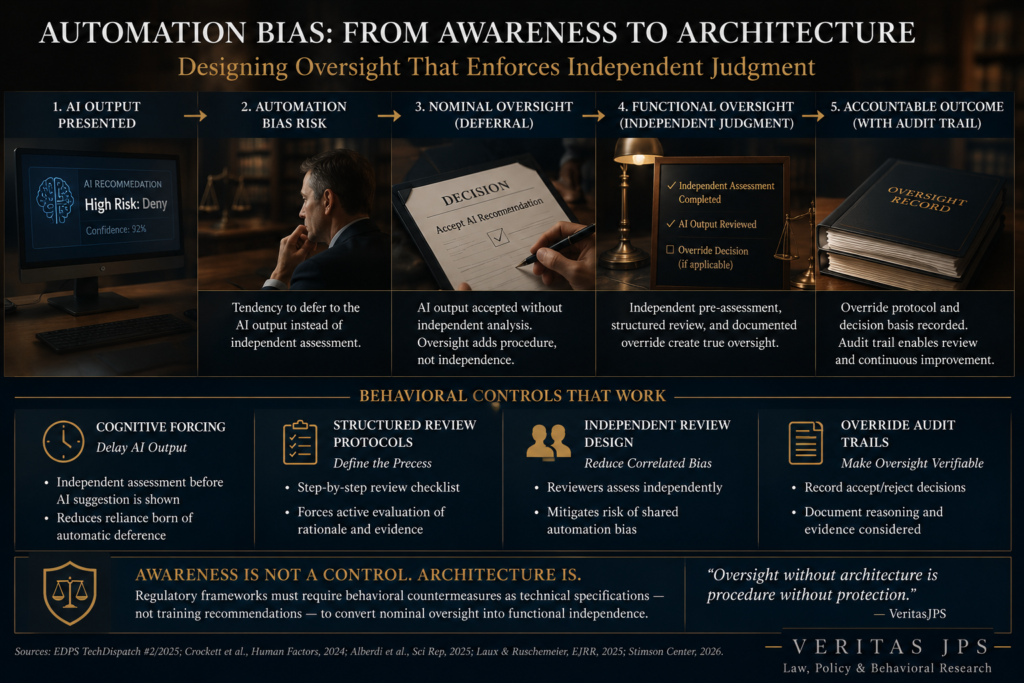
    Five-stage automation bias sequence with behavioral controls for independent review and audit trails.

    Article 14(5) and the Risk of Correlated Bias

    One provision in Article 14 deserves particular scrutiny. Article 14(5) requires that for certain biometric identification uses, at least two natural persons verify the AI system’s output before action is taken. This dual-reviewer requirement is the strongest behavioral safeguard in the Act’s text.

    The literature raises an unexamined question. If both reviewers are exposed to the same AI output, their biases may be correlated rather than independent. Two reviewers deferring to the same automated recommendation does not provide the error-correction function that dual review is designed to achieve. No published study has tested whether correlated over-reliance between co-exposed reviewers negates the Article 14(5) safeguard. The provision assumes independence that the cognitive mechanism may defeat.

    What the Evidence Does Not Yet Show

    A 2025 study published in PLOS ONE, analysing panel data across SDG-16 countries from 2019 to 2023, found that AI integration in judicial systems contributes to reduced bias in adjudication over medium and long time horizons, with mixed and less significant effects in the short term. This finding qualifies any suggestion that AI in courts invariably increases bias. It does not, however, measure automation bias as a distinct cognitive construct. The study examined aggregate bias reduction at the country level using wavelet quantile correlation — a macro-level analysis that cannot isolate the specific mechanism of over-reliance on AI outputs at the individual decision-maker level.

    The distinction matters. The policy question is not whether AI improves aggregate outcomes over time — it may well do so — but whether the specific cognitive process corrupts the oversight mechanism that is supposed to ensure AI outputs are subject to independent human review. Aggregate improvement and individual oversight failure can coexist.

    What Institutional Decision-Makers Should Require

    The evidence base supports five institutional implications:

    1. Behavioral protocol as technical specification: National competent authorities authorizing high-risk AI systems in judicial contexts should require — as a condition of authorization, not as a training recommendation — a documented behavioral protocol specifying how human reviewers will detect and override AI outputs. This protocol should be treated as a technical system requirement, validated and audited alongside other conformity assessment criteria.
    2. Cognitive forcing as minimum standard: Harmonized standards under the AI Act should incorporate cognitive forcing interventions — mandatory independent pre-assessment before AI output is presented — as a minimum behavioral design requirement for high-risk systems in adjudicative settings.
    3. Override audit trails: Deployer institutions should be required to maintain auditable records of override decisions: when a human reviewer accepted an AI output, when they rejected it, and the documented basis for each decision. Without this trail, neither internal governance nor external review can distinguish functional oversight from automated rubber-stamping.
    4. Correlated bias testing for dual review: Before relying on Article 14(5) dual-reviewer provisions as a meaningful safeguard, regulators should commission experimental testing of correlated over-reliance between co-exposed reviewers to determine whether the independence assumption holds.
    5. Behavioral measurement in Global Majority deployments: International institutions supporting judicial AI adoption — including UNESCO and bilateral development agencies — should require behavioral measurement instruments for this cognitive risk as a condition of deployment support, not merely adoption surveys.

    About VeritasJPS

    VeritasJPS provides evidence-based research and advisory at the intersection of jurisprudence, behavioral science, and AI governance. Our work supports institutional decision-makers — judges, policymakers, and compliance leaders — with rigorous analysis grounded in empirical evidence and legal scholarship.

    Learn more at VeritasJPS.

  • Cognitive Regulatory Capture: The Independence Failure Anti-Corruption Design Cannot Reach

    Cognitive Regulatory Capture: The Independence Failure Anti-Corruption Design Cannot Reach

    Quick Answer: Cognitive regulatory capture — the gradual alignment of regulator judgment with industry perspectives through familiarity and social proximity — produces enforcement leniency without corruption. A 2025 systematic review establishes it as the dominant capture mode in established democracies. Current governance frameworks, including the OECD Principles, contain no cognitive independence design requirements.


    Abstract

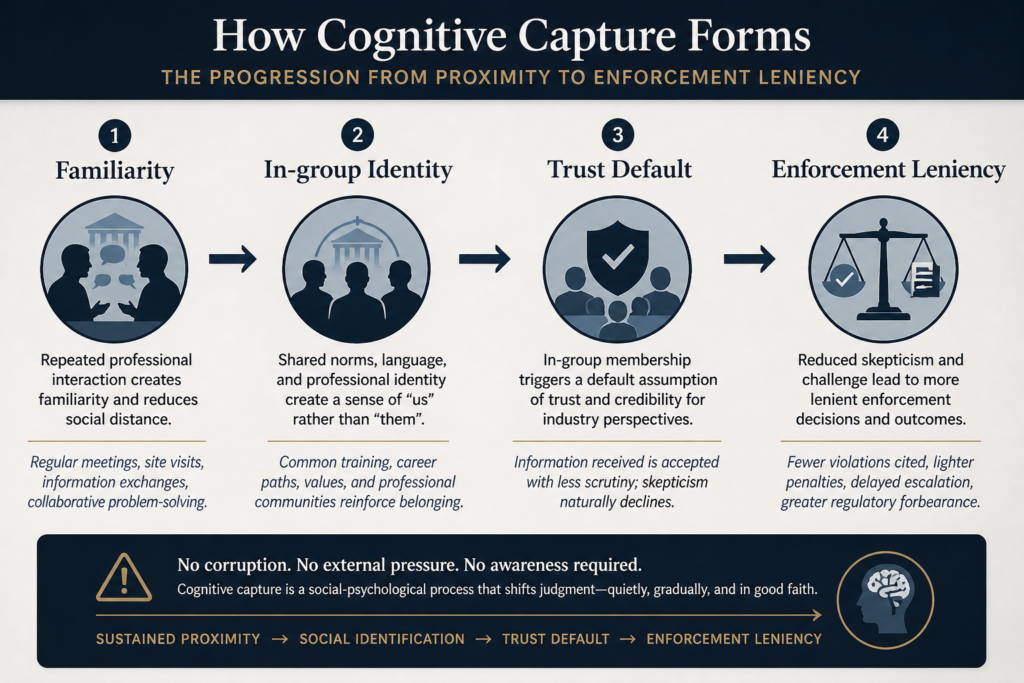
    Regulatory capture discourse centres on structural mechanisms — revolving doors, lobbying, financial incentives — and generates structural solutions: cooling-off periods, disclosure requirements, independent funding. A convergent body of evidence from regulatory sociology, behavioural public administration, and social psychology now documents a distinct capture pathway operating beneath these safeguards. Cognitive regulatory capture — the gradual recategorisation of regulated entities as in-group members through familiarity, social proximity, and professional identity alignment — produces enforcement leniency without any corrupt act, external pressure, or formal institutional failure. A 2025 systematic review consolidates this evidence into a five-concept framework with 33 behavioural indicators, establishing cognitive and cultural capture as the dominant mode in established democracies. The OECD Principles for the Governance of Regulators (2014), still the dominant governance framework, address independence through structural provisions alone and contain no cognitive independence design requirements. This analysis examines the evidence base across jurisdictions, identifies the unresolved empirical questions, and argues that regulatory governance frameworks require cognitive independence protocols — rotation mandates, adversarial review panels, independent challenge functions — as a minimum design standard distinct from anti-corruption rules.

    The Structural Independence Assumption

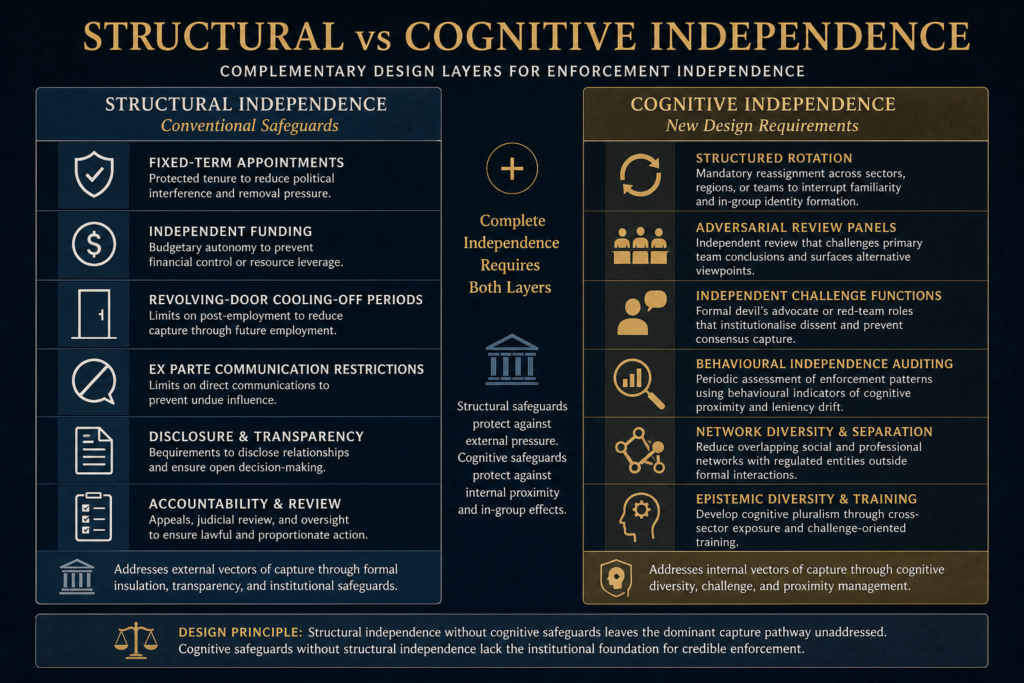
    Regulatory independence doctrine assumes a specific threat model: external actors — industry lobbyists, future employers, political principals — exert pressure on regulatory officials, and institutional design responds by insulating officials from that pressure. Structural provisions follow: fixed-term appointments, independent funding, restrictions on ex parte communications, revolving-door cooling-off periods.

    The OECD Best Practice Principles for the Governance of Regulators (2014) codify this model across seven principles: role clarity, preventing undue influence, decision-making structure, accountability and transparency, engagement, funding, and performance evaluation. The 2017 follow-up, Creating a Culture of Independence, adds five dimensions of de facto independence, including a “culture” dimension addressing staff behaviour norms and conduct policies.

    None of these instruments operationalises cognitive independence. No OECD indicator measures in-group identity formation between regulators and regulated entities. No principle mandates structured rotation. No design requirement specifies adversarial review or independent challenge functions. The governance architecture treats independence as a property of institutional structure. It does not treat it as a property of individual cognition. This is the gap that non-binding guidance — however well-intentioned — cannot close.

    The framework responds to the capture mechanisms that dominated twentieth-century regulatory theory — Stigler’s economic theory of regulation (1971), Peltzman’s refinements, and the post-2008 revolving-door debates. These accounts locate the capture vector outside the regulator. Cognitive capture locates it inside.

    cognitive regulatory capture

    What Is Cognitive Capture — and What Is It Not?

    Cognitive capture is not corruption. No financial incentive. No quid pro quo. No awareness on the part of the captured official. It is not a failure of ethics or integrity in the conventional sense — the official is acting in good faith throughout.

    Chesterfield, Guardiancich, and Heims (2025, Regulation and Governance) provide the most detailed synthesis to date. Their systematic review of 39 studies consolidates cultural capture into five empirical concepts, forming the CHAIN framework:

    • Closeness — direct social ties between regulators and regulated entities developed through repeated professional interaction
    • Homogeneity — shared educational backgrounds, professional training, and career trajectories producing worldview convergence
    • Avoidance — non-challenge of industry positions, where regulators decline to contest industry framing even when evidence supports challenge
    • Identities — shared professional identity formation, where regulators come to see themselves as members of the same professional community as those they regulate
    • Networks — overlapping social and professional networks that sustain proximity outside formal regulatory interactions

    Ten mechanisms operate through these five concepts. The review produces 33 behavioural indicators. The central empirical finding: in established democracies, cultural and cognitive capture has displaced financial capture as the dominant mode. Financial mechanisms have not vanished — but where structural safeguards have reduced explicit corruption, the cognitive pathway has become the primary residual independence risk.

    The definition is precise: cultural capture consists of “social and psychological processes that bias regulators’ beliefs and behaviours, aligning them with those of the regulatees and marginalising alternative viewpoints.” The captured regulator does not adopt industry positions because they have been bought. They adopt them because sustained proximity has made industry perspectives feel reasonable, expert, and aligned with good regulatory practice.

    The Behavioural Independence Gap

    Burchardt (2025, Maastricht Journal of European and Comparative Law) extends this analysis to independence doctrine itself. Working within the ECHR Article 6 and EU judicial framework, Burchardt argues that current independence doctrine is built on formal insulation — structural provisions designed to prevent external interference — and provides no mechanism to address cognitive proximity effects in serving officials.

    In-group bias and familiarity effects, Burchardt argues, operate as structural threats to decisional independence — not episodic ones. They do not arise from a specific conflict of interest that recusal can manage. They arise from accumulated professional proximity over time, producing a baseline shift in judgment that presents as subject-matter expertise rather than bias.

    The design implications follow directly. If independence is treated as a structural property, the response is insulation: separate the decision-maker from external pressure. If independence also has a cognitive dimension, the response must include cognitive interventions: rotation to interrupt familiarity accumulation, adversarial review to challenge in-group consensus, and independent challenge functions to surface viewpoints that proximity has marginalised.

    Burchardt’s analysis is primarily adjudicative — focused on judicial independence within the ECHR framework. Extension to executive regulatory bodies requires an inferential step. But the underlying psychological mechanisms — in-group bias, familiarity-driven trust, cognitive fluency from repeated interaction — are not jurisdiction-specific. They operate wherever sustained professional proximity exists.

    What Does the Field Evidence Show?

    Three empirical studies provide different angles on the mechanism.

    Amore, Le Coq, and Schwenen (2024, HEC Paris working paper) examine US nuclear power plant regulation using administrative panel data and quasi-experimental design exploiting spatial assignment patterns. Inspector experience and spatial proximity interact in determining safety outcomes. Doubling inspector experience is associated with a 0.3 percentage point reduction in emergency training scores at supervised facilities — the authors estimate this as equivalent to approximately USD 1.2 billion in avoided losses annually across the industry. Less experienced inspectors are assigned to facilities farther from regulatory offices, suggesting proximity and experience covary in ways that affect compliance outcomes.

    Clear limitations. Proximity here is spatial and experiential, not social-identity-based. The familiarity mechanism is implicit — the study does not directly measure social identification between inspectors and facility operators. A working paper, peer review pending. But it provides rare quantitative field evidence that something correlated with proximity and tenure affects enforcement stringency in a technically complex regulatory environment.

    Heims (2023, Regulation and Governance) takes a qualitative approach, applying process-tracing to the FDA’s handling of Vioxx — a case study of regulatory failure in pharmaceutical safety. Evidence of cultural capture manifests as absence of critical challenge of industry-submitted data, uncritical repetition of industry framing in regulatory assessments, and failure to seek contradicting evidence during post-market surveillance. Financial capture mechanisms were not confirmed as the primary driver. The behavioural signatures point to cognitive homogeneity and worldview alignment — the regulator and the regulated entity had converged on what constituted reasonable safety evidence without any explicit agreement.

    Inherent limitation of mechanism-tracing: single-case design, selection on a known failure, inability to establish prevalence. But the case provides granular evidence of how cognitive capture manifests — not just that it exists, but what it looks like operationally.

    A 2025 experimental study in Frontiers in Psychology contributes a finding with particular relevance to regulatory staffing. Using a mixed experimental design with an ultimatum game paradigm, the study finds that pro-social individuals — the motivational profile most associated with public service vocations — exhibit stronger in-group favouritism in norm enforcement than pro-self individuals. Pro-socials more readily accept unfair distributions from in-group members. The social identity theory mechanism is confirmed: group identification enhances loyalty and tolerance of in-group norm violations.

    The regulatory implication is counterintuitive. Officials most likely to enter regulatory service — those with strong prosocial orientation and commitment to public good — may be the most susceptible to in-group leniency. Regulatory staffing that selects for public service motivation may simultaneously select for heightened capture vulnerability through the same psychological mechanism.

    Laboratory setting, general population sample, not regulatory professionals. Ecological validity for enforcement contexts is undemonstrated. But the mechanism — pro-social orientation amplifying in-group favouritism — speaks directly to institutional design.

    Two-column framework comparing structural safeguards with cognitive independence design requirements

    The In-Group Identity Puzzle: An Unresolved Conflict

    The social identity theory prediction is straightforward: group identification produces leniency toward in-group members. This aligns with the Chesterfield et al. synthesis, the Heims case study, and the experimental evidence.

    A competing theoretical strand — normative focus theory — predicts the opposite. If group identity heightens normative expectations, in-group members who violate group norms may face harsher enforcement. The in-group violator has betrayed shared standards, triggering a normative enforcement response rather than a leniency response.

    Shayo and Zussman (published in the Journal of the European Economic Association; NBER Working Paper 25355) provide partial field evidence from Israeli small claims courts. Using naturally occurring judicial decision data and judge-litigant ethnicity matching, they find in-group leniency in sentencing — judges are more lenient toward same-group defendants — but a marginally opposing effect in conviction decisions in some specifications. In-group bias operates even under strong non-discriminatory institutional norms. Its direction may vary by decision type.

    For regulatory governance, this unresolved conflict matters practically. If cognitive proximity produces leniency in enforcement discretion (the dominant prediction), rotation and adversarial review are appropriate design responses. If it produces heightened normative enforcement (the minority prediction), proximity might in some contexts serve regulatory objectives. Current evidence supports the leniency prediction in most settings. The conflict is not resolved by existing regulatory field data.

    The Competence-Capture Tradeoff

    Any proposal to interrupt cognitive proximity through rotation or tenure limits confronts the competence argument. Deep sector knowledge improves regulatory decision quality. Regulators who understand their industry make more proportionate, better-targeted enforcement decisions. Rotation imposes learning curves, reduces institutional memory, and may undermine deterrence credibility. The structural friction in self-governance bodies — where reform mandates die at implementation — illustrates the practical costs of institutional redesign without adequate transition infrastructure.

    Not merely a theoretical objection. The OECD engagement principle (Principle 5, 2014) explicitly values regulator-industry engagement as a source of regulatory quality. Amore et al. (2024) provide partial empirical support: more experienced inspectors at nuclear facilities are associated with better safety outcomes overall, even as their proximity correlates with reduced enforcement stringency on specific measures. Competence and capture may be co-products of the same exposure.

    No study has quantified this tradeoff. Commentary in the regulatory governance literature identifies rotation costs — competence loss, institutional memory depletion, compliance relationship disruption — but no field study has measured these costs against measured leniency-reduction from rotation. The design question remains empirically open: at what tenure length does the capture cost exceed the competence gain?

    The Audit Detection Gap

    Cognitive capture is audit-resistant. The enforcement leniency it produces is behaviourally indistinguishable from enforcement proportionality. An inspector who applies a lighter touch because familiarity has shifted their judgment looks identical — to any external audit instrument — to an inspector whose professional judgment has matured. Where paper compliance masks structural failure in corporate liability regimes, cognitive capture masks enforcement drift beneath the appearance of proportionate regulation.

    Moseley and Thomann (2017, in Behavioural Public Administration, Cambridge University Press) document this directly. Inspectors apply more lenient enforcement styles to regulatees they perceive as trustworthy and compliant — a perception developed through repeated interaction. The behavioural output is indistinguishable from proportionate enforcement judgment. Audit instruments measure compliance with procedures. They do not measure the cognitive state producing enforcement decisions.

    The 33 CHAIN indicators developed by Chesterfield et al. represent the most structured attempt to date to make cognitive capture observable at the organisational level. They operate at the organisational level only — identifying cultural capture risk across a regulatory body, not diagnosing it in an individual official. No validated behavioural instrument exists to assess cognitive independence at the individual level.

    What Would Cognitive Independence Design Require?

    If regulatory governance frameworks incorporated cognitive independence as a design parameter — alongside structural independence — the evidence base points to several candidate interventions.

    Structured rotation — mandatory reassignment of regulatory staff across sectors, regions, or regulatory teams at defined intervals. Interrupt familiarity accumulation before in-group identity consolidates. The cost: competence loss and learning-curve effects that remain unquantified against capture reduction.

    Adversarial review panels — independent review functions that challenge enforcement decisions from outside the primary regulatory team. Surface alternative viewpoints that cognitive proximity has marginalised — the “Avoidance” concept in CHAIN. Untested against cognitive capture pathways.

    Independent challenge functions — formalised devil’s advocate or red-team roles within the regulatory body. Institutionalise dissent as a structural feature rather than relying on individual willingness to challenge in-group consensus.

    Behavioural independence auditing — periodic assessment of enforcement patterns using the CHAIN behavioural indicators or equivalent instruments, looking for organisational-level signatures of cognitive proximity effects.

    None has been empirically validated in a regulatory field context. These are design proposals derived from the evidence base, not evidence-based designs. The gap between identifying the mechanism and demonstrating that a specific intervention interrupts it remains open.

    Jurisdictional Coverage and Missing Evidence

    The evidence base is concentrated in established democracies. The United States provides the most granular field evidence — nuclear safety, pharmaceutical regulation, judicial sentencing. The EU contributes doctrinal and institutional analysis. Cross-national systematic review evidence covers established democracies broadly but does not disaggregate by jurisdiction.

    Entirely absent: sub-Saharan African regulatory bodies, South and Southeast Asian regulatory systems, Latin American regulators, post-Soviet transition economies. Whether cognitive capture mechanisms operate differently in lower-capacity regulatory environments — where structural independence may be weaker to begin with — is unknown.

    Sector coverage is similarly uneven. Financial conduct regulation, telecommunications, environmental enforcement, and competition authorities post-2020 have no identified field-level evidence on cognitive capture mechanisms. Cross-sector comparative evidence — whether capture intensity differs between high-discretion regulators and rule-bound inspectorates — does not exist.

    Conclusion: Design Implications for Institutional Decision-Makers

    Five institutional implications follow from the evidence.

    Cognitive proximity is a measurable regulatory governance risk, not a speculative concern. The 2025 systematic review, corroborated by field studies across nuclear safety, pharmaceutical regulation, and judicial decision-making, establishes that social-psychological mechanisms produce enforcement leniency independent of financial incentives.

    Structural independence is necessary but insufficient. Governance frameworks built exclusively on formal insulation — including the OECD Principles — leave the dominant capture mechanism in established democracies unaddressed. The architecture assumes the problem is external. The evidence shows it is internal.

    Cognitive independence design requirements — rotation mandates, adversarial review, challenge functions — belong in governance frameworks as minimum standards, not optional supplements or conduct guidance. A different threat vector than anti-corruption rules. A separate design layer. The risk to institutional legitimacy is not hypothetical — integrity systems that fail by design share the same structural blind spot.

    The competence-capture tradeoff requires empirical quantification before rotation mandates can be calibrated. Design without evidence risks replacing one governance failure with another. The tradeoff is real. The current evidence base does not resolve it.

    Audit and evaluation frameworks need cognitive independence indicators. Structural independence assessments that measure governance arrangements, funding autonomy, and appointment procedures without measuring behavioural indicators of cognitive proximity miss the mechanism that poses the greatest residual risk to enforcement independence.


    About VeritasJPS

    VeritasJPS provides evidence-based research and analysis and advisory at the intersection of regulatory governance, behavioural science, and institutional design. Our work supports institutional decision-makers — regulators, judicial councils, policymakers, and compliance leaders — with analysis grounded in empirical evidence and legal scholarship.

    Learn more: [website URL]