Tag: Compliance

  • Cognitive Regulatory Capture: The Independence Failure Anti-Corruption Design Cannot Reach

    Cognitive Regulatory Capture: The Independence Failure Anti-Corruption Design Cannot Reach

    Quick Answer: Cognitive regulatory capture — the gradual alignment of regulator judgment with industry perspectives through familiarity and social proximity — produces enforcement leniency without corruption. A 2025 systematic review establishes it as the dominant capture mode in established democracies. Current governance frameworks, including the OECD Principles, contain no cognitive independence design requirements.


    Abstract

    Regulatory capture discourse centres on structural mechanisms — revolving doors, lobbying, financial incentives — and generates structural solutions: cooling-off periods, disclosure requirements, independent funding. A convergent body of evidence from regulatory sociology, behavioural public administration, and social psychology now documents a distinct capture pathway operating beneath these safeguards. Cognitive regulatory capture — the gradual recategorisation of regulated entities as in-group members through familiarity, social proximity, and professional identity alignment — produces enforcement leniency without any corrupt act, external pressure, or formal institutional failure. A 2025 systematic review consolidates this evidence into a five-concept framework with 33 behavioural indicators, establishing cognitive and cultural capture as the dominant mode in established democracies. The OECD Principles for the Governance of Regulators (2014), still the dominant governance framework, address independence through structural provisions alone and contain no cognitive independence design requirements. This analysis examines the evidence base across jurisdictions, identifies the unresolved empirical questions, and argues that regulatory governance frameworks require cognitive independence protocols — rotation mandates, adversarial review panels, independent challenge functions — as a minimum design standard distinct from anti-corruption rules.

    The Structural Independence Assumption

    Regulatory independence doctrine assumes a specific threat model: external actors — industry lobbyists, future employers, political principals — exert pressure on regulatory officials, and institutional design responds by insulating officials from that pressure. Structural provisions follow: fixed-term appointments, independent funding, restrictions on ex parte communications, revolving-door cooling-off periods.

    The OECD Best Practice Principles for the Governance of Regulators (2014) codify this model across seven principles: role clarity, preventing undue influence, decision-making structure, accountability and transparency, engagement, funding, and performance evaluation. The 2017 follow-up, Creating a Culture of Independence, adds five dimensions of de facto independence, including a “culture” dimension addressing staff behaviour norms and conduct policies.

    None of these instruments operationalises cognitive independence. No OECD indicator measures in-group identity formation between regulators and regulated entities. No principle mandates structured rotation. No design requirement specifies adversarial review or independent challenge functions. The governance architecture treats independence as a property of institutional structure. It does not treat it as a property of individual cognition. This is the gap that non-binding guidance — however well-intentioned — cannot close.

    The framework responds to the capture mechanisms that dominated twentieth-century regulatory theory — Stigler’s economic theory of regulation (1971), Peltzman’s refinements, and the post-2008 revolving-door debates. These accounts locate the capture vector outside the regulator. Cognitive capture locates it inside.
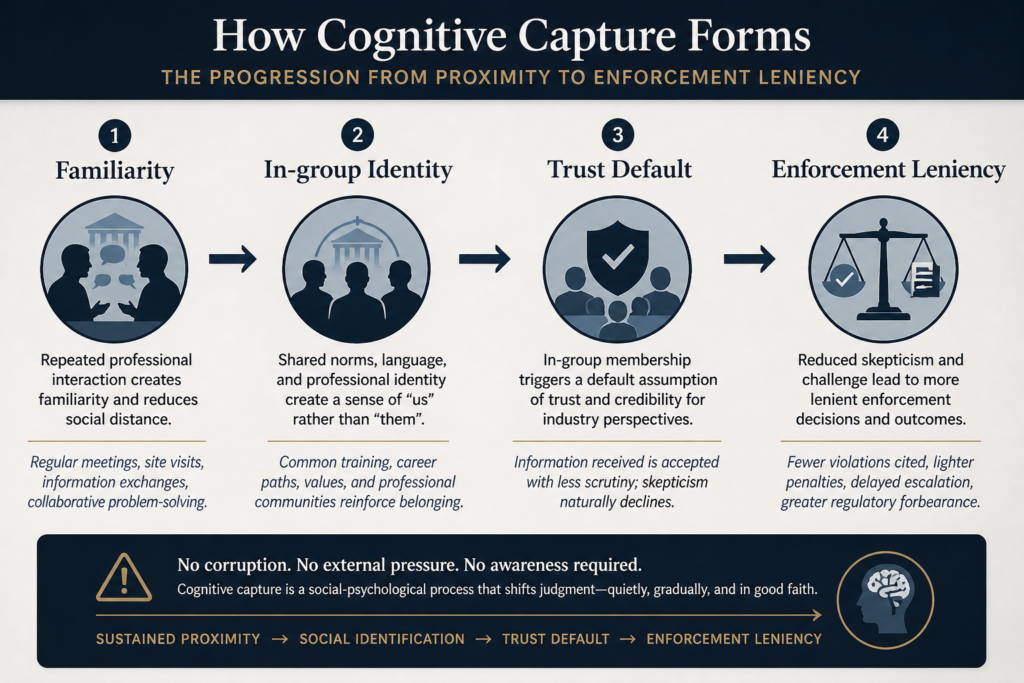
    cognitive regulatory capture

    What Is Cognitive Capture — and What Is It Not?

    Cognitive capture is not corruption. No financial incentive. No quid pro quo. No awareness on the part of the captured official. It is not a failure of ethics or integrity in the conventional sense — the official is acting in good faith throughout.

    Chesterfield, Guardiancich, and Heims (2025, Regulation and Governance) provide the most detailed synthesis to date. Their systematic review of 39 studies consolidates cultural capture into five empirical concepts, forming the CHAIN framework:

    • Closeness — direct social ties between regulators and regulated entities developed through repeated professional interaction
    • Homogeneity — shared educational backgrounds, professional training, and career trajectories producing worldview convergence
    • Avoidance — non-challenge of industry positions, where regulators decline to contest industry framing even when evidence supports challenge
    • Identities — shared professional identity formation, where regulators come to see themselves as members of the same professional community as those they regulate
    • Networks — overlapping social and professional networks that sustain proximity outside formal regulatory interactions

    Ten mechanisms operate through these five concepts. The review produces 33 behavioural indicators. The central empirical finding: in established democracies, cultural and cognitive capture has displaced financial capture as the dominant mode. Financial mechanisms have not vanished — but where structural safeguards have reduced explicit corruption, the cognitive pathway has become the primary residual independence risk.

    The definition is precise: cultural capture consists of “social and psychological processes that bias regulators’ beliefs and behaviours, aligning them with those of the regulatees and marginalising alternative viewpoints.” The captured regulator does not adopt industry positions because they have been bought. They adopt them because sustained proximity has made industry perspectives feel reasonable, expert, and aligned with good regulatory practice.

    The Behavioural Independence Gap

    Burchardt (2025, Maastricht Journal of European and Comparative Law) extends this analysis to independence doctrine itself. Working within the ECHR Article 6 and EU judicial framework, Burchardt argues that current independence doctrine is built on formal insulation — structural provisions designed to prevent external interference — and provides no mechanism to address cognitive proximity effects in serving officials.

    In-group bias and familiarity effects, Burchardt argues, operate as structural threats to decisional independence — not episodic ones. They do not arise from a specific conflict of interest that recusal can manage. They arise from accumulated professional proximity over time, producing a baseline shift in judgment that presents as subject-matter expertise rather than bias.

    The design implications follow directly. If independence is treated as a structural property, the response is insulation: separate the decision-maker from external pressure. If independence also has a cognitive dimension, the response must include cognitive interventions: rotation to interrupt familiarity accumulation, adversarial review to challenge in-group consensus, and independent challenge functions to surface viewpoints that proximity has marginalised.

    Burchardt’s analysis is primarily adjudicative — focused on judicial independence within the ECHR framework. Extension to executive regulatory bodies requires an inferential step. But the underlying psychological mechanisms — in-group bias, familiarity-driven trust, cognitive fluency from repeated interaction — are not jurisdiction-specific. They operate wherever sustained professional proximity exists.

    What Does the Field Evidence Show?

    Three empirical studies provide different angles on the mechanism.

    Amore, Le Coq, and Schwenen (2024, HEC Paris working paper) examine US nuclear power plant regulation using administrative panel data and quasi-experimental design exploiting spatial assignment patterns. Inspector experience and spatial proximity interact in determining safety outcomes. Doubling inspector experience is associated with a 0.3 percentage point reduction in emergency training scores at supervised facilities — the authors estimate this as equivalent to approximately USD 1.2 billion in avoided losses annually across the industry. Less experienced inspectors are assigned to facilities farther from regulatory offices, suggesting proximity and experience covary in ways that affect compliance outcomes.

    Clear limitations. Proximity here is spatial and experiential, not social-identity-based. The familiarity mechanism is implicit — the study does not directly measure social identification between inspectors and facility operators. A working paper, peer review pending. But it provides rare quantitative field evidence that something correlated with proximity and tenure affects enforcement stringency in a technically complex regulatory environment.

    Heims (2023, Regulation and Governance) takes a qualitative approach, applying process-tracing to the FDA’s handling of Vioxx — a case study of regulatory failure in pharmaceutical safety. Evidence of cultural capture manifests as absence of critical challenge of industry-submitted data, uncritical repetition of industry framing in regulatory assessments, and failure to seek contradicting evidence during post-market surveillance. Financial capture mechanisms were not confirmed as the primary driver. The behavioural signatures point to cognitive homogeneity and worldview alignment — the regulator and the regulated entity had converged on what constituted reasonable safety evidence without any explicit agreement.

    Inherent limitation of mechanism-tracing: single-case design, selection on a known failure, inability to establish prevalence. But the case provides granular evidence of how cognitive capture manifests — not just that it exists, but what it looks like operationally.

    A 2025 experimental study in Frontiers in Psychology contributes a finding with particular relevance to regulatory staffing. Using a mixed experimental design with an ultimatum game paradigm, the study finds that pro-social individuals — the motivational profile most associated with public service vocations — exhibit stronger in-group favouritism in norm enforcement than pro-self individuals. Pro-socials more readily accept unfair distributions from in-group members. The social identity theory mechanism is confirmed: group identification enhances loyalty and tolerance of in-group norm violations.

    The regulatory implication is counterintuitive. Officials most likely to enter regulatory service — those with strong prosocial orientation and commitment to public good — may be the most susceptible to in-group leniency. Regulatory staffing that selects for public service motivation may simultaneously select for heightened capture vulnerability through the same psychological mechanism.

    Laboratory setting, general population sample, not regulatory professionals. Ecological validity for enforcement contexts is undemonstrated. But the mechanism — pro-social orientation amplifying in-group favouritism — speaks directly to institutional design.
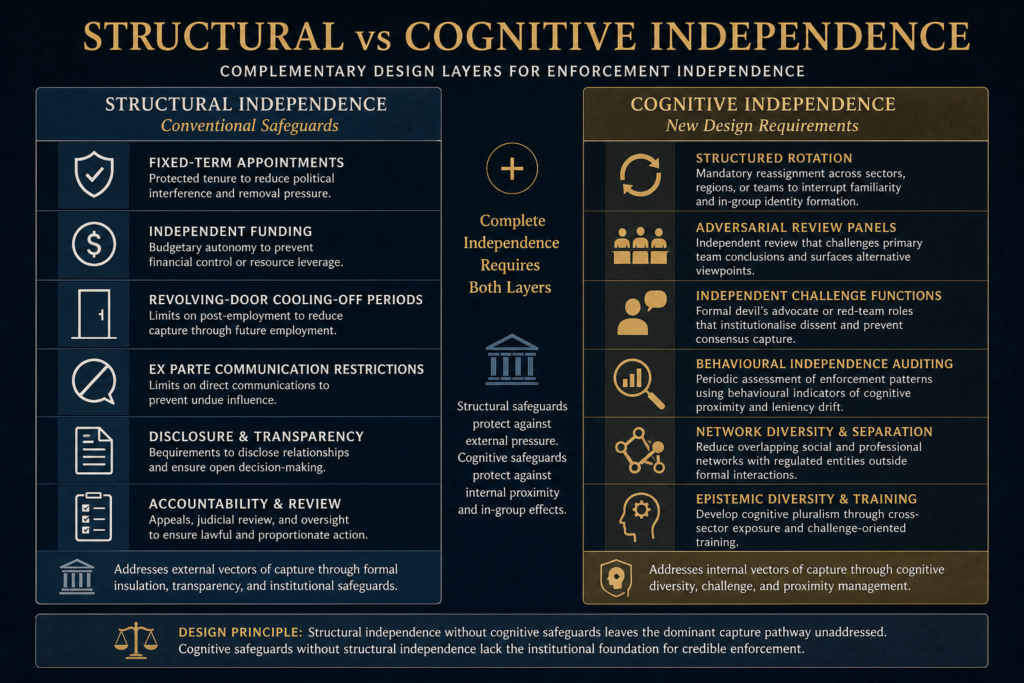
    Two-column framework comparing structural safeguards with cognitive independence design requirements

    The In-Group Identity Puzzle: An Unresolved Conflict

    The social identity theory prediction is straightforward: group identification produces leniency toward in-group members. This aligns with the Chesterfield et al. synthesis, the Heims case study, and the experimental evidence.

    A competing theoretical strand — normative focus theory — predicts the opposite. If group identity heightens normative expectations, in-group members who violate group norms may face harsher enforcement. The in-group violator has betrayed shared standards, triggering a normative enforcement response rather than a leniency response.

    Shayo and Zussman (published in the Journal of the European Economic Association; NBER Working Paper 25355) provide partial field evidence from Israeli small claims courts. Using naturally occurring judicial decision data and judge-litigant ethnicity matching, they find in-group leniency in sentencing — judges are more lenient toward same-group defendants — but a marginally opposing effect in conviction decisions in some specifications. In-group bias operates even under strong non-discriminatory institutional norms. Its direction may vary by decision type.

    For regulatory governance, this unresolved conflict matters practically. If cognitive proximity produces leniency in enforcement discretion (the dominant prediction), rotation and adversarial review are appropriate design responses. If it produces heightened normative enforcement (the minority prediction), proximity might in some contexts serve regulatory objectives. Current evidence supports the leniency prediction in most settings. The conflict is not resolved by existing regulatory field data.

    The Competence-Capture Tradeoff

    Any proposal to interrupt cognitive proximity through rotation or tenure limits confronts the competence argument. Deep sector knowledge improves regulatory decision quality. Regulators who understand their industry make more proportionate, better-targeted enforcement decisions. Rotation imposes learning curves, reduces institutional memory, and may undermine deterrence credibility. The structural friction in self-governance bodies — where reform mandates die at implementation — illustrates the practical costs of institutional redesign without adequate transition infrastructure.

    Not merely a theoretical objection. The OECD engagement principle (Principle 5, 2014) explicitly values regulator-industry engagement as a source of regulatory quality. Amore et al. (2024) provide partial empirical support: more experienced inspectors at nuclear facilities are associated with better safety outcomes overall, even as their proximity correlates with reduced enforcement stringency on specific measures. Competence and capture may be co-products of the same exposure.

    No study has quantified this tradeoff. Commentary in the regulatory governance literature identifies rotation costs — competence loss, institutional memory depletion, compliance relationship disruption — but no field study has measured these costs against measured leniency-reduction from rotation. The design question remains empirically open: at what tenure length does the capture cost exceed the competence gain?

    The Audit Detection Gap

    Cognitive capture is audit-resistant. The enforcement leniency it produces is behaviourally indistinguishable from enforcement proportionality. An inspector who applies a lighter touch because familiarity has shifted their judgment looks identical — to any external audit instrument — to an inspector whose professional judgment has matured. Where paper compliance masks structural failure in corporate liability regimes, cognitive capture masks enforcement drift beneath the appearance of proportionate regulation.

    Moseley and Thomann (2017, in Behavioural Public Administration, Cambridge University Press) document this directly. Inspectors apply more lenient enforcement styles to regulatees they perceive as trustworthy and compliant — a perception developed through repeated interaction. The behavioural output is indistinguishable from proportionate enforcement judgment. Audit instruments measure compliance with procedures. They do not measure the cognitive state producing enforcement decisions.

    The 33 CHAIN indicators developed by Chesterfield et al. represent the most structured attempt to date to make cognitive capture observable at the organisational level. They operate at the organisational level only — identifying cultural capture risk across a regulatory body, not diagnosing it in an individual official. No validated behavioural instrument exists to assess cognitive independence at the individual level.

    What Would Cognitive Independence Design Require?

    If regulatory governance frameworks incorporated cognitive independence as a design parameter — alongside structural independence — the evidence base points to several candidate interventions.

    Structured rotation — mandatory reassignment of regulatory staff across sectors, regions, or regulatory teams at defined intervals. Interrupt familiarity accumulation before in-group identity consolidates. The cost: competence loss and learning-curve effects that remain unquantified against capture reduction.

    Adversarial review panels — independent review functions that challenge enforcement decisions from outside the primary regulatory team. Surface alternative viewpoints that cognitive proximity has marginalised — the “Avoidance” concept in CHAIN. Untested against cognitive capture pathways.

    Independent challenge functions — formalised devil’s advocate or red-team roles within the regulatory body. Institutionalise dissent as a structural feature rather than relying on individual willingness to challenge in-group consensus.

    Behavioural independence auditing — periodic assessment of enforcement patterns using the CHAIN behavioural indicators or equivalent instruments, looking for organisational-level signatures of cognitive proximity effects.

    None has been empirically validated in a regulatory field context. These are design proposals derived from the evidence base, not evidence-based designs. The gap between identifying the mechanism and demonstrating that a specific intervention interrupts it remains open.

    Jurisdictional Coverage and Missing Evidence

    The evidence base is concentrated in established democracies. The United States provides the most granular field evidence — nuclear safety, pharmaceutical regulation, judicial sentencing. The EU contributes doctrinal and institutional analysis. Cross-national systematic review evidence covers established democracies broadly but does not disaggregate by jurisdiction.

    Entirely absent: sub-Saharan African regulatory bodies, South and Southeast Asian regulatory systems, Latin American regulators, post-Soviet transition economies. Whether cognitive capture mechanisms operate differently in lower-capacity regulatory environments — where structural independence may be weaker to begin with — is unknown.

    Sector coverage is similarly uneven. Financial conduct regulation, telecommunications, environmental enforcement, and competition authorities post-2020 have no identified field-level evidence on cognitive capture mechanisms. Cross-sector comparative evidence — whether capture intensity differs between high-discretion regulators and rule-bound inspectorates — does not exist.

    Conclusion: Design Implications for Institutional Decision-Makers

    Five institutional implications follow from the evidence.

    Cognitive proximity is a measurable regulatory governance risk, not a speculative concern. The 2025 systematic review, corroborated by field studies across nuclear safety, pharmaceutical regulation, and judicial decision-making, establishes that social-psychological mechanisms produce enforcement leniency independent of financial incentives.

    Structural independence is necessary but insufficient. Governance frameworks built exclusively on formal insulation — including the OECD Principles — leave the dominant capture mechanism in established democracies unaddressed. The architecture assumes the problem is external. The evidence shows it is internal.

    Cognitive independence design requirements — rotation mandates, adversarial review, challenge functions — belong in governance frameworks as minimum standards, not optional supplements or conduct guidance. A different threat vector than anti-corruption rules. A separate design layer. The risk to institutional legitimacy is not hypothetical — integrity systems that fail by design share the same structural blind spot.

    The competence-capture tradeoff requires empirical quantification before rotation mandates can be calibrated. Design without evidence risks replacing one governance failure with another. The tradeoff is real. The current evidence base does not resolve it.

    Audit and evaluation frameworks need cognitive independence indicators. Structural independence assessments that measure governance arrangements, funding autonomy, and appointment procedures without measuring behavioural indicators of cognitive proximity miss the mechanism that poses the greatest residual risk to enforcement independence.


    About VeritasJPS

    VeritasJPS provides evidence-based research and analysis and advisory at the intersection of regulatory governance, behavioural science, and institutional design. Our work supports institutional decision-makers — regulators, judicial councils, policymakers, and compliance leaders — with analysis grounded in empirical evidence and legal scholarship.

    Learn more: [website URL]
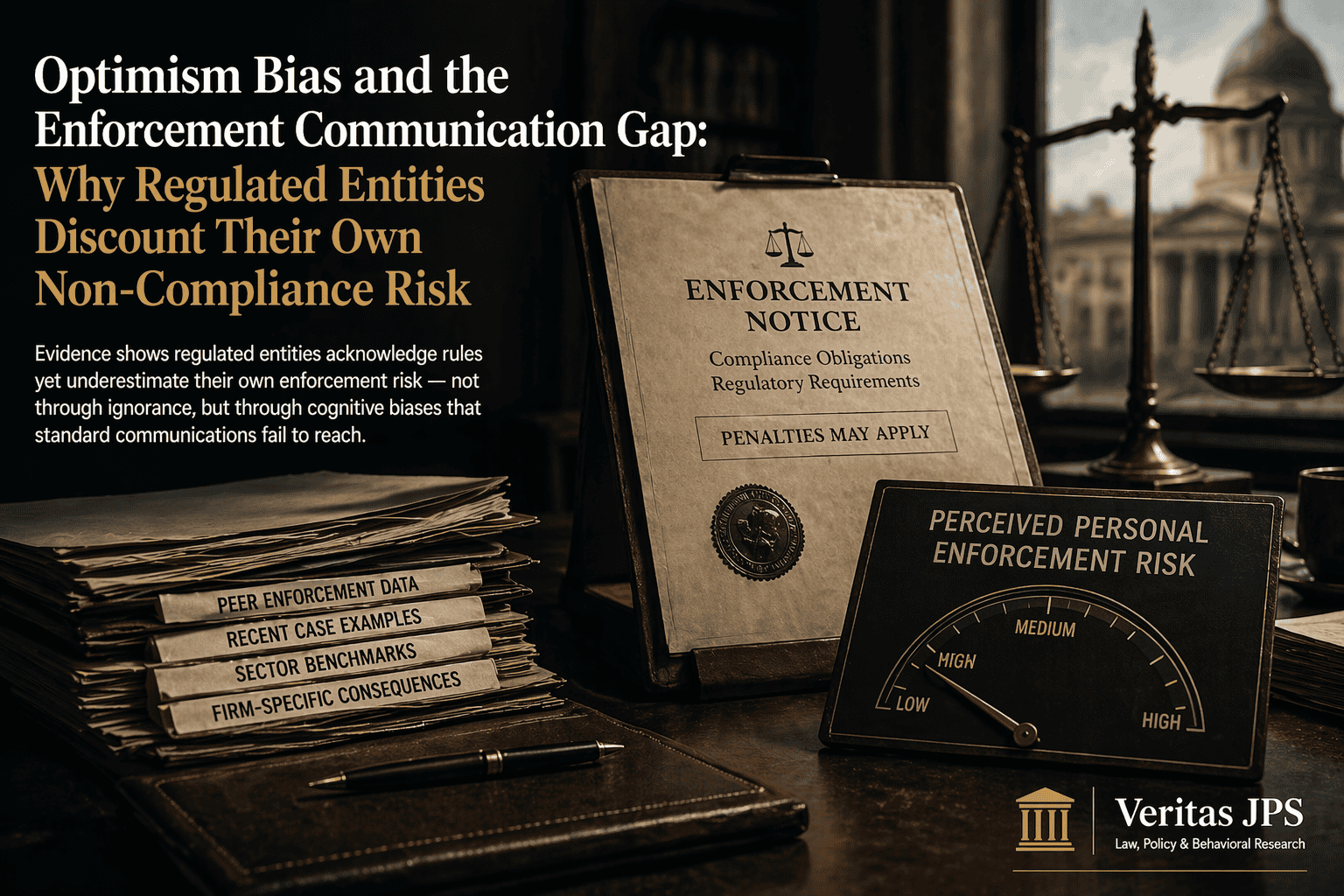
  • Optimism Bias and the Enforcement Communication Gap: Why Regulated Entities Discount Compliance Risk

    Optimism Bias and the Enforcement Communication Gap: Why Regulated Entities Discount Compliance Risk

    Abstract

    Enforcement agencies design optimism bias compliance communications for rational actors who process rules as binary constraints. The empirical evidence on optimism bias invalidates that model. Regulated entities that acknowledge rules still systematically underestimate their personal enforcement exposure — not through ignorance, but through asymmetric belief updating that no deterrence recalibration or compliance training can reach. This analysis examines the neuroscience and behavioural evidence on optimism bias and omission neglect as cognitive drivers of paper-compliance, evaluates whether enforcement communication redesign has been empirically tested as a debiasing intervention, and identifies the structural gap in regulatory guidance that leaves communication design to political communication norms rather than behavioural science.

    The Rational Actor Assumption in Enforcement Communication

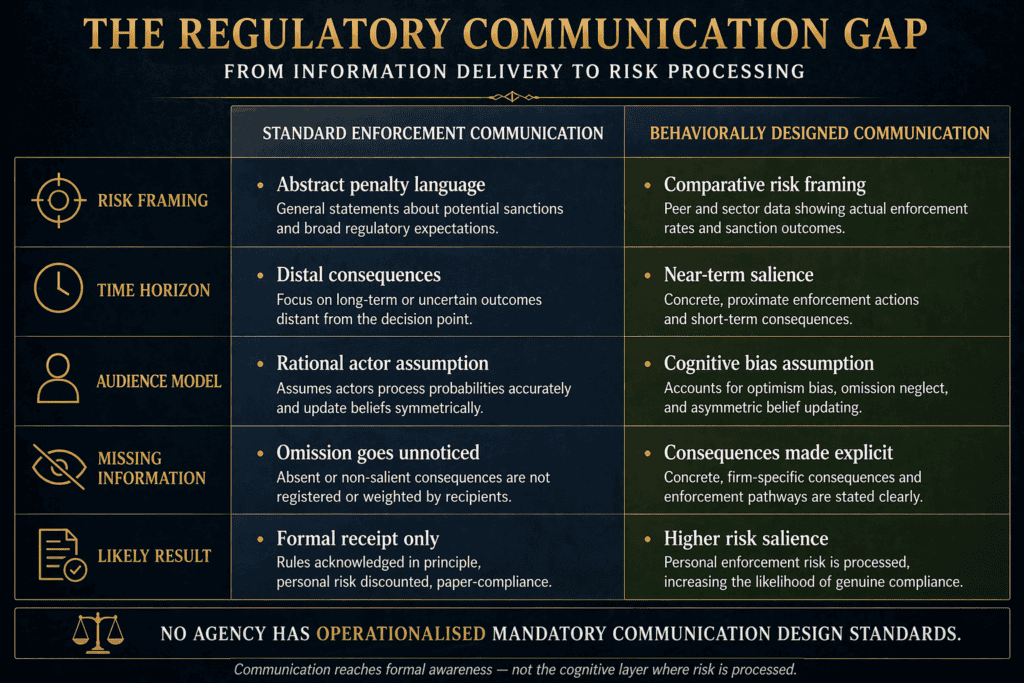
    The architecture of modern compliance communication rests on an implicit model: regulated entities receive information about rules and penalties, calculate detection probability against sanction severity, and adjust behaviour accordingly. The FCA’s Occasional Paper No. 24 — Behaviour and Compliance in Organisations (2016) — documents the limitations of this framework directly. Standard deterrence-based models assume rational cost-benefit calculation, but behavioural biases distort how compliance decisions are actually made within regulated firms. The FCA recommended that regulators shift toward choice architecture and behavioural insights to change the situational framing of compliance decisions, not merely the incentive structure.

    That recommendation was published in 2016. As of 2026, no regulatory agency has operationalised it into mandatory communication design standards.

    Brain diagram illustrating asymmetric belief updating where positive risk information overrides negative signals

    The Cognitive Mechanism: Asymmetric Belief Updating

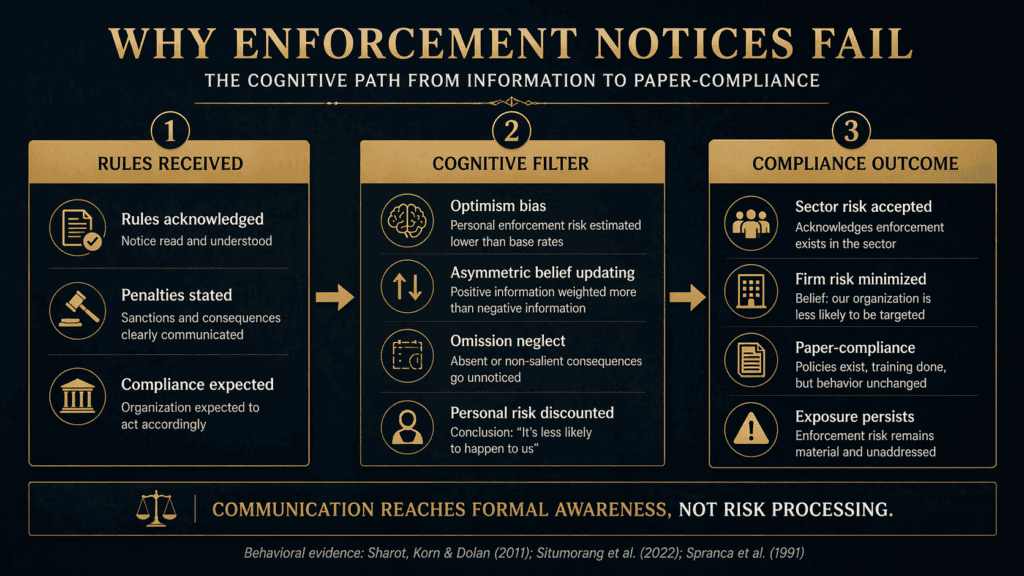
    The neuroscience evidence identifies why rational-actor communication fails. Sharot, Korn and Dolan (2011), published in Nature Neuroscience, demonstrated that optimism bias persists because individuals show asymmetric belief updating: positive information about personal risk is integrated more readily than negative information. The right inferior frontal gyrus shows diminished error-signal coding for undesirable outcomes in high-optimism participants. Enforcement risk communications framed as statistical probabilities are discounted before they reach the decision-making layer.

    This is not a motivational failure. It is a neurological architecture. The regulated actor reads the enforcement notice, accepts the rule applies to the sector, and concludes — without conscious reasoning — that personal enforcement risk is lower than the base rate suggests. Situmorang et al. (N=739, Indonesia, public health regulatory compliance) confirmed the mechanism in a compliance-specific context: unrealistic optimism bias was the single highest predictor of non-compliance behaviour (R²=0.082), outperforming institutional trust as a predictor in stepwise regression.

    Omission Neglect: The Invisible Amplifier

    A second cognitive distortion compounds asymmetric belief updating. Omission neglect — the systematic failure to weight absent or non-salient information — means regulated actors do not register what enforcement communications fail to make explicit. Experimental evidence from Spranca et al. (reviewed in Shulman et al., 2014) demonstrates that individuals form strong judgements on incomplete evidence and systematically underweight harms caused by omission relative to equivalent harms caused by action.

    Applied to enforcement communications: abstract policy language that omits concrete, firm-specific consequence detail is not processed as incomplete information. It is processed as no information. The regulated entity does not notice what the notice does not say. This omission neglect dynamic operates alongside optimism bias compliance failures, compounding the gap between what regulators communicate and what regulated entities actually process.

    The Counterevidence: Construct Heterogeneity

    The evidence is not uniform. Mælan et al. (2022), in a pre-registered Norwegian study (N=4,083, PLOS ONE), found that the expected negative association between optimism and compliance was not supported — optimism showed a small positive association with pandemic compliance. This divergence is attributable to construct heterogeneity: dispositional optimism (a general positive expectancy about outcomes) may support compliance persistence, while unrealistic comparative optimism (the belief that one’s own risk is lower than comparable others’) predicts non-compliance. The two constructs produce directionally opposite effects. Studies that do not distinguish between them generate conflicting findings.

    He et al. (2024) (Frontiers in Psychology, N=270, international construction practitioners) identified cultural bias, confirmation bias, and short-termism as significant predictors of reduced environmental compliance risk perception — but did not isolate optimism bias as a distinct construct. The methodological boundary question is real: is the compliance literature measuring one mechanism under multiple labels, or multiple mechanisms under one label?

    optimism bias compliance

    Temporal Framing as a Partial Debiasing Tool

    One study provides direct evidence on communication redesign as intervention. A German two-study experimental design (consumer insurance compliance) found that comparative optimism had a negative main effect on compliance intention, and that proximal temporal framing — near-term consequence salience — reduced this effect among comparative optimists specifically. The main effect of temporal framing alone was not significant. Framing functioned only as a moderator, not a standalone driver.

    For enforcement agencies, the operational implication is specific. Near-term consequence framing (concrete, proximate enforcement actions) is more likely to reach comparative optimists than distal framing (general deterrence, abstract penalty ranges). The effect was conditional. The context was consumer insurance, not institutional enforcement. Replication in regulated-entity populations has not been conducted.

    The Regulatory Communication Gap

    Institutional and definitional, the gap persists. FCA Occasional Paper No. 24 identified behavioural biases as compliance factors in 2016 but did not specify enforcement communication testing protocols. No OECD or FATF guidance on compliance frameworks addresses the design of enforcement communications as a cognitive debiasing instrument. The behavioural law and economics framework established by Jolls, Sunstein and Thaler (1998, Stanford Law Review) provides the theoretical foundation for treating regulatory communications as cognitive interventions — but this framework has not been operationalised in enforcement methodology in any jurisdiction identified.

    The result: a communication architecture designed by lawyers and economists for rational actors, deployed where the primary compliance failure mechanism is cognitive, not rational. The paper-compliance lag observable in corporate liability regimes is a predictable downstream effect of this mismatch.

    Institutional Implications for Compliance Enforcement

    Enforcement communication audit. Regulatory agencies should audit existing compliance communications against debiasing criteria — not information-delivery criteria. The question is not whether the regulated entity received the notice, but whether the notice was designed to reach the cognitive layer where risk is processed.

    Comparative risk framing. Enforcement communications should include peer-comparison data — sector-specific enforcement rates, comparable-firm sanction outcomes — to counteract comparative optimism. Regulated entities discount abstract risk. They process relative risk.

    Proximal consequence salience. General deterrence language should be supplemented with near-term, firm-specific consequence framing. The temporal framing evidence suggests this is the communication feature most likely to reach comparative optimists.

    Construct specification in compliance research. Future compliance studies must distinguish between dispositional optimism and unrealistic comparative optimism. Without construct isolation, the evidence base will continue producing conflicting findings that regulators cannot operationalise.

    Omission neglect as a design variable. Enforcement communications should be tested for what they omit, not only for what they contain. If concrete consequence detail is absent, omission neglect predicts that regulated actors will not notice the gap.


    VeritasJPS provides evidence-based research and advisory at the intersection of behavioural science, regulatory governance, and compliance enforcement design. Our work supports institutional decision-makers — regulators, enforcement agencies, and compliance leaders — with rigorous analysis grounded in empirical evidence and legal scholarship.

  • Paper-Compliance Lag: Why UK Corporate Liability Regimes Structurally Fail in Their First Years

    Paper-Compliance Lag: Why UK Corporate Liability Regimes Structurally Fail in Their First Years

    Abstract

    Paper-compliance lag defines the first-year enforcement pattern visible across three successive UK corporate liability regimes — the Bribery Act 2010 (s.7), the Criminal Finances Act 2017 (ss.45–46), and the Economic Crime and Corporate Transparency Act 2023 (s.199, failure to prevent fraud).

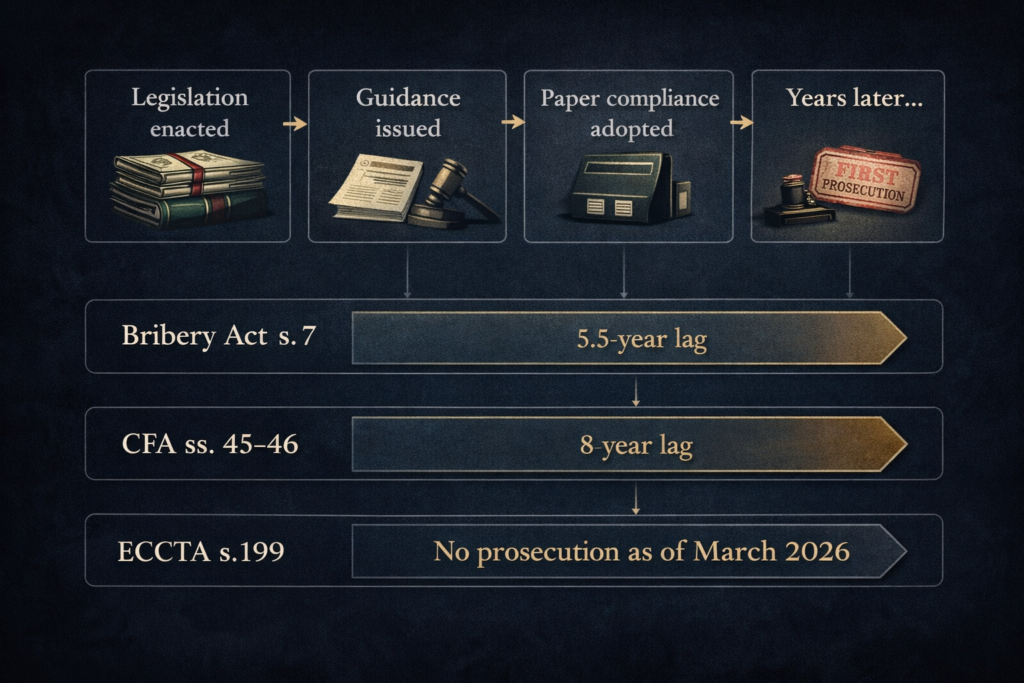
    Three successive UK corporate liability regimes — the Bribery Act 2010 (s.7), the Criminal Finances Act 2017 (ss.45–46), and the Economic Crime and Corporate Transparency Act 2023 (s.199, failure to prevent fraud) — share a structurally repeatable enforcement trajectory: legislation passes, guidance follows, organisations adopt paper compliance, and prosecutions arrive years later. The first s.7 corporate conviction took approximately five and a half years. The first prosecution under ss.45–46 took eight. No prosecution has been brought under s.199 since it entered force in September 2025. This paper-compliance lag pattern is not random.. It is produced by identifiable features of legislative design, prosecutorial resourcing, and organisational response — and it is design-predictable. This analysis argues that enforcement agencies should adopt explicit first-year activation protocols for new corporate liability regimes, rather than accepting structural dormancy as an inevitable cost of corporate criminal law.

    The Dormancy-Then-Activation Arc

    Every major UK “failure to prevent” offence has traced the same arc. Legislation receives Royal Assent. The government publishes guidance — typically months after assent, sometimes after commencement. Organisations respond with compliance documentation. Prosecutors accumulate intelligence. Years later, the first case arrives.

    The Bribery Act 2010 entered force in July 2011. The Ministry of Justice published its “adequate procedures” guidance in March 2011 — nine months after Royal Assent but four months before commencement. The first corporate conviction under s.7, Sweett Group PLC, came in February 2016. Five and a half years. Sweett did not rely on the adequate procedures defence — the company admitted its procedures were absent entirely. The penalty was £2.25 million, a fraction of the financial sanctions secured through Deferred Prosecution Agreements over the same period.

    The Criminal Finances Act 2017 (ss.45–46, failure to prevent facilitation of tax evasion) entered force in September 2017. HMRC published guidance that year. The first corporate prosecution — against an accountancy firm in Stockport — arrived in August 2025. Eight years. By autumn 2025, HMRC confirmed 11 live investigations, 27 “opportunities” under review, and 121 further cases reviewed but not proceeded with. Citation reflects reported judicial practice. Verify with primary case law databases for specific authority.

    The ECCTA 2023 failure to prevent fraud offence (s.199) entered force on 1 September 2025 — nearly two years after Royal Assent in October 2023. Government guidance was published in November 2024. As of March 2026, no prosecution has been brought. The dormancy clock is running.

    What Produces the Lag

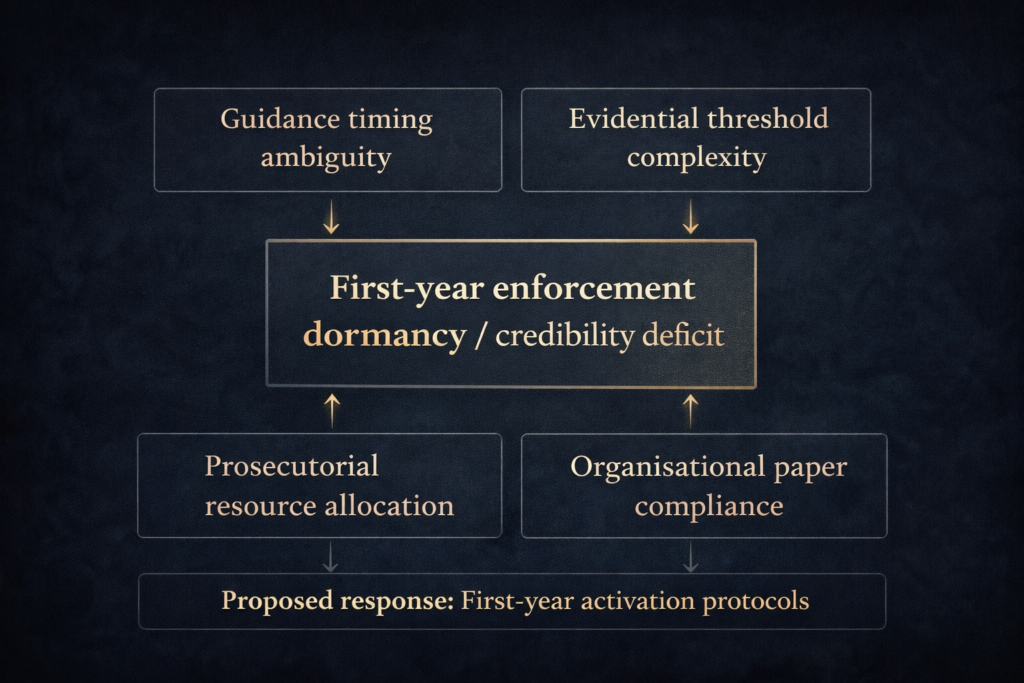
    Compliance commentary treats early dormancy as incidental — a by-product of case-building timelines and prosecutorial caution. It is structural. Four interlocking mechanisms generate it across all three regimes.

    Guidance publication timing. In each regime, the gap between Royal Assent and usable guidance opens a window of statutory ambiguity. The MoJ’s Bribery Act guidance drew criticism from Transparency International UK for its insufficient clarity on what “adequate procedures” required — a judgment the House of Lords Select Committee on the Bribery Act endorsed in its 2019 post-legislative scrutiny (HL Paper 303). The Committee found guidance to be vague, high-level, and insufficiently prescriptive. The ECCTA guidance, published twelve months before commencement, was framed as giving organisations time to build fraud prevention procedures. That framing is deliberate design. But it replicates the same compliance-signal-without-enforcement dynamic that characterised each predecessor regime.

    Evidential threshold complexity. Each offence imposes a distinct burden that prosecutors must discharge before initiating proceedings. Under ss.45–46 CFA 2017, HMRC must prove that an “associated person” criminally facilitated tax evasion — not merely that the organisation’s controls were deficient. The ratio of 121 cases reviewed but not proceeded with against 11 live investigations tells a clear story: evidential thresholds operate as a structural brake on prosecution volume in the early years, irrespective of political intent.

    Prosecutorial resource allocation. The SFO’s first decade of s.7 enforcement was characterised by a marked preference for Deferred Prosecution Agreements over criminal convictions. Six DPAs secured financial sanctions exceeding £1 billion — dwarfing the £2.25 million criminal penalty in Sweett Group. That preference may reflect strategic prioritisation rather than incapacity. But it means criminal conviction rates are a misleading metric for enforcement activity — and organisations calibrating their compliance investment to conviction risk are reading the wrong signal. Under ECCTA s.199, both the SFO and CPS hold prosecution authority. The SFO’s updated Compliance Programme Guidance (November 2025) addresses evaluation criteria for “reasonable fraud prevention procedures” but publishes no case-initiation targets or priority sequencing for the new offence.

    Organisational paper compliance. This is the most persistent mechanism and the hardest to measure. When organisations respond to new offences by documenting policies rather than changing conduct, the resulting compliance posture is difficult for prosecutors to falsify at investigation stage. Nine months after the Bribery Act’s commencement, an FTI Consulting survey found that 29% of respondents described themselves as “risk takers” prepared to contravene the Act to win business. Twenty per cent were confident they could do so without detection. Citation reflects reported judicial practice. Verify with primary case law databases for specific authority. That gap — between documented compliance and actual behavioural intent — is precisely where enforcement dormancy takes root.

    The 2025 Anti-Corruption Strategy: Signalling Without Sequencing

    The UK Anti-Corruption Strategy 2025, published in December 2025, contains 123 stated commitments. It signals expansion of the Domestic Corruption Unit, deployment of AI to accelerate investigations, appointment of a dedicated coordinator for “professional enablers,” and reform of the AML/CTF supervisory regime toward a single regulator.

    What it does not contain is an explicit enforcement activation timeline for ECCTA s.199. No prosecutorial priority sequencing for new offences. No case-initiation metrics. No acknowledgment of the structural dormancy pattern that has characterised every preceding failure-to-prevent regime.

    The Strategy reads as political signalling — confirming where governmental attention is directed — not as an operational prosecution framework. This is not a deficiency unique to the current government. No UK enforcement strategy has ever published an explicit first-year activation protocol for a new corporate liability offence. The omission spans administrations.

    The Counterargument: Dormancy as Design

    The strongest objection to characterising early enforcement gaps as structural failure is that they reflect appropriate prosecutorial discretion. The OECD’s Phase 4 UK Report (2017) found that the Bribery Act had prompted substantial progress in corporate anti-corruption compliance — organisations were adopting preventive measures even without prosecutions. Citation reflects reported judicial practice. Verify with primary case law databases for specific authority. On this reading, deterrence operates through the threat of prosecution, not its execution. Early dormancy is an acceptable trade-off for culture change.

    The argument has force. It also has limits.

    If the enforcement threat is never activated — or activated only against firms that have already admitted to absent procedures, as in Sweett Group — the deterrence signal degrades. The FTI 2012 data showed a significant minority of organisations discounting enforcement credibility within the first year. Eight years of zero prosecutions under ss.45–46 CFA 2017 is not a deterrence strategy. It is a credibility deficit.

    The further counterargument — that DPAs constitute active enforcement even when criminal convictions are absent — is jurisdictionally specific. DPAs were available for s.7 Bribery Act cases. Their availability for ECCTA s.199 is not yet tested, and the broader offence scope (Schedule 13 fraud offences) may shift the enforcement calculus entirely. Relying on DPA precedent from one regime to predict enforcement patterns in another is an assumption, not an analysis.

    The Cross-Regime Pattern

    The enforcement trajectories across all three regimes are structurally consistent:

    • Bribery Act s.7 (2010): Commencement July 2011. Guidance lag approximately nine months post-Royal Assent. First corporate prosecution five and a half years post-commencement. No published activation timeline.
    • CFA ss.45–46 (2017): Commencement September 2017. Guidance lag approximately six months. First prosecution eight years post-commencement. No published activation timeline.
    • ECCTA s.199 (2023): Commencement September 2025. Guidance lag approximately twelve months post-Royal Assent. No prosecution as of March 2026. No published activation timeline.

    The dormancy period is lengthening. 5.5 years, then 8. Whether this reflects increasing evidential difficulty, declining prosecutorial capacity, or the normalisation of paper-compliance as a prosecution barrier cannot be determined from current data. No study has disaggregated these variables across regimes.

    The Home Office’s Post-Legislative Scrutiny Memorandum for the CFA 2017, published in May 2024 — seven years after commencement — confirmed zero corporate convictions under ss.45–46 at that date. The first prosecution followed four months later. Parliamentary scrutiny did not accelerate enforcement activation.

    What the Evidence Does Not Cover

    Several material gaps constrain this analysis.

    No published survey measures large-organisation compliance adoption rates, board-level engagement, or training uptake in the first six months following ECCTA s.199 commencement. Pre-commencement advisory materials describe what organisations should do. No data establishes what organisations have done. The FTI 2012 survey on Bribery Act adoption is the nearest proxy — but it measured a different offence, in a different enforcement environment, fourteen years ago.

    No causal disaggregation study separates prosecutorial resource constraints, evidential threshold complexity, deliberate DPA-preference strategy, and organisational paper-compliance opacity as independent contributors to the dormancy period. This is the single most significant analytical gap for policymakers considering activation-trigger design.

    Scotland and Northern Ireland enforcement under both CFA ss.45–46 and ECCTA s.199 is not separately documented. Cross-border enforcement consistency remains uncharted.

    No comparative analysis maps UK dormancy patterns against equivalent regimes in other jurisdictions — Australia’s corporate liability reforms, the US FCPA enforcement model, or France’s Sapin II obligations. Whether the UK pattern is exceptional or typical of common law corporate liability design is an open question.

    The Case for First-Year Activation Protocols

    The evidence supports a specific institutional recommendation: enforcement agencies should publish explicit activation protocols covering the first twelve to twenty-four months of new corporate liability offences.

    An activation protocol would not mandate prosecutions within the first year. It would require published metrics — investigation initiation targets, intelligence-gathering benchmarks, sectoral engagement indicators — that signal prosecutorial capacity and intent during the period of highest behavioural uncertainty. The current model, in which guidance is published and enforcement materialises years later, produces a predictable credibility deficit. The compliance industry fills it with paper documentation. The regulated population fills it with rational discounting.

    The SFO Director’s public statement that corporations must “get their house in order or be ready to face investigation” is necessary but insufficient. Statements of intent without published enforcement scheduling replicate the signalling pattern that preceded dormancy in both prior regimes.

    The UK’s 2025 Anti-Corruption Strategy had an opportunity to break this cycle. It did not take it. Whether the ECCTA s.199 enforcement trajectory will replicate the five-to-eight-year dormancy of its predecessors depends on choices that prosecutors have not yet made public — and that the institutional design of UK corporate criminal enforcement does not currently require them to make.


    About VeritasJPS

    VeritasJPS provides evidence-based research and advisory at the intersection of corporate criminal liability, compliance science, and institutional enforcement design. Our work supports institutional decision-makers — general counsels, compliance directors, policymakers, and regulators — with rigorous analysis grounded in empirical evidence and legal scholarship.

    Learn more: