
Category: Policy Brief

Pipeline output, 800-1500 words

  • Constitutional Redesign as the Structural Mechanism for Judicial Delegitimization: Pakistan, Hungary, Poland, and the International Standards Gap

    Constitutional Redesign as the Structural Mechanism for Judicial Delegitimization: Pakistan, Hungary, Poland, and the International Standards Gap

    Abstract

    Constitutional amendment — not military coup, not executive decree — has become a dominant contemporary instrument for dismantling judicial independence across democracies with weak insulation mechanisms. Pakistan’s 26th Constitutional Amendment (2024) and 27th Constitutional Amendment (2025) represent the most structurally complete recent execution of this pattern, transferring apex court jurisdiction to an executive-appointed Federal Constitutional Court. Parallel trajectories in Hungary, Poland, and Indonesia confirm a replicable escalation sequence: appointment capture, composition shift, jurisdictional transfer. The UN Basic Principles on the Independence of the Judiciary (1985) and the Bangalore Principles of Judicial Conduct (2002) — the two primary international instruments governing judicial independence — were designed to protect individual judges, not court architectures. They contain no provisions addressing structural court bifurcation, minimum procedural thresholds for constitutional amendments restructuring courts, or jurisdictional transfer as a delegitimization vector. This gap leaves constitutional redesign as a fully documented but underregulated pathway to institutional collapse.

    The Pattern: Amendment as an Insulation-Bypassing Tool

    The conventional account of judicial independence threats centres on dramatic ruptures — military coups, emergency decrees, the outright abolition of courts. That account is outdated. The dominant mechanism now operates inside constitutional frameworks, exploiting the ordinary amendment process to reconstruct courts in ways that strip the institutional preconditions for independence before any individual judge is touched.

    The logic is structural, not personal. Four mechanisms should be distinguished at the outset. Court-packing changes who decides by altering appointments or bench composition. Jurisdiction-stripping changes what an existing court is allowed to decide by removing categories of cases from its reach. Court bifurcation creates a parallel judicial body and reallocates core constitutional functions to it. Apex replacement is the terminal form of the sequence: the formal supreme court remains, but a newly created body becomes the effective final constitutional authority. These mechanisms can occur separately, but in contemporary democratic backsliding they often appear sequentially.

    Court-packing through appointment control shifts the composition of a bench. Court bifurcation goes further: it manufactures an entirely new apex body, transfers constitutional jurisdiction to it, and subordinates the original court — all through amendments that satisfy formal procedural requirements. The existing court retains its name but loses its function. The legitimacy question shifts from “Did the court decide correctly?” to “Does the court still exist in any meaningful operational sense?”

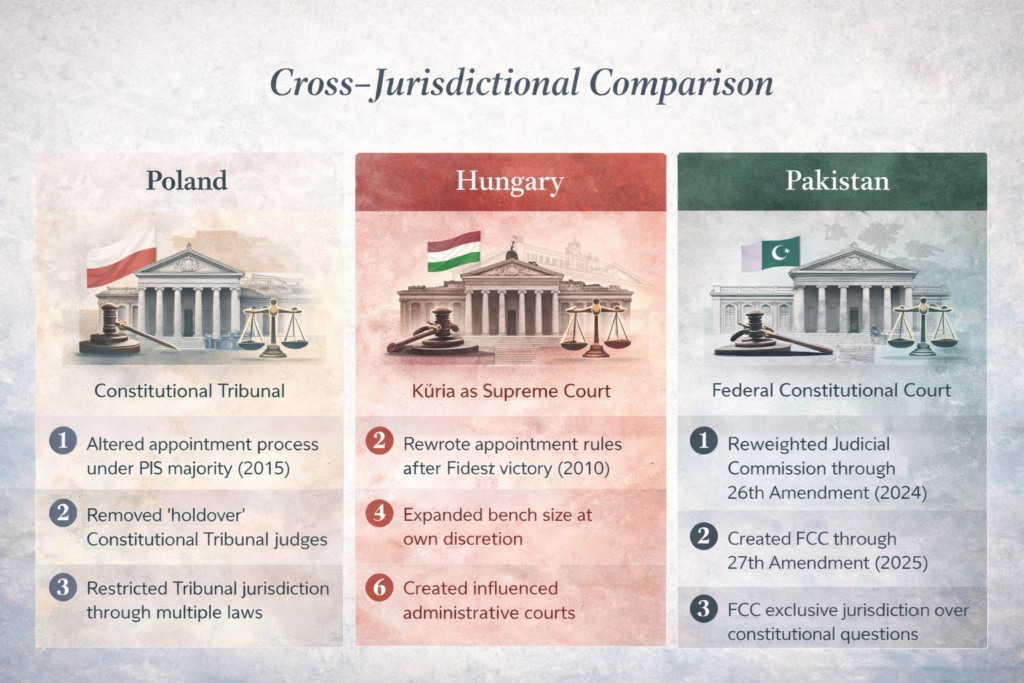
    Across jurisdictions, the pattern holds, though not in identical doctrinal form. What is shared is not institutional identity but structural logic: formal legal redesign used to neutralize courts without formally abolishing them. V-Dem data across Hungary and Poland documents measurable judicial independence erosion following amendment-based restructuring. Indonesia’s Constitutional Court has faced parallel regression through formal instruments, as documented in a 2024 three-country comparison examining court-packing across post-democratic-transition systems. The sequence is consistent: appointment control leads to composition capture, which enables jurisdictional subordination.

    Pakistan: The 26th Amendment (2024)

    Pakistan’s 26th Constitutional Amendment, passed on October 20–21, 2024, overhauled the judicial appointment and tenure architecture of the Supreme Court through ordinary parliamentary majority. Three changes matter.

    First, the Chief Justice of Pakistan is no longer the most senior judge by automatic succession. A Special Parliamentary Committee — eight members from the National Assembly, four from the Senate — now nominates the CJP from the three most senior judges. The government commands a built-in majority on that committee.

    Second, the Judicial Commission of Pakistan was recomposed. Political members — the law minister, attorney general, and parliamentary nominees — now outnumber judicial members on appointment decisions.

    Third, a Constitutional Bench was created within the Supreme Court, carrying exclusive suo motu and advisory jurisdiction. A court within a court, with its own presiding judge nominated by the reconstituted JCP. The bench exercises the most constitutionally sensitive work — the kind that tests executive power — under an appointment architecture in which the executive holds the deciding vote.

    The International Commission of Jurists assessed this as a blow to judicial independence, citing the UN Basic Principles requirement that appointing bodies remain independent of executive control.
    Pakistan: The 27th Amendment (2025) — Court Bifurcation as the Endgame

    The 27th Constitutional Amendment, passed in November 2025, completed what the 26th began. Where the 26th captured appointments, the 27th captured jurisdiction.

    The amendment established a Federal Constitutional Court as a new apex body with exclusive authority over constitutional interpretation, federal-provincial disputes, fundamental rights enforcement, and any substantial question of law involving constitutional interpretation. FCC judgments bind all courts, including the Supreme Court. The Supreme Court was reduced to a non-constitutional appellate body — retaining its name, losing its constitutional role.

    The appointment mechanism for the FCC’s inaugural bench was stripped bare. The first Chief Justice and first batch of judges are appointed by the President on the advice of the Prime Minister. No selection criteria. No transparency requirement. No judicial-body consent. Subsequent appointments run through the JCP and Special Parliamentary Committee — the same bodies already captured by the 26th Amendment, in which judicial members hold a 5-of-13 minority.

    The circularity is documented and deliberate. The 27th Amendment designates the FCC itself as the forum for challenges to its own constitutionality. Court officials refused to accept petitions contesting the amendment. A body created by executive appointment adjudicates challenges to its own creation — a design that forecloses external review by definition.

    Additional provisions reinforced the shift. High Court judges can be forcibly transferred without consent; refusal within 30 days triggers disciplinary proceedings and a bar from judicial functions. Lifetime criminal immunity was extended to the President and to the holder of the Field Marshal rank — currently the Chief of Army Staff.

    The ICJ’s Secretary-General described the 27th Amendment as “dismantling justice” and “a full-frontal assault on the rule of law,” invoking UN Basic Principles 10, 12, 14, 18, and 19: the requirement that appointing bodies be independent, that objective criteria govern selection, and that removal occur only for serious misconduct through appropriate procedure.
    The Escalation Sequence: Replicable Preconditions Across Jurisdictions

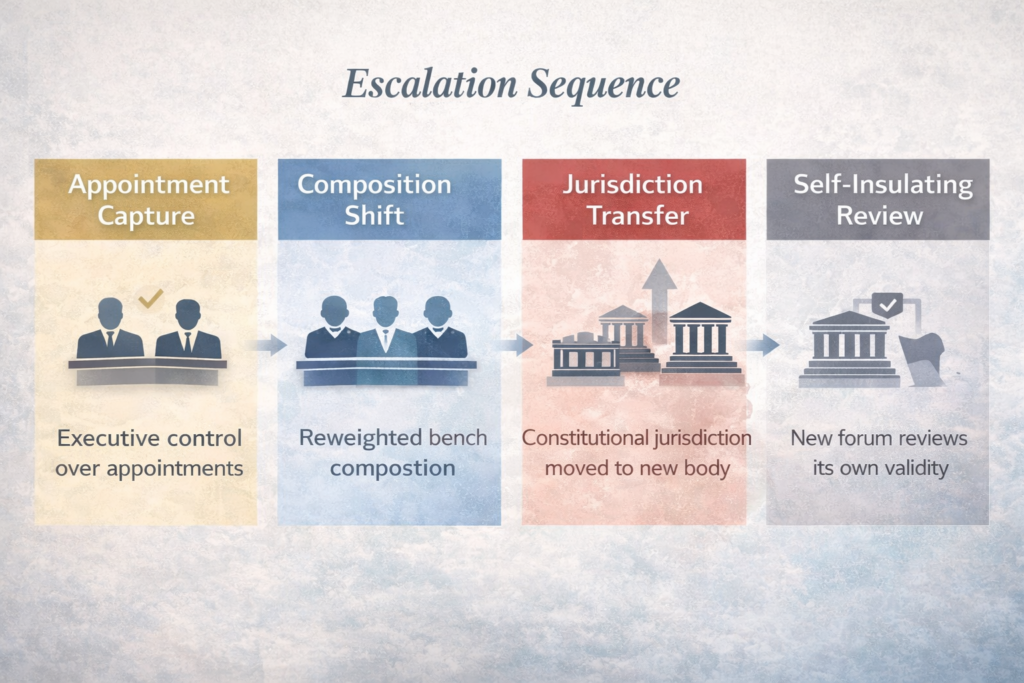
    Pakistan’s 26th-to-27th trajectory is not improvised. It mirrors a documented escalation observable across jurisdictions.

    Stage 1 — Appointment capture. The executive gains effective control over who sits on the bench. In Hungary, Fidesz’s constitutional supermajority restructured the nomination process after 2010. In Poland, PiS used its parliamentary majority to alter the composition of the Constitutional Tribunal from 2015. In Pakistan, the 26th Amendment achieved this through JCP recomposition and the Special Parliamentary Committee.

    Stage 2 — Jurisdictional transfer. Once composition is controlled, jurisdiction gets redirected. Pakistan’s Constitutional Bench (26th Amendment) and then the FCC (27th Amendment) are the clearest recent examples — but the pattern echoes Hungary’s creation of the Kúria as the new supreme court body and the subsequent establishment of administrative courts designed to handle politically sensitive cases.

    Stage 3 — Structural insulation of the new architecture. The reformed body is made self-referential: challenges to its constitutionality route through itself. Pakistan’s 27th Amendment is the most explicit contemporary example, but the principle holds wherever the new court controls the forum for reviewing its own validity.

    A synthetic control study of Hungary and Poland published in the Journal of European Public Policy found a counterintuitive result: Hungary’s formal constitutional redesign — conducted through a supermajority — eroded judicial independence more severely than Poland’s explicit court-packing through simple majority. Hungary’s V-Dem rule-of-law index dropped from 0.89 to 0.71; Poland’s from 0.96 to 0.83 over the 2009–2019 window. Formal process did not legitimize the change. It may have insulated it from challenge. Citation reflects reported judicial practice. Verify with primary case law databases for specific authority.

    What Enables the Pattern: Bilateral Preconditions

    The structural-attack narrative — governments dismantling independent courts — is incomplete. Kureshi (2025), writing in Government and Opposition, identifies a bilateral precondition: judiciaries that adopt what he terms a “representation-replacement approach” — treating themselves as more representative than elected institutions — create the political conditions for structural dismantling. When courts appropriate executive and legislative functions, they hand populist governments rhetorical cover for counter-restructuring.

    This does not excuse constitutional capture. It exposes a second vulnerability: the pattern is not solely about executive overreach but also about institutional overextension by courts themselves. Pakistan’s Supreme Court had, in the decades preceding the 26th Amendment, expanded its reach into territory conventionally occupied by elected branches — a trajectory that Pakistan’s legislative actors subsequently cited as justification for rewriting the rules.

    Separately, Aydin-Cakir and Akarçay (2025) document in the International Review of Law and Economics that verbal government attacks on the judiciary intensify as political corruption rises, specifically in countries with independent media. The mechanism is exposure avoidance: governments go after courts when courts threaten to expose corruption. While this study addresses verbal confrontation rather than structural redesign, it identifies the upstream trigger — corruption-driven accountability avoidance — that precedes the escalation to constitutional amendment.

    The Legitimacy Consequence: What the Evidence Measures

    Gibson’s body of work on judicial legitimacy — the most extensive empirical programme on the subject — supplies the theoretical framework for understanding what constitutional redesign destroys. His 2024 analysis in Science Advances found that the U.S. Supreme Court’s post-Dobbs legitimacy impact may have been the largest documented blow to court legitimacy, with approval polarizing along partisan lines for the first time in decades. His 2025 follow-up in the Annals of the American Academy of Political and Social Science tracked whether those effects persisted — and found evidence they did.

    The critical distinction is between decision-based erosion and structural erosion. Gibson’s work measures legitimacy shifts after controversial rulings — a court that exists and functions but decides unpopularly. Constitutional redesign operates on a different plane. It removes the institutional conditions for diffuse support before any individual ruling can be contested. When Pakistan’s 27th Amendment transferred constitutional jurisdiction to a body appointed by the Prime Minister, the question was no longer “Did the court get it right?” but “Is there a court capable of getting it right at all?”

    Gibson’s own positivity theory — that courts enjoy deep reservoirs of goodwill and institutional loyalty is substantially resilient — provides a partial counterweight. But the theory was developed and tested in the U.S. context, where institutional legitimacy reserves run deep. Whether positivity theory holds in younger democracies with shallower reserves — Pakistan, Hungary, Indonesia — is empirically untested at the structural-redesign level.
    The International Standards Gap

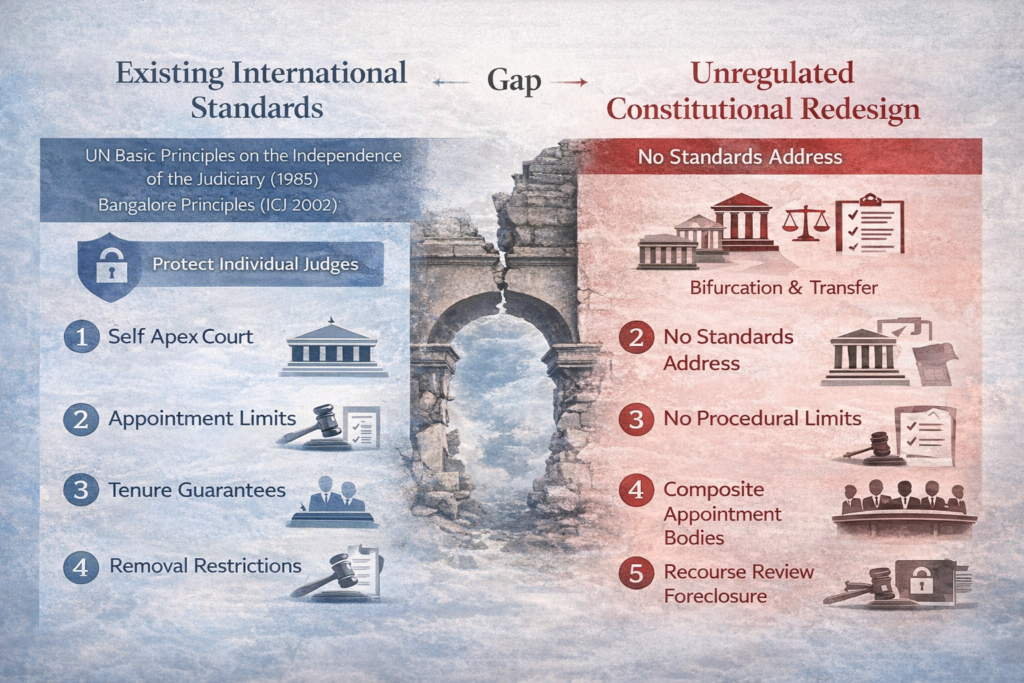
    The two primary international instruments governing judicial independence — the UN Basic Principles on the Independence of the Judiciary (1985) and the Bangalore Principles of Judicial Conduct (2002) — were designed for a different threat model.

    The UN Basic Principles address what can be done to individual judges: Principle 10 governs appointment integrity, Principle 12 secures tenure, Principle 14 protects case assignment, Principle 18 restricts removal. The Bangalore Principles address how judges should conduct themselves: independence, impartiality, integrity, propriety, equality, competence.

    Neither instrument addresses what can be done to courts as institutions. No provision governs structural court bifurcation — the creation of a parallel apex body that displaces an existing court’s jurisdiction. No minimum procedural threshold exists for constitutional amendments that restructure court systems: no requirement for a supermajority, a referendum, or judicial-body consent. No prohibition covers jurisdictional transfer as a mechanism for reducing a court’s scope without formally abolishing it. No standard addresses composite appointment bodies in which judges hold a permanent minority.

    By invoking these instruments against Pakistan’s 27th Amendment, the ICJ exposes their limits. The ICJ can point to principles governing appointment criteria and judge-level conduct. It cannot point to any binding standard that prohibits what Pakistan did: creating a new court, transferring constitutional jurisdiction to it, and appointing its judges without institutional constraint. The instruments were written to protect judges. The threat has moved to court architectures.

    Whether the insulation question — should judicial appointment frameworks be shielded from ordinary legislative amendment? — can be answered through international standard reform remains unclear. León (2024), writing in Global Constitutionalism, examines supermajority rules in judicial decision-making — but no retrieved study evaluates whether requiring supermajority or referendum approval for court-restructuring amendments produces measurably higher judicial independence or legitimacy scores. The design question is real. The evidence base for answering it does not yet exist.

    What This Means for Institutional Decision-Makers

    Five implications follow.

    First, the threat model for judicial independence must expand beyond individual-judge protections. Court bifurcation — creating new bodies that absorb constitutional jurisdiction — is a distinct attack vector that existing international instruments do not cover.

    Second, the escalation from appointment capture to jurisdictional transfer to self-referential insulation is a documented sequence, not a theoretical construct. Monitoring systems that fixate on appointment processes alone will miss the later stages until they are constitutionally entrenched.

    Third, formal constitutional procedure does not legitimate structural dismantling. The Hungary-Poland comparison suggests that constitutional-supermajority redesign may produce deeper independence erosion than simple-majority court-packing — because it is harder to challenge and carries the procedural imprimatur of constitutional legitimacy.

    Fourth, bilateral preconditions matter. Judicial overextension — courts appropriating executive or legislative functions — creates the political conditions for counter-restructuring. Institutional self-restraint is not weakness; it is structural defence.

    Fifth, the absence of empirical measurement is itself a governance failure. No public-opinion instrument has been deployed to measure diffuse support for judicial institutions before and after constitutional court bifurcation in any of the affected jurisdictions. The legitimacy consequences of Pakistan’s amendments, Hungary’s Kúria restructuring, and Indonesia’s Constitutional Court regression are inferred from structural analysis and expert assessment — not from population-level data. That gap must close before evidence-based institutional design can proceed.


    About VeritasJPS

    VeritasJPS provides evidence-based research and advisory at the intersection of jurisprudence, behavioural science, and institutional governance. Our work supports institutional decision-makers — judges, policymakers, and compliance leaders — with rigorous analysis grounded in empirical evidence and legal scholarship.

    Learn more:


  • Zero-Score Ethics: Why Judicial Integrity Systems Fail by Design

    Zero-Score Ethics: Why Judicial Integrity Systems Fail by Design

    Abstract

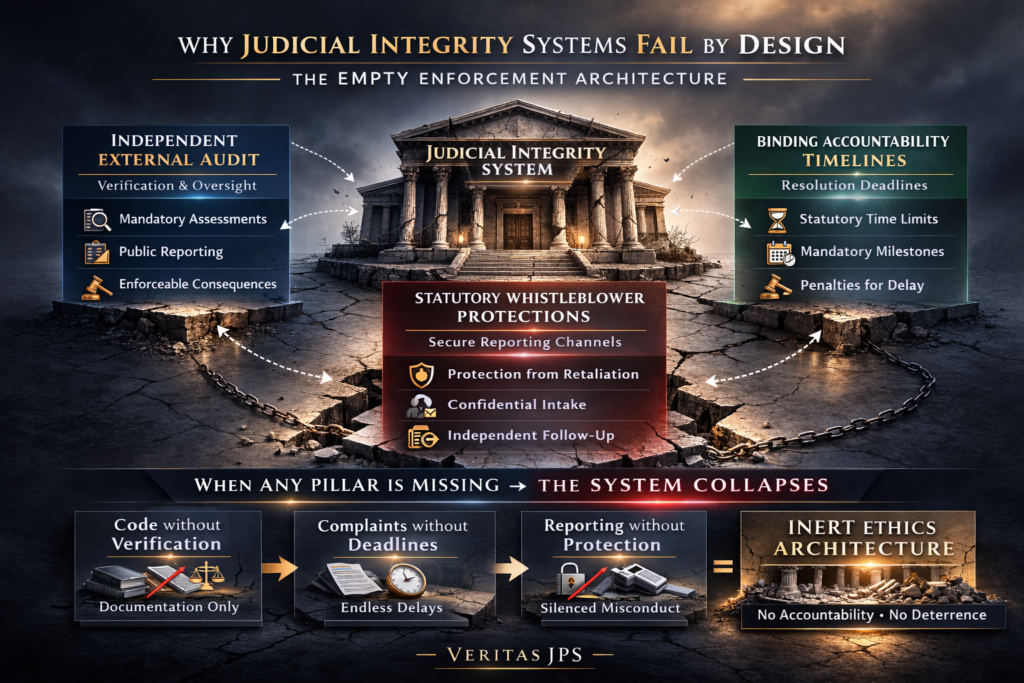
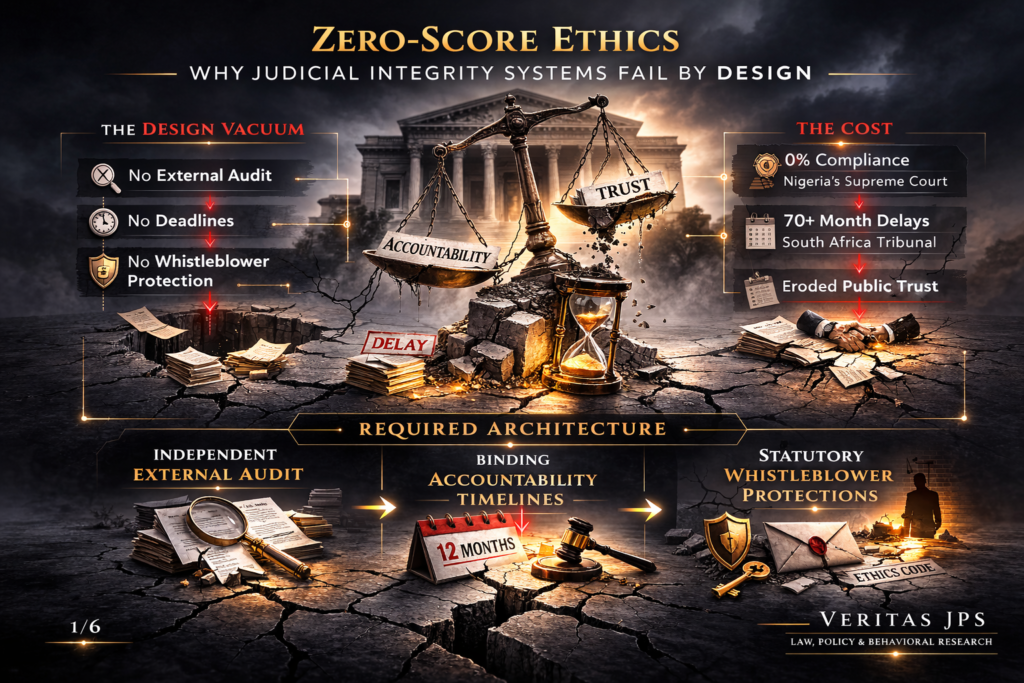
    Judicial integrity systems fail when their enforcement architecture is empty. When Nigeria’s Independent Corrupt Practices Commission assessed 330 federal bodies in 2024, the Supreme Court scored zero percent across every ethics and integrity indicator — management culture, financial management, and administrative systems. The score repeated in 2025. In South Africa, a gross misconduct complaint against a High Court judge required seventy months to reach a finding under a statutory framework designed to resolve such complaints. Neither case represents isolated judicial misconduct. Both expose a structural design vacuum: the simultaneous absence of independent external audit authority, binding accountability timelines, and statutory whistleblower protections — three features the governing international standard, the , neither prescribes nor recommends. This analysis draws on evidence from six jurisdictions and one global index. The central argument: independent external ethics audit bodies with binding reporting timelines should be treated as a minimum institutional design requirement for apex courts, separate from and parallel to judicial conduct committees.

    Judicial Integrity Systems Fail as Architecture, Not Conduct

    Anti-corruption discourse centres on enacting codes and establishing committees. The structural failure that receives insufficient attention sits inside those committees — where absent timelines, absent external audit, and absent whistleblower protection render the ethics architecture inert by design.

    The distinction matters. The standard institutional response to an ethics scandal is to strengthen the code. Add new provisions. Expand the conduct committee’s mandate. Issue guidance. But if the architecture surrounding the code has no mechanism to verify compliance, no deadline to resolve complaints, and no protected channel for reporting misconduct, the code operates as documentation rather than governance.

    The offers a rare instrument for testing this claim. Deployed since 2016 across Nigerian federal agencies, the EICS uses a three-KPI framework — management culture and structure, financial management systems, and administrative systems — to produce composite compliance scores. In the 2024 assessment, the Supreme Court of Nigeria scored 0.00% across all three domains. Fifteen of 330 assessed bodies scored zero. None achieved full compliance.

    That is not a one-cycle anomaly. The 2025 EICS repeated it.

    What a Zero Ethics Score Measures — and What It Misses

    A zero score on the EICS indicates failure on documentation compliance: governance and executive management practices, financial auditing processes, ethics education, and whistleblowing mechanisms. ICPC officers visit agencies physically; submissions are cross-validated against FIRS, Bureau of Public Procurement, and ICPC investigative data; the agency CEO must certify accuracy by signature.

    The limitation is real. The EICS measures documentation compliance, not behavioural outcomes. A zero score may reflect refusal to participate rather than demonstrated substantive failure — and ICPC’s public reporting does not consistently distinguish between non-responsive agencies classified as “Corruption High Risk” by assumption and agencies assessed as substantively non-compliant. The Commission’s own methodology documentation acknowledges that 37.5% of agencies did not respond during the 2020 virtual deployment cycle. That selection bias goes unflagged in the published results.

    The measurement limitation does not neutralize the architectural finding. Whether the Supreme Court scored zero because its integrity infrastructure is substantively absent or because the institution refused to engage with the assessment process, the result exposes the same design failure: no external mechanism compels participation, verification, or consequence.

    The Parker Tribunal and Accountability Delay

    South Africa’s Parker Tribunal offers a timeline specimen for structural delay under a statutory framework. In March 2020, ten Western Cape High Court judges filed formal complaints with the Judicial Service Commission under , alleging gross misconduct — specifically, two mutually contradictory affidavits under oath regarding an alleged assault.

    The procedural timeline: complaint filed March 2020; referral to Judicial Conduct Committee May 2020; prima facie gross misconduct finding June 2020; Tribunal established October 2020; gross misconduct findings delivered January 2026; Parliament’s Justice Committee briefed February 2026. Seventy months from complaint to finding. The underlying allegation — giving contradictory sworn statements — was not factually complex.

    The JSC Act prescribes no binding completion timelines for Tribunal proceedings. The extended duration may partially reflect legitimate procedural safeguards: right to legal representation, multi-stage review, pandemic disruption during 2020–2021. European standards, as Seibert-Fohr notes in comparative analysis of Council of Europe frameworks, require access to judicial review for disciplinary measures — long timelines can represent a design cost of due process rather than evidence of architectural failure.

    But the question is whether due process and accountability timelines are genuinely in tension, or whether the absence of a statutory deadline is a design choice that removes institutional pressure to resolve complaints within a reasonable period.

    Institutional design triangle showing three missing elements of judicial integrity systems: external audit, binding timelines, whistleblower protections

    What Functional Judicial Integrity Design Looks Like: NSW

    The Judicial Commission of New South Wales, established under the Judicial Officers Act 1986, operates with three design features absent from the Parker Tribunal framework and from most apex court integrity systems.

    Statutory binding timelines. Ninety percent of complaints finalized within six months; all within twelve months. Every complaint acknowledged within five working days.

    Structural independence from the judicial hierarchy. The Commission is not controlled by or answerable to the Chief Justice for complaint decisions. Complaints are processed by non-judicial staff, with serious matters escalated to a Conduct Division whose findings can result in a parliamentary removal recommendation.

    Institutional coordination without absorption. Corruption allegations are referred to the Independent Commission Against Corruption rather than handled internally — creating an external accountability channel that self-governance models lack.

    The NSW model is not without problems. As the UNSW Law Journal (2025) notes, external complaints bodies risk becoming forums for litigants making unsubstantiated allegations against judicial officers — diverting investigative resources from substantial misconduct. The Commission covers state-level judiciary only; the High Court of Australia is not subject to it. No published independent audit confirms the twelve-month statutory cap is met in practice for complex cases.

    The design comparison remains instructive. Where the JSC Act creates a framework with no completion deadline and produces a seventy-month resolution cycle, the NSW model creates a framework with a statutory twelve-month cap and delivers measurably faster resolution. The difference is architectural, not cultural.

    The Bangalore Principles Gap in Judicial Integrity Systems

    The (2002) and the UNODC Commentary (2007) remain the governing international framework for judicial integrity. Endorsed by UN ECOSOC Resolution 2006/23 and consulted with judiciaries in over eighty countries, the Principles address six values: independence, impartiality, integrity, propriety, equality, and competence and diligence.

    On accountability architecture, the Principles contain three structural omissions that national frameworks have overwhelmingly replicated rather than corrected.

    The Preamble vests primary responsibility for integrity maintenance with the judiciary itself. It presupposes judges are accountable to “appropriate institutions established to maintain judicial standards, which are themselves independent and impartial” — but leaves the design, powers, and mandates of those institutions entirely to member states. No institutional design floor is prescribed. No minimum staffing, powers, or independence criteria are defined.

    Principle 6 (Competence and Diligence) contains no provision for mandatory complaint resolution timelines or consequences for procedural delay. The Commentary is silent on resolution timelines.

    No Principle or Commentary provision requires external audit of integrity framework performance, financial disclosure verification, or conduct committee operations. No protected disclosure mechanism for judicial staff, court employees, or litigants observing misconduct is established. Principle 6.5 on financial disclosure explicitly defers to national legislation, imposing no floor standard.

    The UNDP’s 2023 guidance on transparent and accountable judiciaries confirms the implementation pattern: Bangalore-aligned reforms remain judiciary-driven, with external experts limited to facilitating judicial self-assessment.

    The US Supreme Court and Self-Governance Without External Oversight

    The US Supreme Court illustrates the terminal condition of the self-governance model. As the Alliance for Justice documented in 2023 and Harvard Law Review analyzed in 2024, SCOTUS adopted a voluntary Code of Conduct in November 2023 that leaves determinations of propriety entirely to individual Justices.

    Three design absences are documented: no independent enforcement body, no mandatory reporting or resolution timeline, and no external audit authority over financial disclosure compliance. The Judicial Conduct and Disability Act 1980 does not apply to SCOTUS Justices. The Code is structurally non-binding — it creates an appearance of accountability infrastructure without the enforcement mechanisms that make infrastructure operational.

    Harvard Law Review’s assessment identifies legislative enforcement as necessary given the documented failure of internal oversight to prevent publicized violations. The Judicial Conference’s stated objective of preserving public trust through internal oversight is directly undermined by recurring lapses. The Courthouse Ethics and Transparency Act represents a moderate legislative response — but even moderate reform faces separation-of-powers resistance that the Bangalore framework’s self-governance premise reinforces.

    Comparison of judicial integrity design across Nigeria, South Africa, and NSW showing enforcement architecture gaps and outcomes

    Regulatory Design Analysis in India and the United Kingdom

    Huchanavar (2023), writing in the Oslo Law Review from a Durham doctoral thesis, applies a three-dimensional regulatory model to judicial conduct frameworks in India and the United Kingdom. The analysis identifies systematic gaps in both systems: failure to address abuses of disciplinary discretion by senior judges, violations of regulatory protocols by first-tier bodies, and unfair application of regulatory processes by investigative authorities. Internal judicial independence — described as a “vanishing point of jurisprudence” — is systematically underemphasized in both jurisdictions.

    The UK finding matters for the broader argument. UK regulatory mechanisms, which include a statutory Judicial Conduct Investigations Office, show some effectiveness in enforcing conduct standards — suggesting that intermediate models between pure self-governance and fully externalized audit can produce functional output. This complicates a binary “self-governance equals inert architecture” thesis and directs attention to specific design features rather than wholesale external takeover.

    The UK model does not resolve the accountability timeline question or the whistleblower protection gap. Huchanavar’s analysis is doctrinal, not empirical — it does not measure complaint resolution rates, actual timelines, or protected disclosure usage.

    Macro-Level Evidence from the WJP Rule of Law Index

    The covering 143 countries, reports deterioration on indicators directly adjacent to judicial integrity enforcement. Indicators measuring whether the judiciary limits executive power declined in 61% of countries. Civil justice free from improper government influence weakened in 67%. Civil justice overall declined in 68%.

    The WJP Index measures perceived outcomes and behaviours rather than design features directly. The correlation between declining scores and specific structural gaps — absent external audit, absent binding timelines, absent whistleblower protection — is inferential, not directly tested. The methodology uses approximately 29 expert survey responses per country, limiting statistical power for cross-country causal analysis.

    The macro-level trend confirms that the structural weaknesses documented in individual jurisdictions — Nigeria, South Africa, the United States, India, the United Kingdom — are not outliers. They reflect a systemic pattern consistent with the Bangalore framework’s self-governance premise producing inadequate enforcement infrastructure across legal traditions.

    The Missing Empirical Foundation

    Seven research gaps constrain the institutional design argument:

    No peer-reviewed longitudinal study measures whether formal ethics code adoption at apex court level produces statistically significant change in complaints filed, sustained, or resolved. The causal link between architecture and behavioural outcomes remains empirically untested.

    No validated cross-national methodology distinguishes “inert” integrity architecture (framework present but non-operational) from absent architecture — the ICPC’s zero-score instrument does not resolve this distinction.

    Binding timeline mechanisms exist in sub-apex systems (NSW), but no study measures whether mandatory timelines reduce substantive misconduct occurrence or merely accelerate administrative processing.

    No empirical study has measured the complaints-suppression effect of absent for judicial staff and court users.

    Positive-design comparator evidence at apex court level is structurally thin: NSW covers state judiciary only; the UK JCIO has not been independently audited for outcome effectiveness.

    The ICPC EICS instrument has not been validated against external behavioural outcomes — its predictive validity for actual anti-corruption results is unestablished.

    No comparative study simultaneously examines the full institutional design triangle — independent external audit, mandatory timelines, and statutory whistleblower protections — as a combined predictor of integrity system performance.

    These gaps do not weaken the architectural argument. They define the research programme required to test it.

    Institutional Design Implications

    The evidence supports five conclusions for institutional designers.

    Judicial integrity codes without independent external verification mechanisms are architecturally incomplete. The Bangalore framework’s self-governance premise has been tested across jurisdictions — Nigeria, the United States, South Africa — and produces documentable enforcement failure at apex court level.

    Binding accountability timelines with enforceable consequences for breach are a resolvable design feature, not an irreconcilable tension with procedural fairness. The NSW model demonstrates that a twelve-month statutory cap and due process coexist within a single framework.

    Whistleblower protection for judicial staff, court employees, and litigants is absent from both the international standard and most national frameworks. This is the least-documented structural omission — and the one most likely to suppress complaint volume at the point of origination.

    The Bangalore Principles require revision. A 2007 Commentary that prescribes no external audit mechanism, no binding timelines, and no whistleblower protections cannot serve as the governing international standard for judicial integrity in 2026. These are not gaps awaiting supplementary guidance — they are architectural choices that national frameworks replicate by default.

    Independent external integrity audit bodies with binding reporting timelines should be treated as a minimum institutional design requirement for apex courts — separate from and parallel to judicial conduct committees. The conduct committee addresses individual complaints. The external audit body assesses whether the integrity system itself is operational. Distinct governance functions require distinct institutional homes.

    Citation reflects reported institutional practice for Tier 2 sources (AFJ 2023, Seibert-Fohr comparative paper). Verify with primary case law databases for specific authority.

    About VeritasJPS

    VeritasJPS provides evidence-based research and advisory at the intersection of judicial integrity, institutional governance, and behavioural science. Our work supports institutional decision-makers — judges, policymakers, anti-corruption bodies, and compliance leaders — with rigorous analysis grounded in empirical evidence and legal scholarship.
    Learn more: